What Makes a DeFi Strategy Actually Sustainable?
--
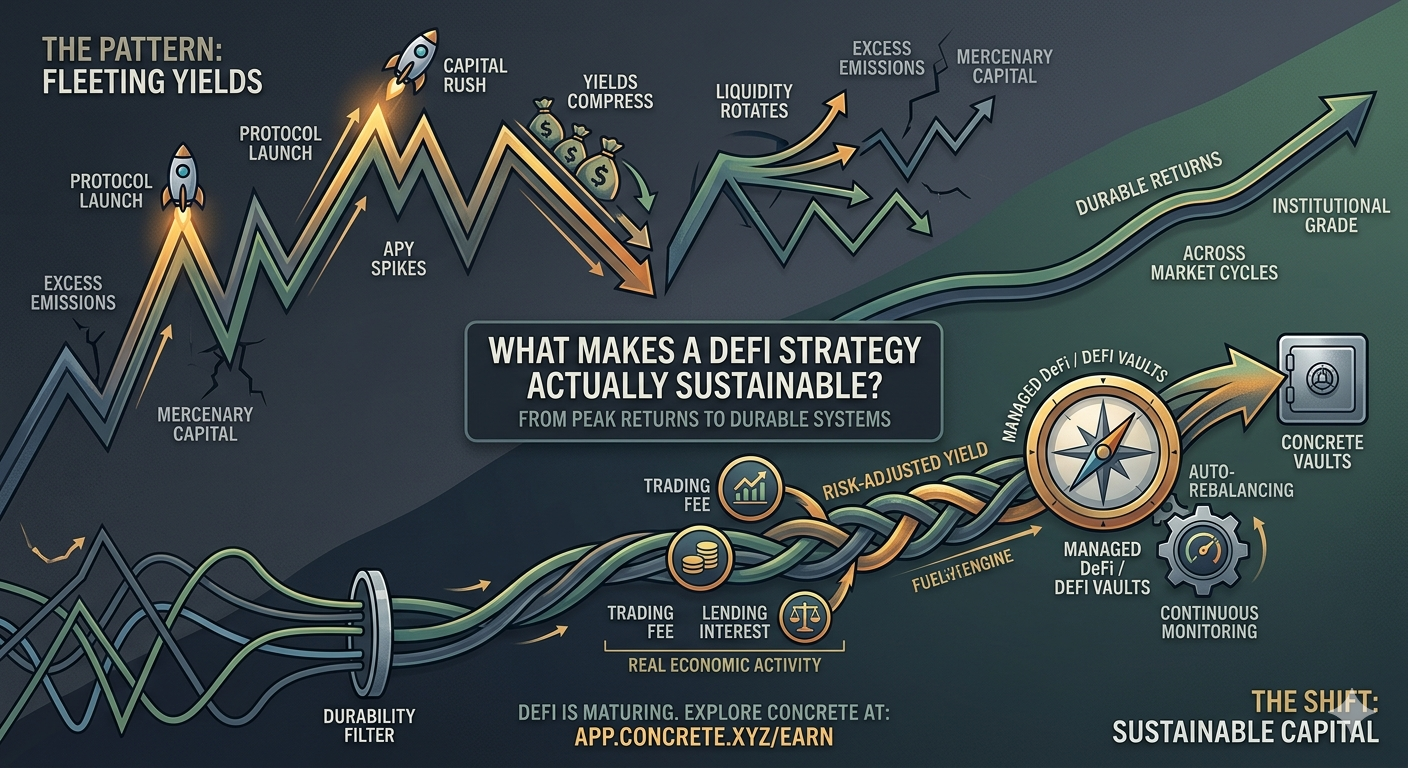
DeFi has a pattern everyone recognizes.
A new protocol launches with eye-catching APYs.
Capital floods in almost instantly.
Yields begin to compress.
Liquidity rotates to the next opportunity.
Then the cycle repeats.
This loop has defined much of DeFi’s growth. It’s fast, reactive, and often driven by short-term incentives. But it raises a deeper question:
**Why do most DeFi strategies fade so quickly?**
— -
### Defining Sustainability in DeFi
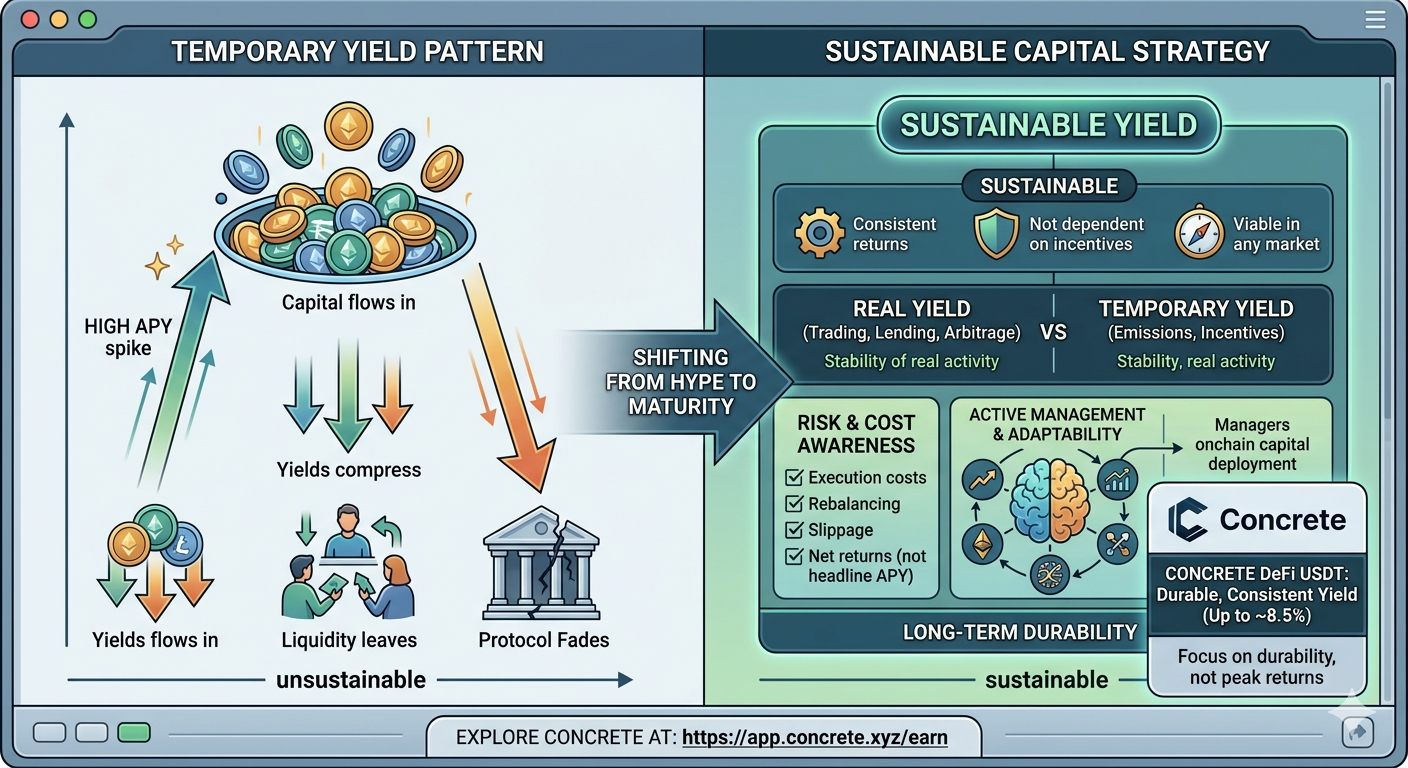
A sustainable DeFi strategy isn’t just about high returns — it’s about **durability over time**.
At its core, a sustainable strategy should:
* Generate **consistent returns**, not just spikes
* Avoid relying entirely on token incentives
* Remain viable across **different market conditions**
This shifts the focus from chasing peak APY to building **sustainable yield** that can persist through cycles.
— -
### Real Yield vs Temporary Yield
Not all yield is created equal.
Some strategies generate returns from **real economic activity**:
* Trading fees
* Lending demand
* Arbitrage opportunities
Others rely heavily on:
* Token emissions
* Liquidity incentives
The difference matters.
Incentive-driven yield often declines as emissions taper or token prices fall. Meanwhile, yield derived from real usage tends to be more stable because it’s tied to actual demand.
This is where **risk-adjusted yield** becomes critical. A lower but consistent return can outperform a volatile, incentive-heavy strategy over time.
— -
### Liquidity, Market Conditions, and Adaptability
Sustainability is also shaped by the environment a strategy operates in.
Key factors include:
* **Liquidity depth** — shallow liquidity increases volatility and slippage
* **User activity** — demand drives real yield
* **Market volatility** — some strategies depend on it, others suffer from it
* **Strategy demand** — crowded trades compress returns
Some DeFi strategies only work under specific conditions. Others are designed to adapt.
The most resilient strategies are those that can adjust as markets evolve rather than break when conditions change.
— -
### The Hidden Costs of Yield
Headline APY rarely tells the full story.
Over time, performance is impacted by:
* Execution costs
* Rebalancing frequency
* Slippage
* Changing correlations between assets
A strategy that looks strong on paper can degrade significantly once these factors are accounted for.
This is why focusing on **net returns**, not just advertised yield, is essential when evaluating managed DeFi opportunities.
— -
### Designing Better DeFi Strategies
Sustainable strategies are built differently.
They often include:
* **Diversification** across multiple yield sources
* Continuous monitoring and adjustment
* Flexibility to adapt to market changes
* A focus on long-term performance rather than short-term spikes
This is where DeFi begins to resemble a system rather than a collection of isolated opportunities.
It’s also where **managed DeFi** starts to play a larger role — bringing structure, oversight, and optimization to onchain capital.
— -
### The Role of DeFi Vaults
DeFi vaults represent a shift toward more structured strategy design.
Instead of relying on a single opportunity, vaults aim to:
* Allocate capital across multiple strategies
* Optimize for **risk-adjusted yield**
* Adapt to changing conditions
* Reduce dependence on short-term incentives
**Concrete vaults** are built with this philosophy in mind — prioritizing sustainable yield over temporary performance.
Explore Concrete at: https://app.concrete.xyz/earn
— -
### A Real Example: Concrete DeFi USDT
Consider **Concrete DeFi USDT**, which offers up to ~8.5% stable yield.
At first glance, this may seem less exciting than triple-digit APYs seen elsewhere in DeFi. But over time, consistency often wins.
Stable, predictable returns:
* Reduce exposure to volatility
* Attract long-term capital
* Enable compounding without disruption
This highlights an important truth: **the most sustainable opportunities often look the least flashy**.
— -
### The Bigger Shift in DeFi
DeFi is evolving.
The early phase was defined by rapid experimentation and yield chasing. But the next phase is about maturity.
We’re seeing a transition:
* From short-term incentives → to long-term strategy
* From isolated opportunities → to integrated systems
* From speculative yield → to sustainable yield
In this new landscape, infrastructure matters more than emissions. Strategy design matters more than hype.
The future of DeFi won’t be defined by the highest APY.
It will be defined by the strategies that last.