What Makes a DeFi Strategy Actually Sustainable?
--
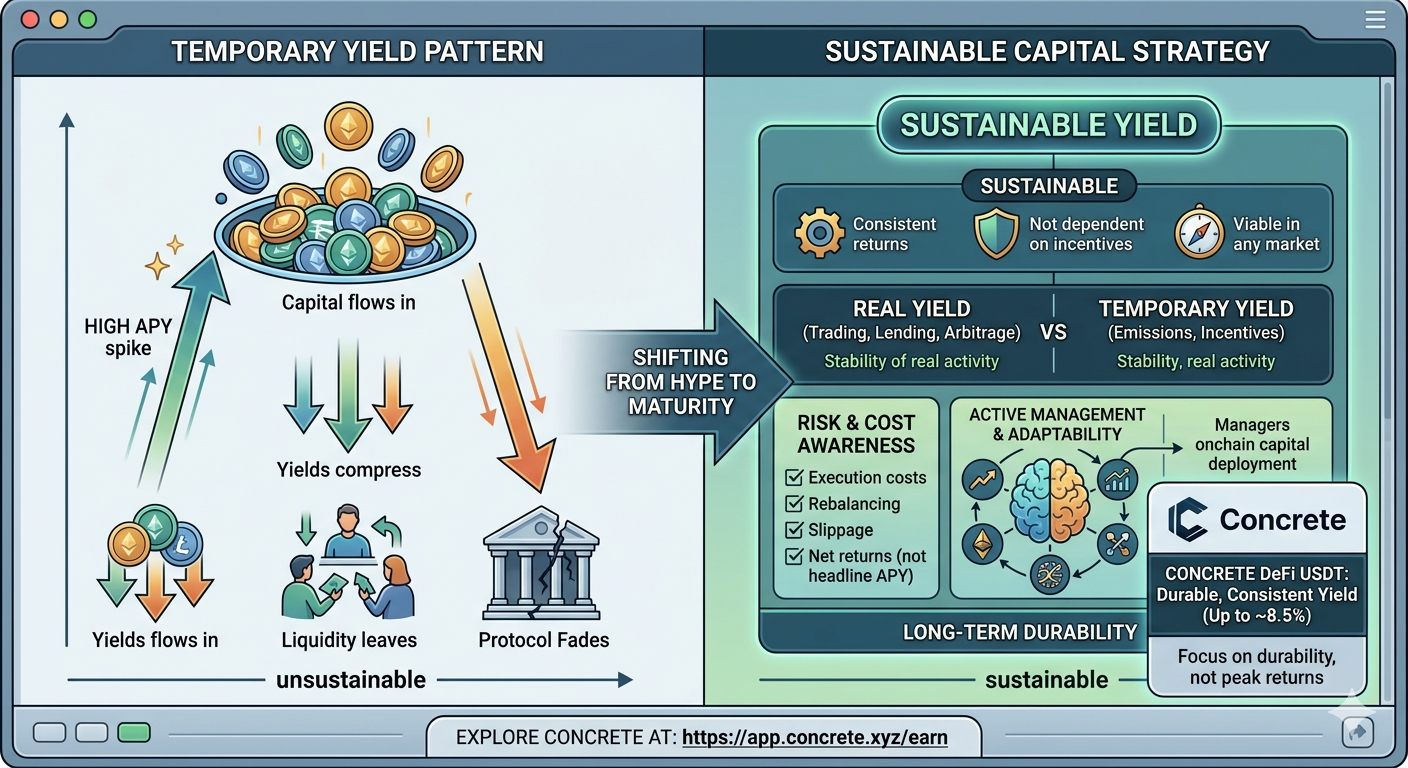
DeFi is full of yield. New protocols launch every week, APYs spike into the triple digits, and capital rushes in like a tidal wave. But if you’ve spent more than a month in the space, you’ve seen the pattern: the wave eventually crashes. Yields compress, liquidity leaves, and the “opportunity of a lifetime” disappears as quickly as it arrived.
In a maturing financial ecosystem, the most important question isn’t “Where is the highest yield?” but “What actually lasts?”
This week, we’re diving into what separates short-term hype from the long-term, durable strategies that survive across market cycles.
1. The Pattern: The Lifecycle of a Hype Cycle
We’ve all seen it. A new protocol launches with massive incentives. The “degen” capital floods the pool to farm the high APY. As the pool grows, the yield is diluted. Eventually, the incentive tokens are sold off, the price drops, and the liquidity moves to the next shiny object.
This cycle is the hallmark of early DeFi, but it’s also the reason most strategies fade. They aren’t built on economic value — they are built on temporary momentum.
2. Defining Sustainability: Beyond the APY
In the world of managed DeFi, sustainability isn’t just a buzzword; it’s a design requirement. A truly sustainable strategy must:
- Generate consistent returns over months and years, not just days.
- Function without incentives, meaning it creates value even if there are no “bonus” tokens being handed out.
- Remain viable whether the market is pumping, dumping, or moving sideways.
Sustainability is about durability, not just peak performance.
3. Real Yield vs. Temporary Yield
Not all yield is created equal. To understand if a strategy will last, you have to look at the source.
- Real Yield: Comes from actual economic activity. This includes interest paid by borrowers, trading fees from volume, or arbitrage profits. It is tied to the usage of the protocol.
- Temporary Yield: Usually comes from “emissions” — printing a protocol token to subsidize users.
While emissions can be a great way to bootstrap a project, they eventually run out. Real economic activity is the only thing that keeps the lights on long-term.
4. The Role of Liquidity & Market Conditions
A strategy might look amazing in a bull market but collapse when volatility hits. Sustainability depends on:
- Liquidity Depth: Can the strategy handle large inflows and outflows without breaking?
- Adaptability: Does the strategy adjust when demand for borrowing drops or when trading volume shifts?
The best DeFi strategies don’t just work in perfect conditions; they adapt to the cycles.
5. Risk & Cost Awareness: The Hidden Leak
A strategy might claim a 10% APY, but once you factor in execution costs (gas fees), rebalancing slippage, and shifting correlations between assets, that 10% might actually be 4%.
Sustainable strategies are built with risk-adjusted yield in mind. They account for the “leakage” that happens during management, ensuring that the net return is what actually reaches the user’s wallet.
6. From Opportunities to Systems
We are moving away from “finding deals” and toward “building systems.” Modern strategy design involves:
- Diversification: Not putting all capital into one protocol.
- Continuous Monitoring: 24/7 observation of health factors and yields.
- Adaptive Allocation: Moving capital to the most efficient onchain capital sources in real-time.
7. How Concrete Vaults Solve for Durability
Concrete vaults were built to break the cycle of yield-chasing. Instead of looking for the highest possible spike, Concrete focuses on:
- Sustainable Sources: Prioritizing yield from real activity (like institutional lending markets).
- Active Management: Shifting capital across strategies to find the best risk-adjusted path
- Reduced Incentive Reliance: Building strategies that stand on their own merit, not just temporary subsidies.
8. Real-World Example: Concrete DeFi USDT
Look no further than the Concrete DeFi USDT vault. While other pools might offer 50% for a week and then drop to 2%, this vault targets a stable, consistent yield (up to ~8.5%).
By avoiding the “pump and dump” cycles of volatile assets, it attracts institutional DeFi capital that values reliability. Over a long enough timeline, a consistent 8.5% often outperforms a volatile strategy that spends half its time in a drawdown.
9. The Bigger Shift: The Future of Lasting Yield
DeFi is growing up. We are moving from short-term yield chasing to sophisticated long-term capital strategies. The next era of onchain finance won’t be defined by who has the highest headline APY today, but by which infrastructure — and which strategies — are still standing in three years.
Sustainability is the ultimate competitive advantage.
Ready to stop chasing and start growing? Explore Concrete at: https://app.concrete.xyz/earn