What Makes a DeFi Strategy Actually Sustainable?
--
DeFi is full of yield.
New strategies launch every week.
APYs spike.
Capital flows in.
And then?
Yields drop.
Liquidity disappears.
Attention moves somewhere else.
We’ve all seen this cycle play out — over and over again.
So the real question isn’t:
“What has the highest yield?”
It’s:
“What actually lasts?”
The Familiar Pattern
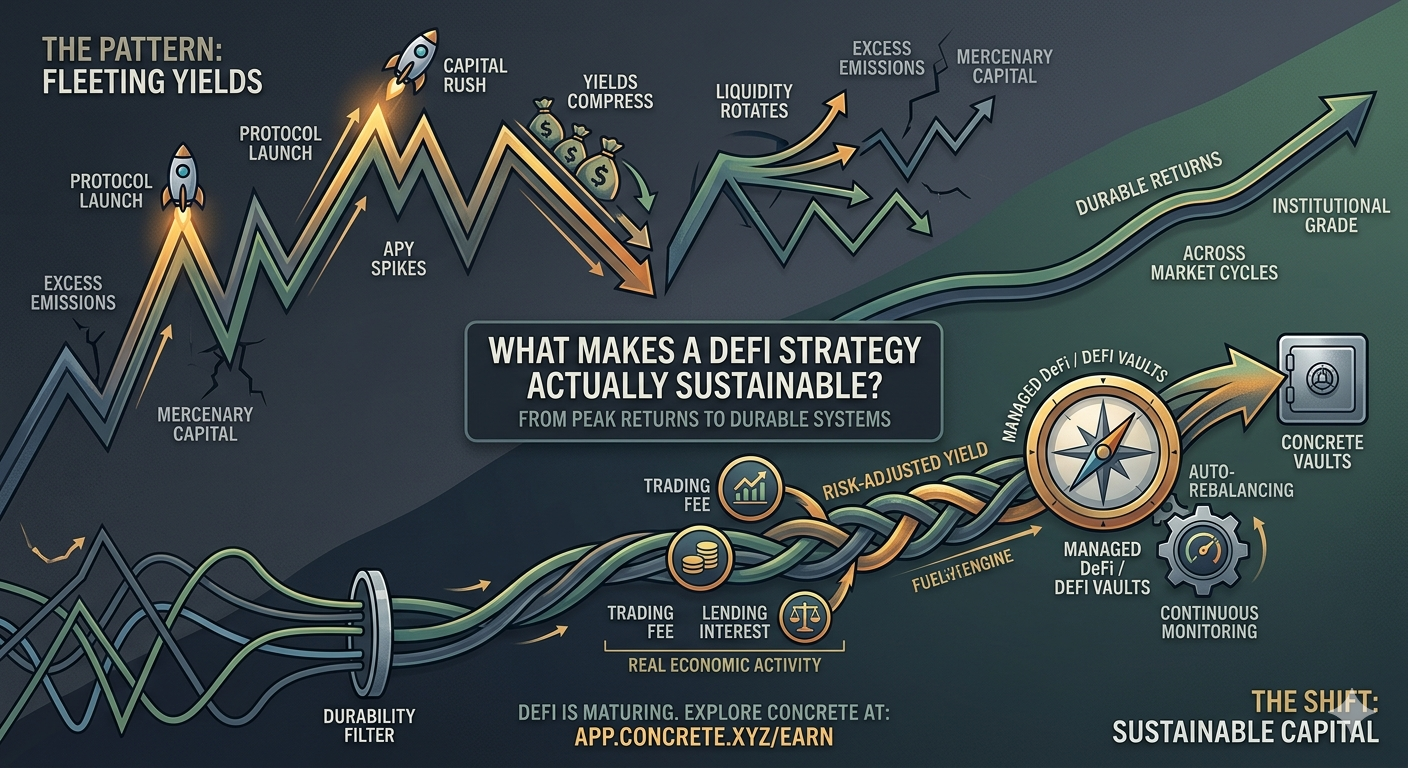
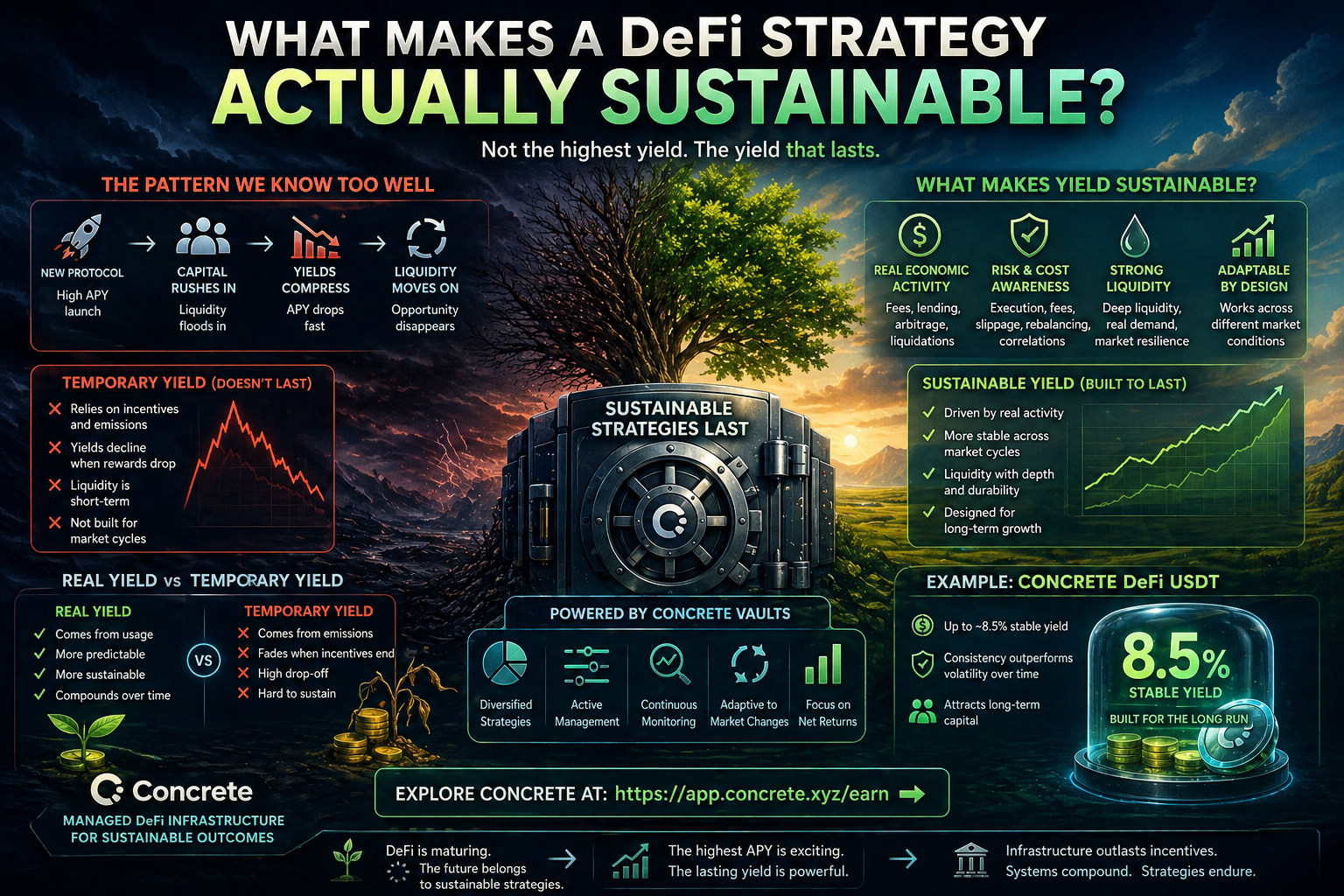
The lifecycle of most DeFi strategies is predictable:
- A new protocol launches with high APY
- Early capital flows in quickly
- Incentives attract more liquidity
- Yields begin to compress
- Rewards decline
- Capital rotates to the next opportunity
What starts as an exciting opportunity becomes unsustainable almost as quickly as it appeared.
This isn’t an exception.
It’s the default pattern.
Which raises the real question:
Why do most strategies fade so quickly?
What “Sustainable” Actually Means
In DeFi, sustainability isn’t about peak performance.
It’s about durability over time.
A sustainable strategy should:
- Generate consistent returns
- Not rely entirely on token incentives
- Remain viable across different market conditions
- Continue functioning even when attention shifts elsewhere
It’s not about winning for a week.
It’s about surviving across cycles.
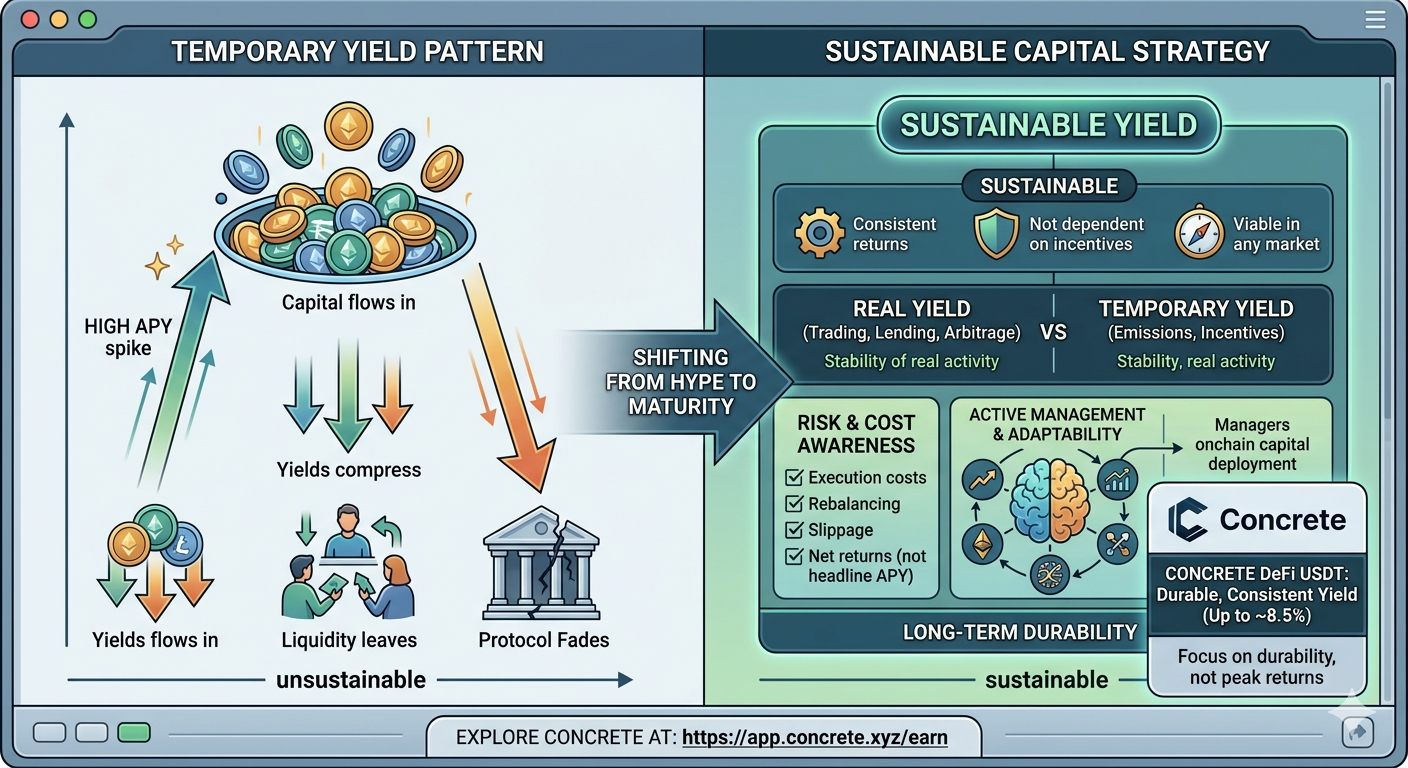
Real Yield vs Temporary Yield
Not all yield is created equal.
Some yield comes from real economic activity, such as:
- Trading fees
- Lending demand
- Arbitrage opportunities
- Liquidations
This type of yield is tied to actual usage of the system.
It tends to be more stable.
Other yield comes from:
- Token emissions
- Incentive programs
- Short-term liquidity mining campaigns
This is temporary yield.
It works — until it doesn’t.
As incentives decline:
- Yields drop
- Liquidity exits
- The strategy weakens
Sustainable strategies are built on real yield, not temporary incentives.
The Role of Liquidity and Market Conditions
Sustainability also depends on the environment a strategy operates in.
Key factors include:
- Liquidity depth — Can the strategy scale without breaking?
- User activity — Is there consistent demand?
- Market volatility — Does the strategy hold up under stress?
- Structural demand — Is the opportunity persistent or cyclical?
Some strategies only work in perfect conditions.
Others adapt.
The difference determines whether yield lasts — or disappears.
Risk and Cost: The Hidden Erosion
A strategy may look strong on paper but degrade over time.
Why?
Because of hidden costs:
- Execution fees
- Slippage during trades
- Rebalancing friction
- Changing correlations between assets
These factors reduce net yield, even when gross APY looks attractive.
This is why risk-adjusted yield matters.
A sustainable strategy doesn’t just generate returns.
It preserves them.
How Sustainable Strategies Are Built
As DeFi matures, strategy design is evolving.
It’s no longer about finding a single opportunity.
It’s about building systems that:
- Diversify across strategies
- Continuously monitor performance
- Adapt to changing market conditions
- Optimize for net returns, not headline APY
This is where DeFi begins to resemble real financial systems.
Less experimentation.
More structure.
Where Concrete Vaults Fit In
This shift is exactly what Concrete vaults are designed for.
Instead of chasing short-term opportunities, Concrete vaults focus on:
- Sustainable yield sources
- Structured capital allocation
- Continuous strategy management
- Adapting to market changes
- Reducing reliance on incentives
They don’t treat yield as a static number.
They treat it as something to be managed over time.
This is managed DeFi, not reactive farming.
A Real Example: Concrete DeFi USDT
To make this concrete, consider Concrete DeFi USDT.
The vault offers up to ~8.5% stable yield.
At first glance, that may seem less exciting than higher APYs elsewhere.
But sustainability changes the perspective.
- The yield is designed to be consistent
- Strategies are managed within a structured system
- Capital remains continuously productive
Over time, stable yield can outperform volatile strategies that spike and collapse.
Consistency compounds.
Volatility disrupts.
The Bigger Shift in DeFi
DeFi is evolving.
From:
- Short-term yield chasing
To:
- Long-term capital strategies
From:
- Incentives
To:
- infrastructure
From:
- peak returns
To:
- sustainable outcomes
The future of DeFi won’t be defined by the highest APY.
It will be defined by the strategies that survive, adapt, and compound over time.
🚨 Explore Concrete at:
👉 https://app.concrete.xyz/earn 🚨
Because in the long run:
Sustainable yield isn’t the most exciting.
But it’s the one that lasts.