Most Web3 Campaigns Don’t Have an Exposure Problem — They Have a Targeting Problem
--
Why follower-based distribution may become one of the most important upgrades in Web3 marketing infrastructure.
Web3 projects are spending millions on attention.
And much of it is being wasted.
Not because the products are bad.
Not because the teams are weak.
Not even because the market is too competitive.
Most campaigns fail for a simpler reason:
The message reaches the wrong people.
In crypto, irrelevant attention is one of the fastest ways to burn marketing budget.
Yet most projects still optimize for visibility instead of relevance.
That’s the real problem.
The Illusion of Successful Web3 Marketing
Modern Web3 campaigns often look impressive on the surface.
Dashboards show:
- thousands of task completions
- massive impression counts
- endless reposts
- large engagement spikes
But behind those numbers, a different reality usually exists.
Many campaigns are inflated by:
- reward farmers
- inactive followers
- low-trust accounts
- recycled engagement
- low-intent participation
The campaign appears successful.
But very little real distribution actually happens.
This is the hidden crisis inside many crypto growth strategies:
Noise is being mistaken for traction.
Vanity Metrics Are Quietly Destroying Campaign Efficiency
One of the biggest mistakes in Web3 marketing is optimizing for metrics that look good instead of metrics that create outcomes.
Most campaigns prioritize:
- impressions
- post quantity
- participant count
- surface-level engagement
Because those numbers are easy to show internally.
But none of those metrics guarantee:
- trust
- conversion
- retention
- community alignment
- ecosystem adoption
A campaign with:
- 1,000 random accounts
- weak audiences
- low credibility
can easily underperform against:
- 25 respected niche creators
- highly targeted communities
- trusted ecosystem voices
Because influence is not just about scale.
It’s about relevance.
And relevance is becoming the most valuable asset in digital distribution.
Web3 Has a Distribution Quality Problem
Crypto has become extremely efficient at generating visibility.
But visibility without targeting creates weak outcomes.
This is why many projects experience:
- low user retention
- poor campaign conversion
- weak community stickiness
- short-lived hype cycles
The industry optimized for reach…
before learning how to optimize for audience quality.
That mistake is expensive.
Especially now that user attention is fragmented across:
- X
- Telegram
- Discord
- YouTube
- TikTok
- creator communities
- niche ecosystems
In this environment, broad exposure becomes less effective every year.
Targeted distribution becomes more valuable.
Why Creator Trust Matters More Than Raw Reach
The creator economy has fundamentally changed how information spreads online.
People no longer trust brands first.
They trust:
- niche creators
- ecosystem educators
- respected community members
- consistent voices
- trusted curators
That shift matters enormously for Web3.
Because crypto adoption is heavily narrative-driven.
Most users discover:
- new protocols
- ecosystems
- AI tools
- infrastructure projects
- meme coins
- DeFi products
through creators they already trust.
Not through ads.
Not through generic campaigns.
Trust has become distribution infrastructure.
And projects that fail to understand this are often paying for visibility they never truly own.
The Problem With “Open Participation” Campaigns
Many Web3 task systems are designed around maximum participation.
At first, this sounds logical.
More participants should mean more visibility.
But in practice, open participation often creates:
- spam
- repetitive content
- low-quality promotion
- irrelevant reach
- engagement farming loops
The result is distribution dilution.
When everyone can participate equally, the quality of campaign distribution collapses toward the average.
And averages rarely create momentum.
This is why many founders feel disappointed after campaigns that looked “successful” numerically.
The impressions were real.
The influence was not.
Why Follower-Based Targeting Changes the Equation
This is where follower-based task filtering becomes strategically important.
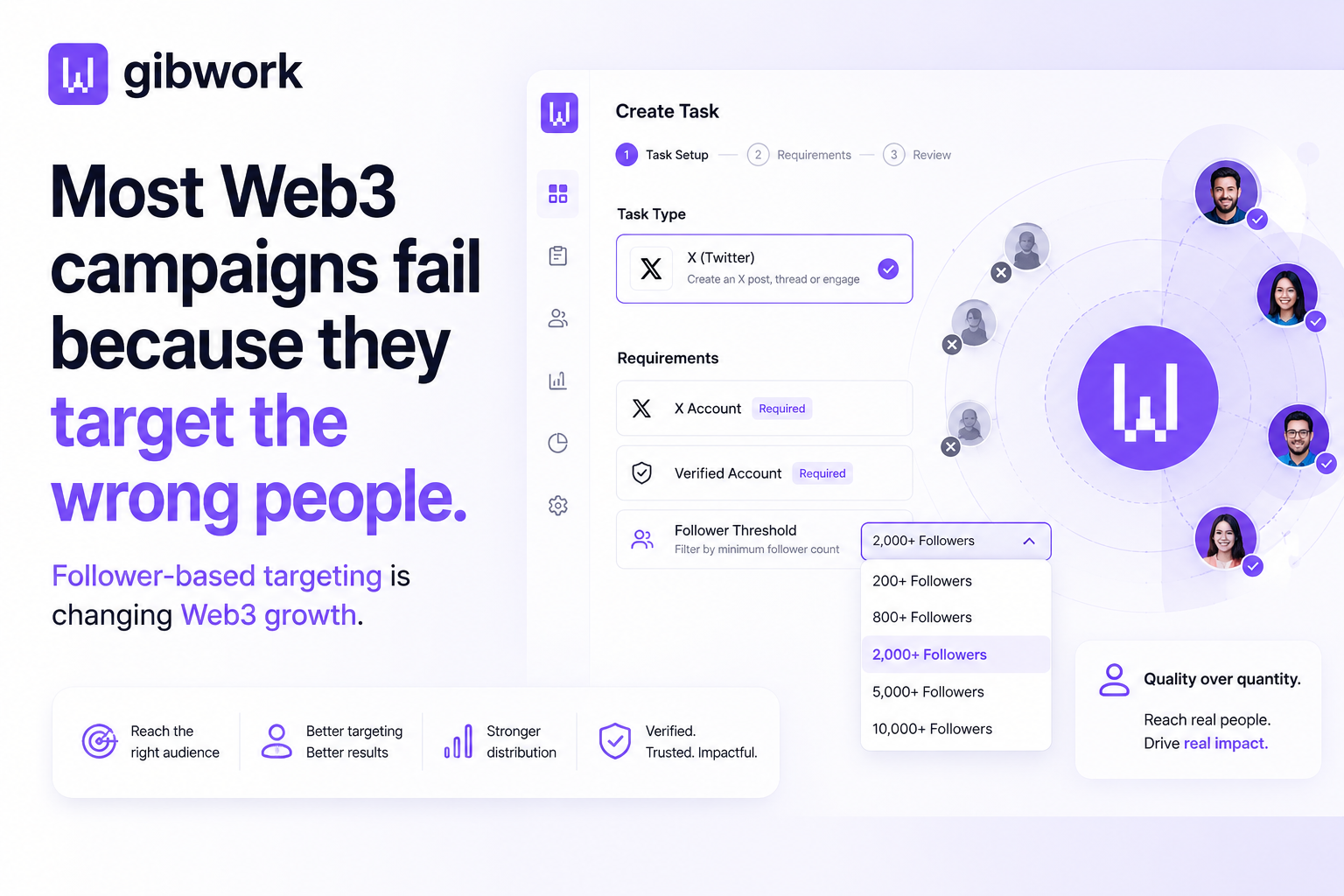
Platforms like Gibwork are beginning to introduce systems where projects can create campaigns specifically for creators who meet certain audience thresholds.
For example:
- 200+ followers
- 800+ followers
- 2K+ followers
- 5K+ followers
- 10K+ followers
On the surface, this looks like a simple feature.
In reality, it changes campaign economics.
Because projects are no longer optimizing for:
- maximum participation
They’re optimizing for:
- distribution quality
That is a completely different strategy.
Signal vs Noise: The New Marketing Divide
Most Web3 campaigns today are optimized for noise.
Follower-based targeting optimizes for signal.
That distinction matters more than most teams realize.
Because signal creates:
- trust
- conversion
- ecosystem curiosity
- community discussion
- meaningful reach
Noise creates:
- temporary spikes
- inflated dashboards
- weak retention
- low-intent traffic
The next generation of successful crypto campaigns will likely belong to projects that understand this difference early.
A Simple Scenario Most Founders Understand Immediately
Imagine two campaigns.
Campaign A
- 1,500 participants
- random audiences
- low-trust accounts
- repetitive posting
Campaign B
- 40 respected niche creators
- highly targeted crypto audiences
- trusted ecosystem voices
- relevant community alignment
Which campaign creates stronger long-term outcomes?
Most experienced founders already know the answer.
Because attention quality compounds.
Random visibility does not.
The Real Shift Happening in Web3 Marketing
Follower-based targeting is not just a feature update.
It represents a larger philosophical shift in crypto growth strategy.
The industry is slowly moving from:
- mass participation
toward:
- intelligent distribution
From:
- quantity-driven campaigns
toward:
- relevance-driven ecosystems
From:
- vanity metrics
toward:
- conversion-aware targeting
This transition will likely define the next era of Web3 marketing infrastructure.
Why This Matters for Founders
Most founders think they need:
- more exposure
- more impressions
- more mentions
- more viral reach
But many actually need:
- better audience alignment
- stronger creator partnerships
- higher-trust distribution
- cleaner campaign targeting
That is a very different problem to solve.
And the teams that solve it early will likely outperform competitors still chasing surface-level engagement metrics.
Because in modern Web3:
Relevant attention is worth more than massive visibility.
Final Thought
The future of Web3 growth will not belong to the loudest projects.
It will belong to the projects with:
- the smartest distribution
- the strongest creator alignment
- the highest-quality audience targeting
Follower-based campaign filtering is a small feature on the surface.
But strategically, it may signal something much bigger:
The beginning of smarter distribution economics in crypto.
Explore Gibwork
Projects exploring smarter creator distribution and follower-based campaign targeting can explore Gibwork here: