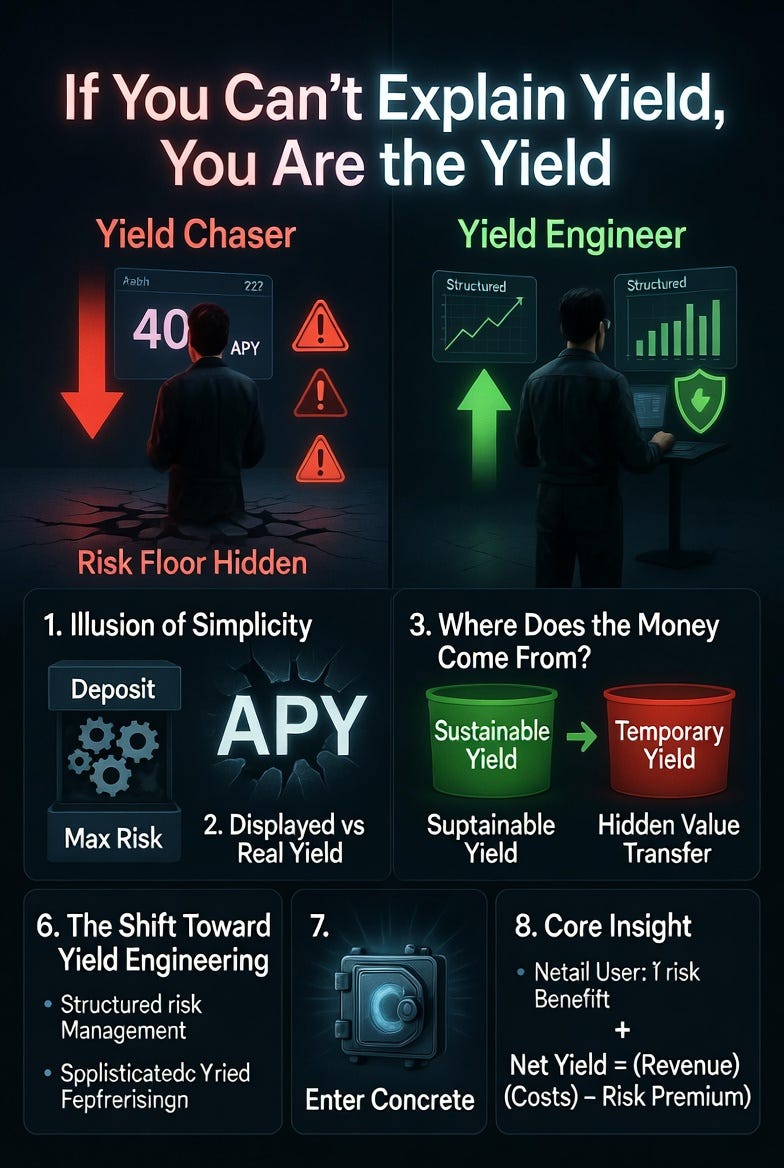
If You Can’t Explain Yield, You Are the Yield
 Ryda4 min read·Just now
--
Explore Concrete at app.concrete.xyz
DeFi made yield look easy.
Too easy.
You open a dashboard and boom -25% APY, 60% APY, sometimes even higher. Numbers ticking up in real time. Your balance growing while you do absolutely nothing.
Deposit. Earn. Repeat.
It feels like free money.
But here’s the catch:
If it feels that simple, you’re probably missing something important.
Because behind every juicy APY is a system. And if you don’t understand that system…
you might be the one powering it.
The Illusion: “Just Deposit and Earn”
DeFi is really good at presentation.
Everything is designed to feel smooth:
- Clean dashboards
- Big, attractive APYs
- One-click deposits
- Little to no explanation
It gives off the vibe that yield just… exists.
But it doesn’t.
Yield is not magic. It’s mechanics.
And those mechanics are often hidden behind the interface.
The Number You See vs The Yield You Get
Let’s talk about that APY you’re excited about.
That number? It’s usually the best-case version of reality.
In practice, a lot happens between “deposit” and “profit”:
- Impermanent loss can reduce your gains in liquidity pools
- Rebalancing slowly chips away at returns
- Fees and slippage eat into execution
- Market volatility changes everything, fast
- Token incentives can drop in value
So that shiny 40% APY?
It might turn into 15%… or 5%… or worse.
Think of displayed yield as the trailer.
Your actual return is the full movie.
So… Where Does Yield Come From?
This is the question most people skip.
But it’s the most important one.
In DeFi, yield usually comes from real activity happening in the system:
- Trading fees — when people swap tokens, liquidity providers earn a cut
- Lending interest — borrowers pay to access capital
- Arbitrage — traders profit from price differences across markets
- Liquidations — penalties from risky positions getting wiped out
- Token incentives — protocols rewarding users to attract liquidity
Here’s the key:
Not all yield is created equal.
- Fees and lending = more sustainable
- Incentives and emissions = can disappear fast
If you don’t know which one you’re earning from, you’re basically guessing.
The Hidden Game: Value Transfer
Now let’s get real for a second.
In markets, money doesn’t just appear.
Someone earns… because someone else pays.
So if you don’t understand how your yield is generated, there’s a good chance:
👉 You’re the one on the paying side.
It can look like this:
- You provide liquidity, but don’t notice your downside risk
- You farm rewards, but the token loses value faster than you earn it
- You join a strategy without understanding how it performs in bad conditions
You feel like you’re earning.
But under the hood, value might be flowing away from you.
That’s the uncomfortable truth behind the title:
If you can’t explain the yield, you are the yield.
Same Protocol, Totally Different Results
Here’s something interesting:
Two people can use the exact same DeFi protocol… and get completely different outcomes.
Why?
Because they’re playing different games.
- One is chasing the highest APY they can find
- One is thinking about risk, cost, and structure
- Another is modeling outcomes before even clicking “deposit”
Same tools.
Different mindset.
Over time, the gap between these users gets very wide.
The Shift: From Chasing Yield to Engineering It
DeFi is growing up.
We’re slowly moving away from:
“Where’s the highest APY?”
…to something smarter:
“What’s the best risk-adjusted return?”
This is what people mean by yield engineering.
It’s about:
- Planning before investing
- Understanding how returns are generated
- Managing risk, not ignoring it
- Focusing on what you actually keep, not what’s advertised
Less hype.
More structure.
Enter: Smarter Infrastructure (Like Concrete Vaults)
Let’s be honest — doing all of this manually is hard.
Tracking positions, rebalancing, calculating risk… it’s a lot.
That’s where tools like Concrete Vaults come in.
Instead of figuring everything out yourself, they help by:
- Automatically allocating your capital
- Running structured strategies
- Rebalancing positions over time
- Reducing costly mistakes
In simple terms:
They help you move from guessing → structured investing
You’re still in control, but you’re not flying blind.
The Takeaway That Changes Everything
At the end of the day, yield isn’t just a number on a screen.
It’s a formula:
Revenue
– Costs
– Risk
Once you start thinking this way, your whole approach changes.
You stop chasing flashy APYs.
You start asking better questions.
You begin to actually understand what you’re doing.
And that’s the real edge in DeFi.
Explore Concrete at app.concrete.xyz