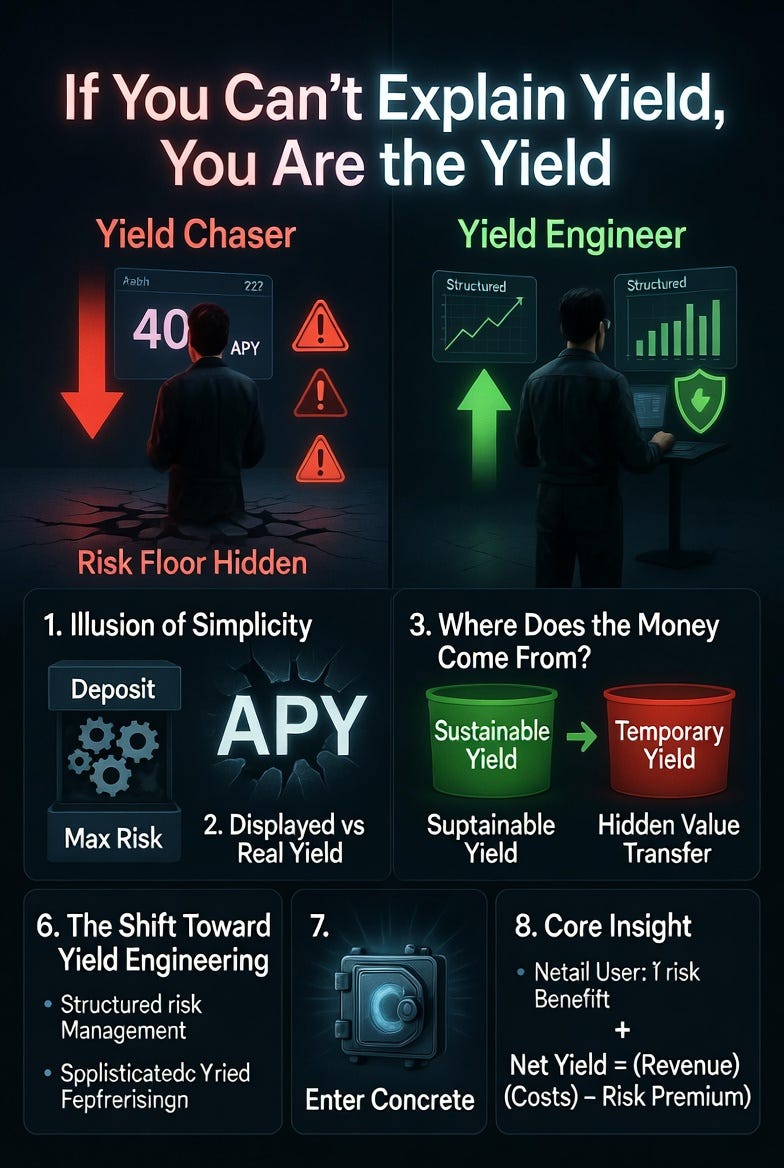
If You Can’t Explain Yield, You Are the Yield
 Cryptowala4 min read·Just now
--
In the fast-paced world of DeFi, a high APY is the ultimate siren song. We’ve all seen the dashboards: neon-green percentages, “one-click” deposit buttons, and the promise of effortless compounding. It feels like magic. But in finance, magic is usually just a lack of transparency.
If you are chasing numbers without understanding the mechanics, you aren’t just a participant — you might be the exit liquidity.
1. The Illusion of Simplicity
Modern DeFi has mastered the user interface. We are presented with a seamless “Deposit $\rightarrow$ Earn” flow that abstracts away the gears turning beneath the hood. You see a 40% APY and your brain registers “profit.”
However, this simplicity creates a dangerous tension. When the explanation behind a return is minimal, the risk is usually maximal. The dashboard shows you the ceiling (what you could earn), but it rarely shows you the floor (what you could lose).
2. The Gap: Displayed vs. Real Yield
The number on your screen is often a “Gross” figure, but you live and die by the “Net.” The gap between the two is where most retail investors lose their edge. Consider the silent killers of yield:
- Impermanent Loss (IL): Your 20% yield is irrelevant if the underlying assets diverge and leave you with 30% less value than if you had simply held them.
- Rebalancing & Gas Costs: Frequent shifts in liquidity positions can eat a double-digit chunk of your returns.
- Volatility Impact: High APY in a local token often offsets a rapid decline in that token’s price.
When you factor in execution friction and inflation, a 25% APY can quickly compress into a -5% real return.
3. Where Does the Money Actually Come From?
To survive in DeFi, you must be able to point to the source of the value. Generally, yield falls into two buckets:
Sustainable Yield
- Trading Fees: Organic demand from users swapping assets.
- Lending Activity: Borrowers paying interest to use your capital.
- Liquidations & Arbitrage: Capturing inefficiencies in the market.
Temporary Yield
- Incentives/Emissions: “Printing” a protocol token to attract liquidity. This is a marketing spend, not a business model. It works until the selling pressure outweighs the rewards.
4. The Hidden Value Transfer
This brings us to the core thesis: If you don’t understand the system, you are likely the one subsidizing it.
When you provide liquidity without modeling the outcomes, you are essentially selling an option to more sophisticated traders. You are absorbing the downside and the volatility risk so that someone else — usually an arbitrageur or a professional market maker — can profit. If you aren’t modeling your risk, you are the “yield” being harvested by those who are.
5. Why Outcomes Differ
Two users can deposit into the exact same pool and walk away with vastly different results.
- The Yield Chaser: Looks for the highest number, ignores the cost of entry/exit, and doesn’t account for token inflation.
- The Yield Engineer: Analyzes the structure of the pool, models the risk of the underlying assets, and calculates the net return after fees and potential IL.
The difference isn’t luck; it’s understanding.
6. The Shift Toward Yield Engineering
DeFi is moving away from the era of “blind chasing” and toward Yield Engineering. This means moving beyond the “hope and pray” method and toward:
- Structured risk management.
- Automated outcome modeling.
- A relentless focus on net, risk-adjusted returns.
7. Enter Concrete: Moving from Guessing to Structured Exposure
This is exactly why Concrete Vaults are becoming the essential infrastructure for the next generation of DeFi.
Understanding every moving part of a strategy is a full-time job. Concrete Vaults bridge the gap by providing the “Engineering” for you. By using Concrete, users move from manual guesswork to structured exposure:
- Automated Allocation: Capital is moved to where it is most efficient.
- Managed Strategies: Sophisticated positions that account for more than just a raw APY.
- Risk Mitigation: Rebalancing positions to reduce manual errors and protect against market shifts.
Instead of trying to outpace the professionals, Concrete allows you to utilize the same infrastructure they do.
8. The Core Insight
Yield is not just a random number generated by a protocol. It is a simple equation:
$$\text{Net Yield} = (\text{Revenue}) — (\text{Costs}) — (\text{Risk Premium})$$
When you stop looking at DeFi as a casino and start looking at it as a series of engineered outcomes, your performance changes. Don’t be the yield — start engineering it.
Explore the future of yield at app.concrete.xyz