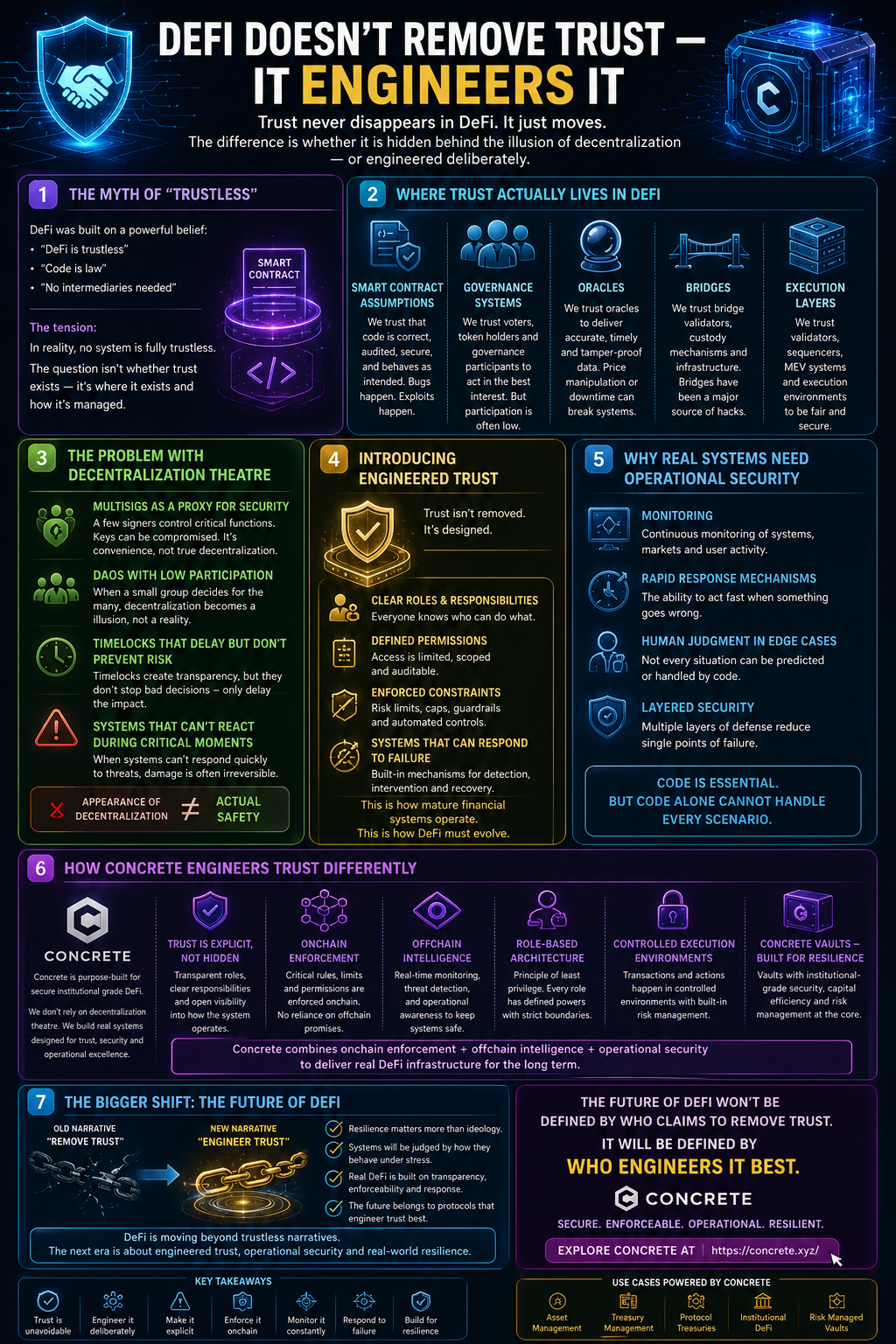
DeFi Doesn’t Remove Trust — It Engineers It
 BADAL3 min read·Just now
--
One of the most powerful ideas behind DeFi was simple:
“Don’t trust people. Trust code.”
For years, this became the foundation of the industry.
Smart contracts replaced intermediaries.
Protocols promised “trustless” systems.
And decentralization became the answer to almost every problem.
But as DeFi evolved, something important became clear:
Trust never disappeared. It just moved.
The Myth of “Trustless” Systems
The word trustless sounds absolute.
It suggests a world where:
- no intermediaries exist
- no human judgment is required
- code alone guarantees safety
But no financial system is completely free from trust.
Even in DeFi, users still trust:
- smart contracts
- governance systems
- oracle networks
- bridges
- execution infrastructure
The real question isn’t whether trust exists.
It’s:
👉 where trust exists
👉 how visible it is
👉 and whether it is engineered properly
Where Trust Actually Lives in DeFi
Much of DeFi’s trust is hidden behind abstraction.
When users interact with a protocol, they often assume the system is fully autonomous.
But underneath, many assumptions still exist.
For example:
Smart Contracts
Users trust that the contract logic is secure and behaves as intended.
Governance Systems
Protocols often rely on token voting or governance councils to make decisions.
Oracles
External price feeds introduce another layer of dependency.
Bridges
Cross-chain systems frequently become major security risks.
Execution Layers
Transactions still depend on infrastructure that can fail, delay, or behave unexpectedly.
Trust was not removed.
It was redistributed across infrastructure.
The Problem With Decentralization Theatre
As DeFi grew, some systems optimized more for appearance than resilience.
This created what many now call “decentralization theatre.”
Examples include:
- multisigs presented as full security models
- DAOs with low voter participation
- timelocks that delay action but don’t prevent failure
- systems unable to respond during critical moments
These structures may appear decentralized on the surface, but appearance alone does not create safety.
A protocol can look decentralized and still be fragile.
Real resilience requires more than ideology.
It requires design.
Engineered Trust: A Better Framework
Mature systems do not pretend trust disappears.
They structure it intentionally.
This is what engineered trust means.
It involves:
- clearly defined roles
- explicit permissions
- enforceable constraints
- systems designed to respond under stress
This is how traditional financial infrastructure operates.
And increasingly, it is how sophisticated DeFi infrastructure is evolving as well.
Why Operational Security Matters
Real-world systems are messy.
Unexpected events happen:
- markets move violently
- liquidity disappears
- oracles fail
- exploits emerge
Code alone cannot predict every scenario.
That’s why resilient systems require:
- continuous monitoring
- rapid response mechanisms
- layered security
- human judgment in edge cases
The goal is not to eliminate trust entirely.
The goal is to engineer systems where trust is visible, constrained, and accountable.
How Concrete Approaches Trust Differently
This is where Concrete takes a more structured approach.
Instead of hiding trust behind “fully trustless” narratives, Concrete focuses on operational security and engineered infrastructure.
Concrete vaults are designed around:
- explicit role separation
- controlled execution environments
- on-chain enforcement
- off-chain intelligence
- systems built for response, not just prevention
This creates a framework where trust is:
- structured
- observable
- enforceable
Rather than relying on decentralization theatre, Concrete prioritizes systems that can operate safely under real conditions.
The Bigger Shift in DeFi
DeFi is maturing.
The industry is gradually moving beyond simplistic “trustless” narratives toward something more realistic:
👉 engineered resilience
The next generation of DeFi infrastructure will likely be judged by:
- how systems behave under stress
- how risk is managed
- how quickly failures can be contained
- how transparently trust is structured
Because in the end, resilience matters more than ideology.
Final Thought
DeFi does not remove trust.
It engineers it.
The future of the industry will not belong to the protocols that claim trust no longer exists.
It will belong to the systems that design trust most intelligently.
🚀 Explore Concrete at:
https://concrete.xyz/