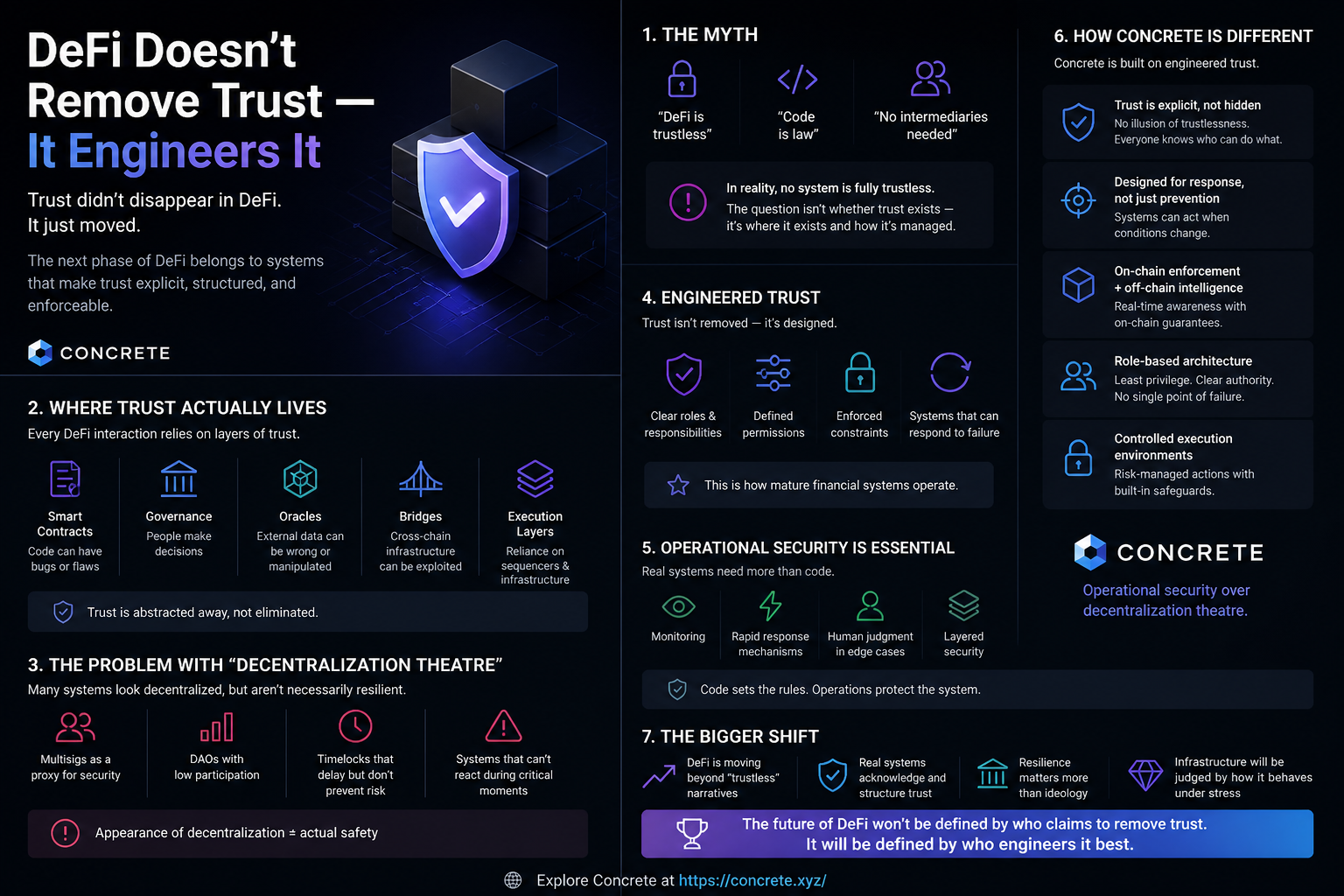
DeFi Doesn’t Remove Trust — It Engineers It
--
Decentralised Finance was born from a powerful idea:
Don’t trust people. Trust code.
For a time, that belief felt revolutionary. Smart contracts replaced intermediaries. Transactions became automated. Systems ran without traditional gatekeepers. It gave rise to a bold claim: DeFi is trustless. But as the ecosystem matured, reality became harder to ignore, trust never disappeared. It simply moved.
The Myth of “Trustless” Systems
At its core, the idea of a trustless system suggests that participants do not need to rely on any human judgement or central authority.
- “Code is law.”
- “No intermediaries.”
- “Fully decentralised.”
These phrases shaped the early identity of DeFi. Yet in practice, no financial system operates without trust. The real question is not whether trust exists, but where it exists and how it is managed.
Where Trust Actually Lives in DeFi
Even the most decentralised protocols rely on multiple layers of trust:
- Smart contracts
Users trust that the code is secure, audited, and free from vulnerabilities. - Governance systems
Token holders make decisions that can alter protocol behaviour, often with uneven participation. - Oracles
External data feeds introduce dependencies on third-party accuracy and integrity. - Bridges
Cross-chain infrastructure remains one of the most fragile components in the ecosystem. - Execution layers
Validators, sequencers, or block producers influence how transactions are processed.
In each case, trust is not eliminated. It is abstracted and distributed across technical and human systems.
The Problem With Decentralisation Theatre
As DeFi scaled, a pattern emerged: systems that appear decentralised but lack true resilience. This is what many now refer to as decentralisation theatre.
Examples include:
- Multisignature wallets acting as a stand-in for robust security
- DAOs with low voter participation but high decision-making power
- Timelocks that delay actions without preventing harmful outcomes
- Protocols unable to respond quickly during crises
These systems may look decentralised on the surface, yet struggle under real-world stress. There is a critical difference between the appearance of decentralisation and actual safety.
From Trustless to Engineered Trust
The next phase of DeFi requires a shift in thinking, trust is not something to eliminate, it is something to design.
Engineered trust means:
- Clearly defined roles and responsibilities
- Explicit permissions and access controls
- Enforced constraints within systems
- Mechanisms to respond when things go wrong
This is how mature financial systems operate. Trust is structured, visible, and accountable. DeFi is beginning to move in the same direction.
Why Operational Security Matters
Code alone cannot anticipate every edge case. Real-world systems demand:
- Continuous monitoring
- Rapid response capabilities
- Human judgement in complex scenarios
- Layered security across multiple components
Without these, even well-designed protocols can fail when exposed to unexpected conditions. Operational security becomes just as important as code correctness.
A Different Approach: Concrete
This is where a new model of DeFi infrastructure is emerging.
Concrete takes a fundamentally different approach:
- Trust is made explicit, not hidden behind assumptions
- Systems are designed for response, not just prevention
- Onchain enforcement is combined with off-chain intelligence
- Role-based architecture ensures accountability
- Execution environments are controlled and structured
Rather than relying on decentralisation as a blanket solution, Concrete focuses on operational security and resilience. It acknowledges that trust exists and builds systems that manage it deliberately.
The Bigger Shift
DeFi is evolving beyond its early narratives. The idea of fully trustless systems is giving way to something more practical and more robust.
- Trust is being acknowledged, not denied
- Systems are being designed for failure, not just success
- Resilience is becoming more important than ideology
The future of DeFi infrastructure will not be defined by who claims to remove trust, it will be defined by who engineers it best.
Explore More about Concrete at: https://concrete.xyz/