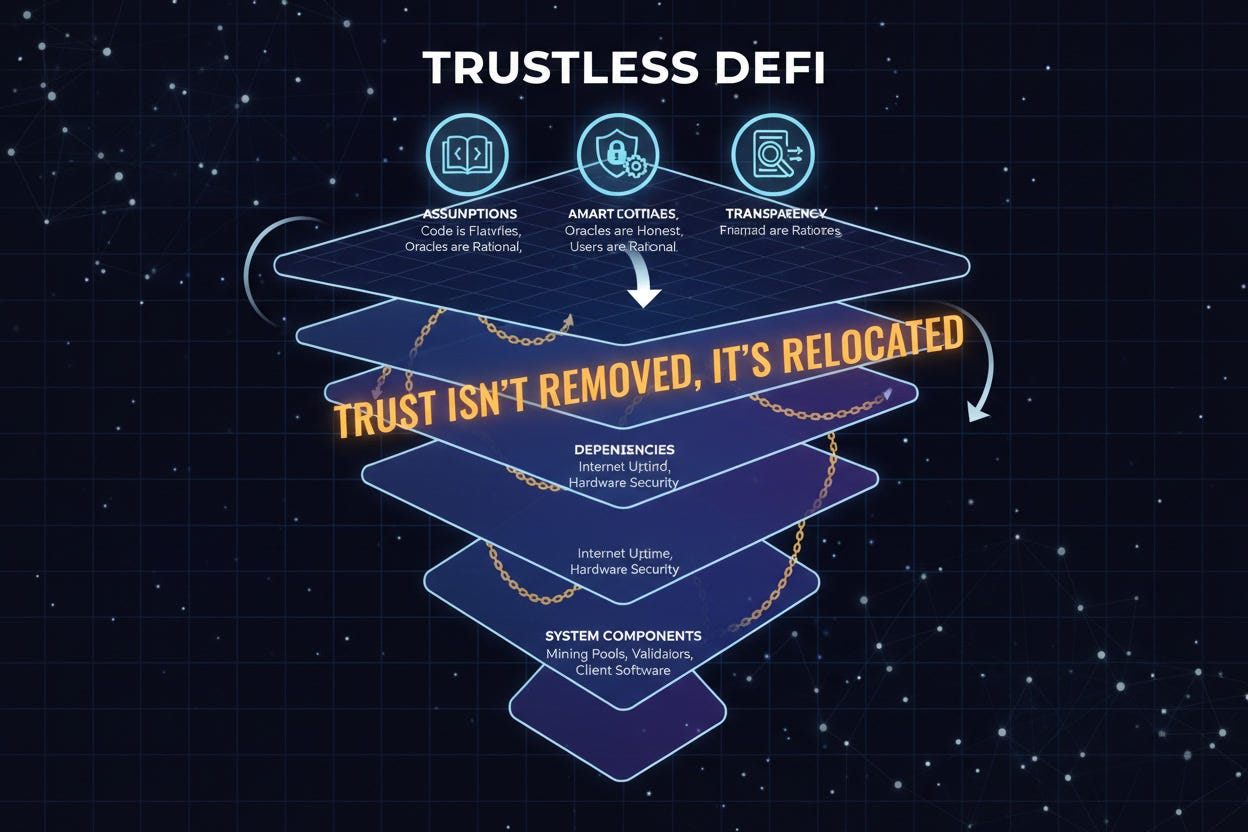
DeFi Doesn’t Remove Trust — It Engineers It
--
The Myth of Trustless Finance
Decentralized Finance (DeFi) was born from a powerful idea:
“Don’t trust people. Trust code.”
This philosophy challenged traditional finance by removing intermediaries and replacing them with smart contracts. The promise was simple — a trustless system where code governs everything and human bias disappears.
But as DeFi evolved, reality told a different story.
No system is truly trustless.
The real question is not whether trust exists — but where it exists, and how it is managed.
Where Trust Actually Lives in DeFi
Despite the “trustless” narrative, DeFi systems rely on multiple layers of trust:
- Smart Contracts — Users trust that the code is secure and free from bugs.
- Governance Systems — Token holders make decisions, but participation is often low and centralized.
- Oracles — External data feeds must be trusted to provide accurate information.
- Bridges — Cross-chain systems introduce major security risks and dependencies.
- Execution Layers — Transactions rely on validators and infrastructure to execute correctly.
In reality, trust hasn’t disappeared — it has been redistributed and abstracted.
The Problem with Decentralization Theatre
Many DeFi systems appear decentralized, but that appearance can be misleading.
This is what we call “decentralization theatre.”
Examples include:
- Multisig wallets acting as centralized control points
- DAOs with low voter participation
- Timelocks that delay decisions but don’t eliminate risk
- Systems that fail to respond during critical events
These structures create the illusion of decentralization without guaranteeing real safety.
There is a clear difference between:
Looking decentralized vs being resilient and secure
Introducing Engineered Trust
Instead of pretending trust doesn’t exist, the next evolution of DeFi is about designing it properly.
Engineered trust means:
- Clearly defined roles and responsibilities
- Permissioned actions with boundaries
- Enforced constraints on system behavior
- Built-in mechanisms to respond to failures
This is how mature financial systems operate — and DeFi is beginning to move in the same direction.
Why Operational Security Matters
Code alone cannot handle every real-world scenario.
DeFi systems must incorporate:
- Continuous monitoring
- Rapid response mechanisms
- Human judgment for edge cases
- Layered security architecture
Without these, even the most decentralized systems can fail under stress.
How Concrete Approaches Trust Differently
Concrete represents a shift in how DeFi infrastructure is designed.
Instead of hiding trust, it makes it explicit and structured.
Key principles include:
- Trust is visible and intentional, not assumed
- Systems are built for response, not just prevention
- Combines on-chain enforcement with off-chain intelligence
- Uses role-based architecture to manage permissions
- Operates within controlled execution environments
This approach prioritizes operational security over superficial decentralization.
Explore Concrete at: https://concrete.xyz/
Concrete is on-chain finance yield infrastructure — a platform powering institutional-grade yield products for digital assets with transparent, risk-managed performance built for scale.
The Bigger Shift in DeFi
The future of DeFi is changing.
It is no longer about eliminating trust — it is about designing it better.
- Systems will be judged by resilience, not ideology
- Transparency will replace assumptions
- Security will matter more than decentralization narratives
- Infrastructure will be tested under real stress conditions
The next generation of DeFi won’t be defined by who claims to remove trust.
It will be defined by who engineers it best.