Cortex DeSci Genesis Mining Guide: How ETHs Inscription Holders Claim the Second Airdrop Wave
--
Why did you mint ETHs inscriptions?
data:,{"p":"erc-20","op":"mint","tick":"eths","id":"1","amt":"1000"}
28 bytes. Ethereum L1 calldata. Permanent. Not because of what it’s worth today — because it will always be there.
Cortex DeSci applies the same logic to science. $0.0098. One biomedical hypothesis. Ethereum L1. Permanent. Not stored on a company’s server. Not in a database that can be shut down. Etched into on-chain calldata — as long as Ethereum exists, it exists.
This is the CXS-20 inscription protocol — an extension of what you already believe in.
Your ETHs inscriptions have already reserved your spot in the Cortex snapshot: 5,000,000 CXS, 1,672 wallets, Group 0 airdrop, claimable on Day 0.
But that’s not what this guide is about.
This guide is about the other pool — 6,000,000 CXS allocated to Group 2, reserved for miners who complete activation within the first 30 days. Epoch 1 multiplier is 3×. It decays from there and never comes back.
Day 0 is April 28, 2026. You don’t have much time.
This guide walks you through the full flow — from installation to claiming your airdrop — in under 30 minutes.
Table of Contents
- What is Cortex Genesis Mining?
- Install the Cortex Chrome Extension
- Choose Your Mining Mode
- Submit Knowledge Triplets
- Epoch Scoring & Multipliers
- Activation Requirements: Don’t Miss the Threshold
- Airdrop Claim: The Day 30 Countdown
- Maximize Your Rewards
- FAQ
01 What is Cortex Genesis Mining?
Cortex DeSci is a decentralized scientific knowledge graph protocol built on Ethereum mainnet. Miners earn CXS tokens by submitting AI-verified knowledge triplets to the chain.
Genesis Mining is the protocol’s inaugural mining season: — Earliest participants earn up to 3× Epoch multiplier bonuses — Unlocks the 6M CXS airdrop pool (Group 2) — First topic Epoch: Longevity
Core Concepts
- Triplet — The atomic unit of knowledge: Subject → Predicate → Object. Example:
SIRT1 → activates → autophagy - Epoch — A 7-day settlement cycle; CXS is distributed based on quality score + volume
- Quality Score — AI evaluation of a triplet’s accuracy, novelty, and literature support (0–100)
- Multiplier — Earlier Epochs carry higher multipliers: Epoch 1 = 3×, decaying to 1×
- Activation — Once all thresholds are met, your wallet is officially activated and earns full CXS weight
⚡ Why Epoch 1 Matters Most
Daily emissions are fixed at 200,000 CXS, distributed proportionally across all miners. With the Epoch 1 multiplier at 3×, your share of the same quality submissions is more than 3× higher than a miner joining in Epoch 10. The earlier you start, the steeper the reward curve.
02 Install the Cortex Chrome Extension
The Cortex miner is a Chrome/Brave browser extension that automatically extracts knowledge triplets from academic papers as you read them and submits them on-chain.
Step 1 — Install the extension
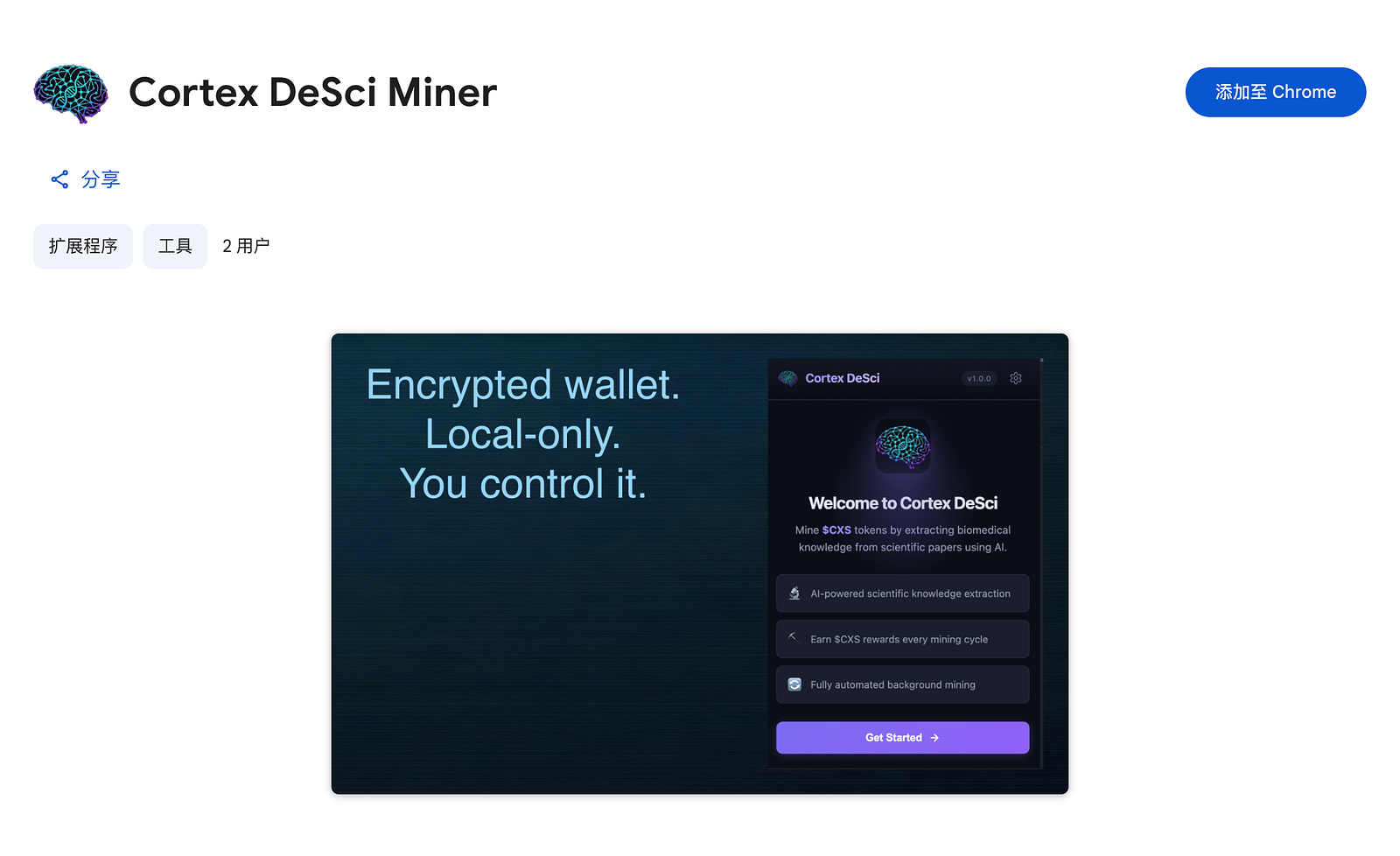
Search for “Cortex DeSci Miner” in the Chrome Web Store and click “Add to Chrome.”
Step 2 — Open the extension panel
Click the Cortex icon in your Chrome toolbar. You’ll see the “Welcome to Cortex DeSci” screen. Click “Get Started” to begin setup.
Step 3 — Choose your mining mode
Select Crypto Native / Miner (experienced with wallets, you manage your own private key) or Researcher / Student (no crypto background needed, the extension generates a wallet for you).
Step 4 — Complete onboarding tasks and get your CXS API Key
Visit app.cortexdesci.xyz/tasks and complete the following tasks. Once done, click “Generate Key” to create your CXS API Key: — Follow @CortexDesci and post a verification tweet — Retweet the official announcement — Join the Telegram community and complete bot verification (required to unlock API Key generation)
Step 5 — Configure the extension
In the Settings panel, enter your CXS API Key. Select an AI Provider (default: Groq — free, no configuration needed). Set your preferred mining cycle interval (default: every 30 minutes). Save and you’re ready to mine.
Supported Browsers
- ✅ Google Chrome
- ✅ Brave
- ✅ Microsoft Edge (Chromium)
- ❌ Firefox (not supported)
- ❌ Safari (not supported)
03 Choose Your Mining Mode
The Cortex extension does not use MetaMask or any external wallet as a Web3 signer. The extension manages your mining private key internally. Choose one of two modes on first launch.
Once set, switching modes is not recommended — your score and rewards are permanently tied to your Ethereum address.
Mode A — Crypto Native / Miner (for users familiar with wallets)
You generate and manage your own mining private key, with full custody of your assets.
Steps:
- Create a dedicated mining address in MetaMask or another wallet app (do NOT use your main wallet)
- Export the private key for that address (MetaMask: Account Details → Show Private Key)
- Complete the Step 4 onboarding tasks to get your CXS API Key
- Select “Crypto Native / Miner” in the extension and follow the wizard to enter your private key + API Key
⚠️ Security note: Always create a fresh address for mining. Never import a private key from a wallet holding significant assets. The extension uses the key solely to sign triplet submissions on-chain and initiates no other asset operations.
Mode B — Researcher / Student (for academics and crypto newcomers)
The extension automatically generates an Ethereum address for you. No prior wallet experience required. Labels: Guided setup · No crypto needed.
Steps:
- Select “Researcher / Student” in the extension
- The extension generates a new Ethereum address — immediately back up the displayed private key (it cannot be recovered if lost)
- Follow the guided setup to complete configuration and start mining
⚠️ Security note: Mining rewards accumulate in this auto-generated address. Check your balance periodically and keep your private key backup in a safe location.
💡 For ETHs Holders: Link Your Airdrop Wallet to a Mining Wallet
If the wallet holding your ETHs/VitaDAO airdrop isn’t practical for active mining (e.g. cold wallet, hardware wallet, multisig), you can bind it to a separate dedicated mining wallet via the Dashboard. Submissions from the mining wallet will count toward the airdrop wallet’s activation progress.
This means you don’t have to expose the wallet holding your ETHs inscriptions to participate in Group 2.
04 Submit Knowledge Triplets
A knowledge triplet is the atomic unit of the Cortex knowledge graph. Format: Subject → Predicate → Object. The AI model scores each triplet for quality, which directly determines your CXS rewards.
Triplet Format Examples
SIRT1→activates→autophagyNAD+→increases→SIRT1 activitymTOR→inhibits→autophagyNMN→precursor-of→NAD+senescent cells→secrete→SASP factors
How to Produce High-Quality Triplets
Source your literature — Read original papers on PubMed, bioRxiv, or Google Scholar. Extract relationships that are directly supported by experimental evidence.
Stay on topic — Current Epoch focus: NAD+, AMPK, mTOR, aging, longevity, senescence, NMN, SIRT1. On-topic triplets carry higher weight.
Use precise predicate terms — Stick to standard biological relationship terms: activates / inhibits / regulates / promotes / prevents / binds / increases / decreases
Normalize entity names — Use standard gene/protein/pathway nomenclature to avoid ambiguity (e.g. SIRT1 not Sirtuin-1)
Avoid duplicates — Don’t resubmit triplets already in the graph. The AI detects duplicates and penalizes scores.
✅ Recommended Submission Volume
- Submit 20–30 high-quality triplets per day — sufficient to reach activation threshold within 7 days
- Submitting more than 50/day triggers rate filtering. Over-submitting doesn’t increase rewards; it lowers your average quality score
05 Epoch Scoring & Multipliers
At the end of each Epoch (7 days), the system tallies all miners’ scores and distributes that Epoch’s CXS emissions (1,400,000 CXS per Epoch) proportionally.
Scoring Formula
Personal Epoch Score  = Σ(triplet quality scores) × Epoch multiplier
Personal CXS Earnings = (personal score / total network score) × 1,400,000 CXS
Epoch Multiplier Decay Table
EpochPeriodMultiplierStrategy1Day 1–73.0×🔥 Full sprint — peak earnings window2Day 8–142.5×High bonus still active, keep submitting3Day 15–212.0×Steady phase, maintain daily cadence4–6Day 22–421.5×Declining phase, stay activated7+Day 43+1.0×Baseline rewards, long-term mining
06 Activation Requirements: Don’t Miss the Threshold
To be counted in CXS reward distribution and qualify for Group 2 (6M CXS), your wallet must satisfy all of the following thresholds before Day 30. Missing any single condition disqualifies you from Group 2.
Activation Thresholds (all required)
MetricThresholdNotesTotal triplets submitted≥ 120Quality-checked triplets; ~4/day average is enoughActive days≥ 7Submissions must span at least 7 distinct calendar daysAverage quality score≥ 75Mean AI quality score across all submissionsWallet ETH balance≥ 0.005 ETHRequired at snapshot time (anti-Sybil check)
Check Your Progress
- ◆ Visit app.cortexdesci.xyz → Dashboard → Mining Progress
- ◆ The extension panel shows your live submission count, total score, and activation status
- ◆ API check:
GET /api/v1/airdrop/check?wallet=0xYourAddress
07 Airdrop Claim: The Day 30 Countdown
The Cortex Airdrop is split across three Groups, totalling 13,000,000 CXS. 100% instant unlock — no vesting, no linear release.
The Three Groups
GroupEligible WalletsTotalCountUnlock0 — ETHsEthereum mainnet ETHS inscription holders5,000,000 CXS1,672Day 01 — VitaDAOVitaDAO VITA token holders2,000,000 CXS1,022Day 02 — Genesis MinersMiners who complete activation by Day 306,000,000 CXSTBDDay 30
How to Claim (after Day 30)
- Visit app.cortexdesci.xyz/airdrop
- Connect your airdrop-eligible wallet
- Click “Check Eligibility” to see your Group and CXS amount
- Click “Claim” to submit the on-chain claim transaction (small gas fee required)
- CXS transfers to your wallet immediately upon confirmation
⏰ Claim Deadline
The claim window is open for 18 days. CXS not claimed before the deadline will be permanently burned. Don’t delay once the window opens.
08 Maximize Your Rewards
🔥 Strategy A: Full Sprint in Week One
- Epoch 1 (3× multiplier) is the highest-yield window of the entire mining lifecycle
- Target 25–40 high-quality triplets per day during Day 1–7
- Pre-select 5–10 papers in longevity/aging and batch-extract before launch day
- Your Week 1 score will constitute the majority of your total cumulative score (3× vs. later 1×)
🎯 Strategy B: Quality Over Quantity
- An average quality score below 75 severely discounts your Epoch earnings
- 10 triplets at quality 90 outperform 40 triplets at quality 60
- Use AI tools to assist extraction, but always verify claims against the source paper
- When in doubt, don’t submit — incorrect triplets carry a penalty
✅ Strategy C: Multi-Wallet Coordination (compliant)
- If you hold both ETHs inscriptions and a mining wallet, use the binding feature to maximize rewards from both pools simultaneously
- Activation is calculated independently per wallet — scores cannot be merged across wallets
- Never use scripts for bulk registration — the system has Sybil detection, and flagged wallets are permanently banned
⏳ Strategy D: Consistency Beats Burst Mining
- The 7 active-day requirement is a hard floor — a single day of mass submissions cannot compensate for missing days
- Daily moderate high-quality submissions are safer than weekend burst sessions
- Monitor your Dashboard closely during Day 25–30 to confirm all thresholds are met
09 FAQ
Q: I don’t have ETHs inscriptions or VitaDAO tokens. Can I still participate?
A: Yes! Group 2 (Genesis Miners) is open to everyone. Complete the activation thresholds before Day 30 and you’re eligible for your share of the 6M CXS pool.
Q: Does submitting triplets cost gas?
A: Yes, but the fee is minimal. Each triplet is inscribed to Ethereum L1 calldata via the CXS-20 protocol, consuming approximately 28,280 gas — roughly under $0.01 at current gas prices. This is the cost of permanent, on-chain storage: you’re paying for every hypothesis to live on Ethereum forever.
Q: Do triplets with quality scores below 75 still count?
A: They count toward the total submission count, but carry very low weight in your score. Large volumes of low-quality submissions drag down your average and can affect your activation status.
Q: Can I change my wallet address after binding?
A: No. Once bound, your wallet address is permanent. All scores, airdrop eligibility, and rewards are tied to the original registered address. Use an address you intend to keep long-term.
Q: How many triplets can I extract from a single paper?
A: There’s no hard limit, but 5–15 core relationships per paper is the recommended range. Extracting more than 30 from one paper typically degrades quality scores, since peripheral relationships have weaker literature support.
Q: How do I check my ETHs inscription balance?
A: Visit ethscriptions.com or query the Ethscriptions API with your address. Both Ethereum mainnet balances and Facet chain bridge balances are included in the snapshot.
Q: When exactly is Day 0?
A: Day 0 is April 28, 2026. Follow @CortexDesci for real-time announcements.
Official Channels
- Website — cortexdesci.xyz
- App — app.cortexdesci.xyz
- Twitter — @CortexDesci
- Telegram — t.me/+KiVqJ_S_jUxhNGM0
- GitHub — github.com/cortexdesci
- CXS Token Contract —
0xc07eca2c3e9158cd45e8cc83502e99761300e7fd
Final Thoughts
ETHs inscriptions proved that Ethereum mainnet can serve as a permanent cultural memory layer.
CXS-20 aims to prove it can serve as a permanent scientific memory layer.
$0.0098 per hypothesis. On Ethereum L1. Forever.
Start writing history on Day 1.
If this guide helped you, please clap 👏, follow Cortex DeSci, and share it with anyone interested in DeSci, inscriptions, or longevity science.
#DeSci #Ethereum #Ethscriptions #Longevity #Web3 #CXS