GitHub Copilot is your accelerator. SonarQube, CodeScene, and ExtenSURE are your mission control. In 2026, you need all four to build production-ready software.
The Era of “Accelerated Creation”
In 2026, the question is no longer, “Should we use Generative AI to write code?” The question is, “How do we govern the explosion of code it creates?”
We are living in the age of “Augmented Development.” My team can push out features 50% faster than last year, thanks to powerful assistants like Claude and Copilot. But a dark truth is emerging in our pull requests: Speed without a steering wheel is just a faster way to crash.
The Hallucination Gap
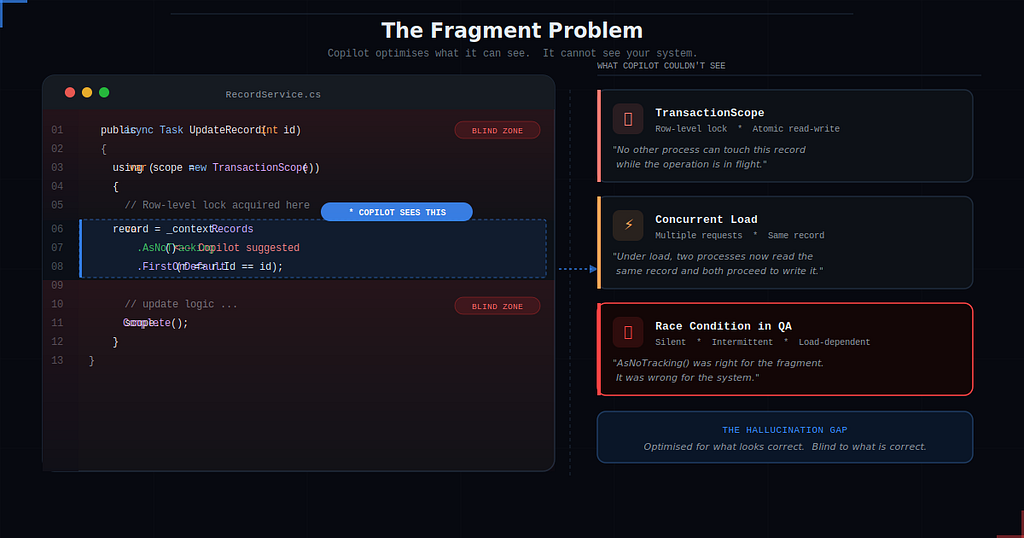
AI-generated code is a powerful draft, but it is not “Production-Ready.” The danger lies in the “Hallucination Gap.”
AI works on probability — it suggests what looks right based on billions of public patterns. Static analysis works on proof — it uses deterministic logic to prove that code is correct, secure, and maintainable. Relying solely on AI to review its own probabilistic work is a conflict of interest.
To build robust software today, we must treat AI-generated code with professional skepticism. Traditional static code analysis tools aren’t becoming obsolete; they are evolving into our digital immune system.

The “Shift-Left” Toolkit (Pre-Build)
Modern engineering rigor doesn’t start in the CI/CD pipeline; it starts in the developer’s IDE. The goal is to catch “hallucinations” and technical debt before they even hit the repository.
- SonarLint / CodeMaid: Your first line of defense for syntax, code smells, and immediate clean code enforcement.
- CodeScene (IDE Extension): It provides a Code Health™ score in real-time. If an AI suggests a “God Function” (a function that does too much), CodeScene flags it immediately.
- Snyk Code / Veracode IDE: Using their AI-native engines to find security vulnerabilities like SQL injection or cross-site scripting the second the AI assistant types them.
The “Hardened” Pipeline (Post-Build)
Once code is pushed, the human developer’s role shifts to “Governor.” The automated pipeline must enforce hard Quality & Security Gates that are agnostic to who (or what) wrote the code.
Behavioral Analysis: The Software Psychologist
The traditional tools (SonarQube, Roslyn) focus on the syntax — the logic of the code itself. But in 2026, we have a new layer: Behavioral Analysis.
This is where a tool like CodeScene shines. It doesn’t just look at a snapshot of code; it analyzes code history and developer interaction. It identifies Hotspots — complex areas of the codebase that are also frequently changed. This tells you where Technical Debt is actually costing the company money, rather than just pointing out a minor formatting error. CodeScene can even warn you if an AI-generated PR is creating a “knowledge silo” that your human team will be unable to maintain.
ExtenSURE: The Engineering Governance Framework
For mission-critical applications, a simple scan isn’t enough. We use a platform like ExtenSURE (developed by Persistent Systems) to govern the entire GenAI-led SDLC. It goes beyond finding bugs, providing a formal engineering framework for Technical Due Diligence. It audits the final product to ensure that standard software architecture principles were not sacrificed for speed.
The Multi-Layered Security Gate
Do not fall for the “Single Pane of Glass” myth. To protect your system, you need layers of different tools, because each one is good at something different.
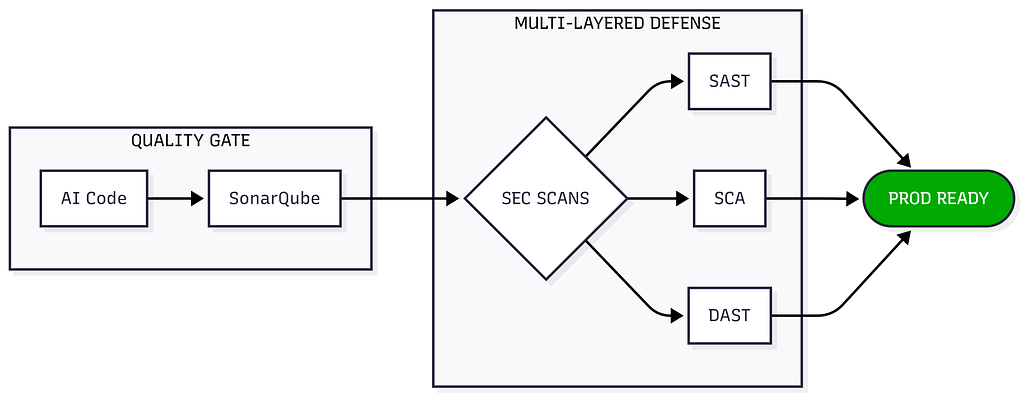
- Layer 1 (SAST): Deep, multi-file code analysis via tools like Checkmarx or GitHub CodeQL to trace data flows.
- Layer 2 (SCA): Critical for checking open-source dependencies (e.g., Mend.io, Snyk) to ensure the AI hasn’t suggested a library with a known “Log4j”-style vulnerability.
- Layer 3 (DAST): Dynamic scanning with tools like Invicti or Bright Security that tests the running application from the outside, catching vulnerabilities static tools can’t see.
Conclusion: Gas and Brakes
The most advanced development teams in 2026 aren't the ones using the most AI prompts. They are the ones with the most robust Deterministic Gates.
They use AI to accelerate creation and use Static Analysis to validate the output. AI is your gas pedal. Static Analysis is your brakes. You need both to win the race safely.
Beyond the Prompt: Why Static Analysis is the “Digital Immune System” of AI-Augmented Development was originally published in Level Up Coding on Medium, where people are continuing the conversation by highlighting and responding to this story.