Your Favorite DeFi Protocol Is Not Trustless
 Coby4 min read·Just now
--
And the sooner the industry admits that, the better it gets.
Say “trustless” out loud.
Now think about the last time you deposited into a protocol without reading the smart contract. Without checking who runs the oracle. Without knowing how many people actually control the multisig.
Right. We all trust. Every single day, in every protocol we use. The question was never whether trust exists in DeFi. The question is whether anyone built it properly.
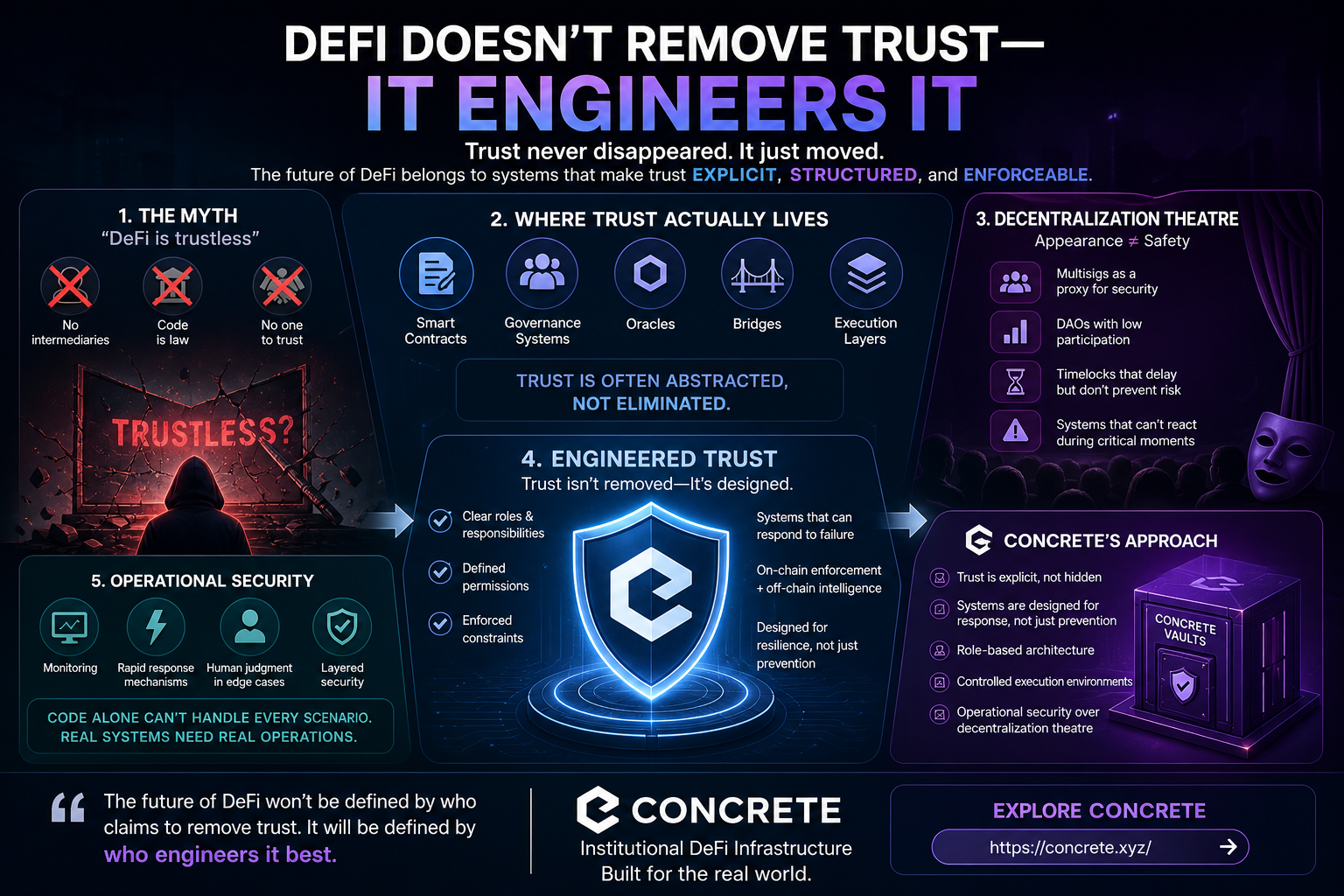
The honest map of where trust lives
Every DeFi protocol has a trust map, whether it drew one or not.
You trust the developers who wrote the contract. You trust the auditors who reviewed it — for a fixed fee, under a deadline, before the code was modified six more times. You trust the oracle operator whose price feed your liquidations depend on. You trust the bridge that your assets crossed to get here. You trust the governance system, which in most cases means you trust a handful of large wallets who show up to vote while everyone else doesn’t bother.
That’s a lot of trust for a “trustless” system.
None of this makes DeFi bad. It makes DeFi human. Complex systems built by people, for people, will always contain trust. The failure isn’t that trust exists. The failure is pretending it doesn’t — and therefore never designing it properly.
The multisig problem nobody wants to talk about
Here’s a test. Take your favorite “decentralized” protocol. Find out who controls the upgrade mechanism.
In a surprising number of cases, you’ll find a multisig. Maybe 4-of-7. Maybe 3-of-5. The team will tell you this is a security feature, and in some ways it is — it prevents a single key from being compromised and draining everything.
But call it what it is: a small group of people with the ability to change the protocol. That’s not decentralization. That’s a committee. A committee with a hardware wallet instead of a conference room, but a committee nonetheless.
The timelock doesn’t fix this. 48 hours sounds like a community protection window. In practice, when something is moving fast — an exploit, a market dislocation, a governance attack — 48 hours is either too long to wait or too short to mount a coherent response. Timelocks delay. They don’t prevent. And they create a false sense of security that can be more dangerous than no protection at all.
What happens when the edge case arrives
At some point, every protocol meets its edge case.
The market condition nobody modeled. The exploit vector the auditors didn’t catch. The oracle manipulation that looked theoretically difficult until someone with enough capital decided to try. The governance attack that succeeded because most token holders were asleep.
When that moment comes, what matters is not the protocol’s ideological purity. What matters is: can anyone respond? Is there monitoring that caught the anomaly before it cascaded? Is there a mechanism to pause, to intervene, to limit damage? Is there someone with both the authority and the information to make a fast decision?
In systems built around “code is law,” the answer is often no. The code runs. The damage happens. The post-mortem gets published two weeks later.
This is the gap that nobody wants to name: operational security. The layer above the smart contract. The humans and systems that watch, detect, and respond. This layer exists in every mature financial system in the world. In DeFi, it’s frequently treated as an afterthought — or worse, as ideologically suspect, because it involves humans having authority.
Concrete built around this problem
Concrete (concrete.xyz) started from a different premise: trust doesn’t disappear from financial infrastructure. So build for it deliberately.
Concrete vaults don’t hide their trust model. They engineer it. Onchain enforcement handles what code does well — transparent, immutable, auditable rules. Off-chain intelligence handles what code can’t — real-time monitoring, threat detection, the capacity to act when the situation demands it.
Role-based architecture means there’s no ambiguity during a crisis. Defined permissions mean actions happen within controlled execution environments, not in open-ended conditions where a mistake compounds before anyone notices.
The result is infrastructure designed to hold up under pressure — not because it claims to be trustless, but because it was built knowing that pressure would eventually come.
The reputational shift already happening
Institutional capital entering DeFi isn’t looking for “trustless.” It’s looking for legible.
It wants to understand who is responsible for what. It wants defined risk parameters, not vibes. It wants to know that if something goes sideways at 3am, there’s a system — and probably a person — positioned to respond.
This is how every other financial infrastructure in the world operates. Not by eliminating trust, but by structuring it. By making it explicit, bounded, and enforceable.
DeFi is moving in this direction whether the ideologues like it or not. Because capital is patient, but capital is also rational. And rational capital doesn’t stay in systems where trust is invisible, undesigned, and therefore unmanageable.
The real competition
The next few years will sort protocols into two categories.
The ones that spent this period perfecting their decentralization narrative. And the ones that spent it building operational depth — monitoring, response mechanisms, layered security, clear accountability.
When the next major stress event hits — and it will — the difference between those two categories will be visible to everyone.
The future of DeFi belongs to whoever engineers trust best. Not whoever claims to have removed it.
Concrete is building the infrastructure that institutional DeFi actually needs. Explore at concrete.xyz