The clock is ticking. Every second you hesitate, a hacker is draining what took you years to build.
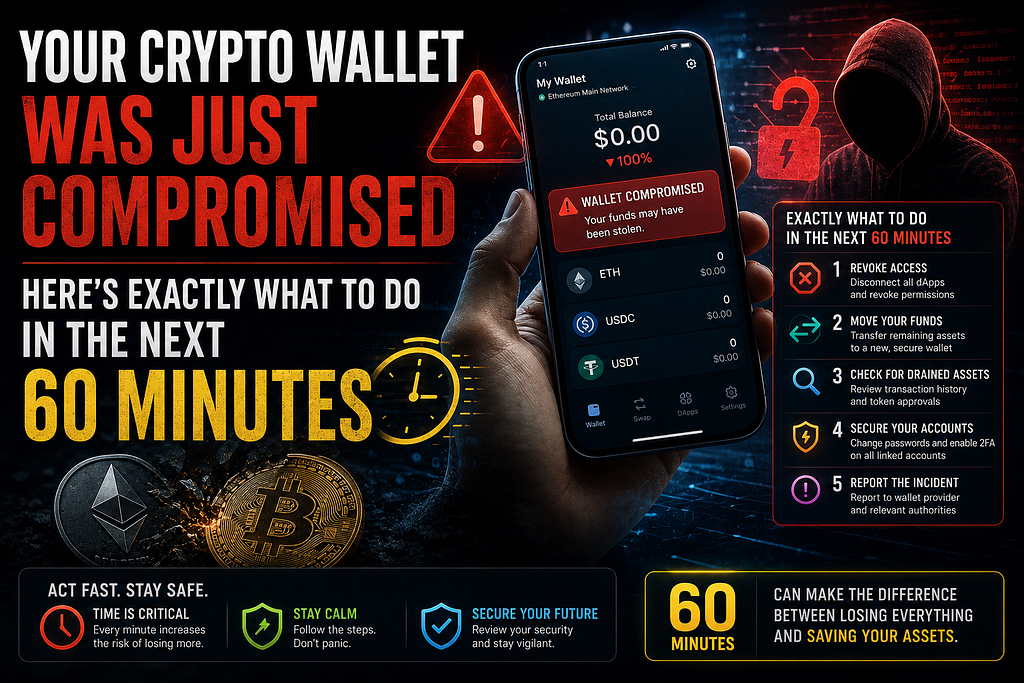
You open your wallet app and feel your stomach drop. Transactions you didn’t make. Tokens you didn’t send. A balance that’s falling in real time — or already gone. Your hands might be shaking right now. That’s okay. But what you do in the next sixty minutes will determine how much you lose, how fast you recover, and whether the attacker gets a second chance.
This isn’t a theoretical guide. This is a minute-by-minute emergency playbook for a compromised crypto wallet, written for the moment you’re living right now. Bookmark it. Share it before you need it. And if you’re already in the middle of a breach — keep reading, fast.
First: Understand What You’re Dealing With
Before you act, take thirty seconds to assess. Not all wallet compromises are the same, and the wrong response can make things worse.
Ask yourself:
- Are funds actively moving right now, or did the breach already happen?
- Is this a hot wallet (MetaMask, Trust Wallet, Coinbase Wallet) or a hardware wallet (Ledger, Trezor)?
- Did you recently click a link, connect to a dApp, or enter your seed phrase anywhere?
- Do you use the same password or recovery phrase across multiple wallets or exchanges?
The answers shape your next move. A hot wallet that’s actively being drained requires immediate, aggressive action. A hardware wallet that may have had its recovery phrase exposed requires a different but equally urgent response. Either way, you have a narrow window.
Read More: [Updated] The 2026 Crypto Scam Warning List: How to Spot and Avoid Fake Platforms
Minutes 0–10: Stop the Bleeding
1. Disconnect Your Internet — Right Now
This sounds basic, but it’s the most important thing you can do in the first sixty seconds. Disable Wi-Fi, turn on airplane mode, unplug your ethernet cable. If malware is operating on your device, cutting the connection stops it from communicating with its command-and-control server.
This won’t undo what’s happened, but it may interrupt an ongoing drain.
2. Revoke Token Approvals Immediately
If you still have any funds left and the wallet isn’t fully drained, your priority is revoking smart contract permissions. Many crypto wallet hacks don’t steal your private key — they exploit unlimited token approvals you granted without realizing it.
Go to revoke.cash (for Ethereum and EVM chains) or the equivalent tool for your chain (e.g., sol-incinerator for Solana) and revoke every approval you don’t recognize — and honestly, most that you do. Do this from a different, clean device if at all possible. You can also contact Scambrokercheck.com for a comprehensive case review and guidance.
3. Do NOT Transfer to a New Wallet You Just Created on the Same Device
This is a critical mistake many people make under pressure. If your current device is compromised, any new wallet you create on it is already compromised too. The malware will capture your new seed phrase the moment it’s generated.
If you must move funds, use a hardware wallet you already own and know is clean, or a completely separate device that has never touched your compromised wallet or any related apps.
Minutes 10–25: Assess the Full Scope
4. Check Every Connected Wallet and Exchange
Attackers rarely stop at one wallet. If they accessed your seed phrase, they can derive every address in that wallet’s derivation path. More dangerously, if they have access to your email or password manager, your centralized exchange accounts (Binance, Coinbase, Kraken) may be next.
Log in to every exchange account you use — again, from a clean device — and immediately:
- Enable withdrawal whitelisting if available
- Revoke API keys you don’t recognize
- Check recent login history for unfamiliar IP addresses
- Change your password and rotate your 2FA to an authenticator app (not SMS, which is vulnerable to SIM swapping)
5. Identify the Attack Vector
You need to understand how this happened to stop it from happening again. The most common crypto wallet compromise methods in 2024–2026 are:
Phishing sites: A fake Uniswap, OpenSea, or wallet interface that captured your seed phrase when you “logged in.”
Malicious dApp approvals: You connected a legitimate-looking protocol that requested unlimited token approvals, then drained you later.
Clipboard hijacking malware: Software on your device replaces copied wallet addresses with the attacker’s address. Every transaction you think you’re sending to yourself goes to them.
Compromised browser extensions: Fake or hijacked MetaMask, Phantom, or similar extensions. Even legitimate extensions can be compromised through supply chain attacks.
SIM swap attack: An attacker convinced your carrier to port your phone number, bypassing SMS-based 2FA.
Be honest with yourself as you trace back your last 48–72 hours of crypto activity.
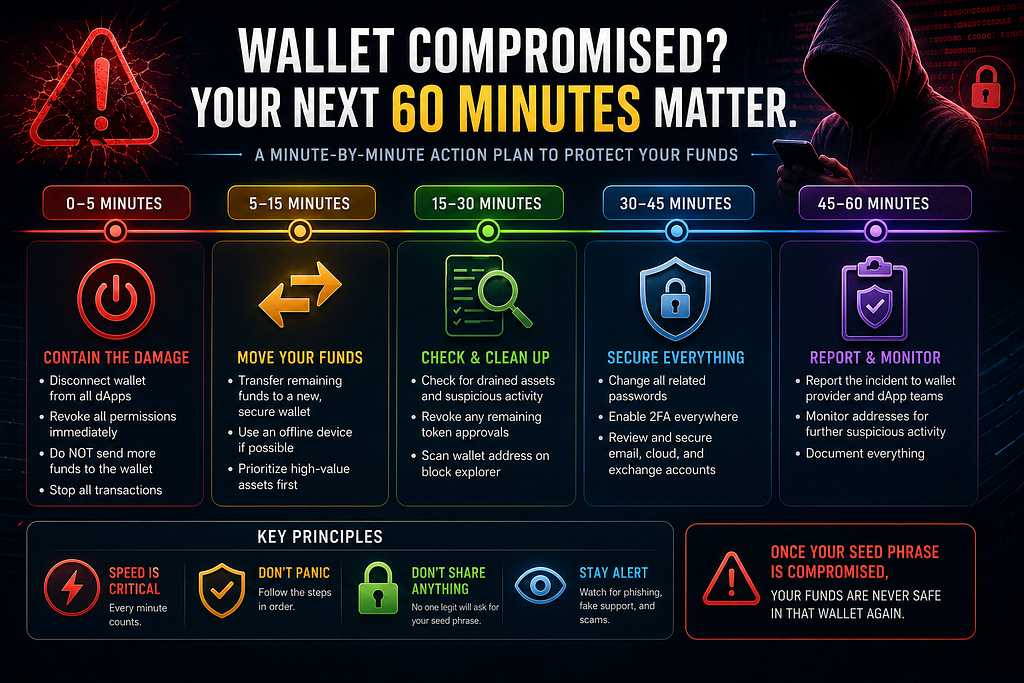
Minutes 25–40: Protect What’s Left
6. Move Remaining Funds — With Extreme Care
If you have assets remaining in the compromised wallet and you’ve already revoked approvals, you may be able to salvage them. But this requires surgical precision.
The safest path:
- Use a hardware wallet (Ledger, Trezor, Coldcard) that you set up offline on a clean device. This is your destination address.
- If you don’t have a hardware wallet, use a clean device (a friend’s laptop, a factory-reset phone) to create a brand new software wallet and note the seed phrase offline, on paper, never digitally.
- Transfer the smallest valuable token first as a test. Confirm it arrives before moving everything.
- Be aware: if gas fees or the native token (ETH, SOL, MATIC) are already drained, you may not be able to move ERC-20 tokens. Some services like Flashbots Protect or MEV-resistant RPCs can help, but these require technical knowledge to use correctly. Review your case with MintonFin.com for help.
7. Secure Your Email and Password Manager
A compromised crypto wallet is often a symptom of a deeper security breach. Your email account is the master key to everything — exchange accounts, recovery flows, 2FA resets.
- Change your email password immediately on a clean device
- Enable the strongest 2FA available (hardware security key > authenticator app > SMS)
- Audit active sessions and revoke any you don’t recognize
- If you use a password manager, rotate the master password and check for any unauthorized access events
Minutes 40–60: Document and Report
8. Preserve Every Piece of Evidence
This matters more than most people realize. Law enforcement agencies — including the FBI’s IC3, Europol’s EC3, and national cybercrime units — have successfully recovered stolen crypto in high-profile cases, but only when victims provide complete, detailed records quickly.
Document and screenshot:
- All transaction hashes from the exploit (find them on the blockchain explorer: Etherscan for ETH, Solscan for SOL, BSCScan for BNB, etc.)
- The attacker’s wallet address(es)
- Any phishing URLs, emails, or Discord messages that were part of the attack
- The approximate time and date of each unauthorized transaction
- Which dApps you recently connected to
Save all of this to a secure cloud location and a local backup simultaneously.
9. Report the Attack
File a report with:
- FBI Internet Crime Complaint Center (IC3): ic3.gov — for US-based victims
- Action Fraud (UK): actionfraud.police.uk
- ScamBrokerCheck (SBC): scambrokercheck.com — review your case and get help.
- Your local cybercrime unit — most developed countries have one
- The blockchain’s security community: Many chains and protocols maintain security contact channels. Ethereum Foundation, Solana Foundation, and major DeFi protocols like Uniswap and Aave have security disclosure paths.
- Chainalysis, TRM Labs, or Elliptic — These blockchain analytics firms work with law enforcement and exchanges to flag attacker addresses. While you can’t engage them directly, reporting to law enforcement starts the process.
10. Alert Your Network
If the attacker compromised your social accounts or email, they may use them to target your contacts next — especially in crypto communities. Immediately:
- Post a public warning on Twitter/X, Discord, and Telegram if you’re active in those communities
- Send a direct message to close contacts warning them not to click any links that appear to come from you
- Notify any DAOs, NFT projects, or DeFi protocols where you hold admin or multisig privileges — your compromised key may represent a systemic risk to others
After the 60 Minutes: What Comes Next
The acute emergency is over, but recovery takes weeks. Here’s what the road ahead looks like:
Week 1: Complete a full security audit of every device you use for crypto. Run malware scans (Malwarebytes is a solid free option). Consider a full factory reset of any device that may be infected. Assume every browser extension you installed in the past six months is suspect — uninstall, verify, and reinstall only from official sources.
Week 2: Rebuild your security stack from scratch. Get a hardware wallet if you don’t have one. Ledger and Trezor remain the industry standards, despite past controversies. A hardware wallet that’s set up correctly means even a fully compromised computer can’t drain your funds.
Week 3–4: Tax and financial implications. In most jurisdictions, stolen crypto is potentially deductible as a casualty loss (rules vary significantly by country — consult a crypto-specialized tax professional). Document the value of stolen assets at the time of theft for your records.
The Brutal Lessons: What Would Have Prevented This
If you’ve gotten through the emergency phase and you’re rebuilding, here’s what the security community and seasoned crypto holders universally recommend:
Never store your seed phrase digitally: Not in a notes app. Not in Google Drive. Not in a photo. Not in a password manager. On paper, in a fireproof safe, or on a metal seed phrase backup. Period.
Use a hardware wallet for anything you can’t afford to lose: A $70 Ledger Nano has protected billions in assets. The math is obvious.
Treat every dApp approval as a potential attack vector: Use a burner wallet for interacting with new or unverified protocols. Never use your main wallet to experiment.
Separate your identities: One wallet for DeFi interaction. One for long-term storage. One for NFT minting. Never connect your main holding wallet to anything.
Use a dedicated browser and device for crypto: A cheap Chromebook used only for crypto activity, with no extensions installed, dramatically reduces your attack surface.
SMS 2FA is not 2FA for crypto: SIM swapping is trivially easy for attackers who have your phone number. Use an authenticator app (Authy, Google Authenticator) or a hardware key (YubiKey) for every exchange account.
The Hard Truth About Crypto Security
Blockchain is trustless and permissionless — which is also what makes theft so devastating. There is no bank to call. There is no chargeback button. There is no FDIC insurance. The immutability that makes crypto valuable is the same immutability that makes theft permanent in most cases.
But permanent doesn’t mean hopeless. The blockchain is also a perfect ledger — every transaction is recorded, every address is traceable, and the investigative tools available to law enforcement and forensic firms are growing more powerful every year. The faster you act and the more thoroughly you document, the better your odds of any recovery.
You’ve just been through one of the most stressful experiences in crypto. The acute shock will pass. Focus on the steps in front of you, one at a time. Secure what’s left. Document everything. Report it. And then rebuild smarter.
The people who survive crypto hacks and come back stronger are the ones who treat it as a brutal, expensive education — and never make the same mistake twice.
If this guide helped you, please share it with your crypto community before they need it. The best defense is preparation — and too many people only find this information after it’s too late.
Follow for more guides on crypto security, DeFi risk management, and on-chain safety practices.
Your Crypto Wallet Was Just Compromised — Here’s Exactly What to Do in the Next 60 Minutes was originally published in Coinmonks on Medium, where people are continuing the conversation by highlighting and responding to this story.