Why the Wisdom of the Crowd Beats Wall Street Analysts (And Why Your Research Tools Are Holding You Back)
--
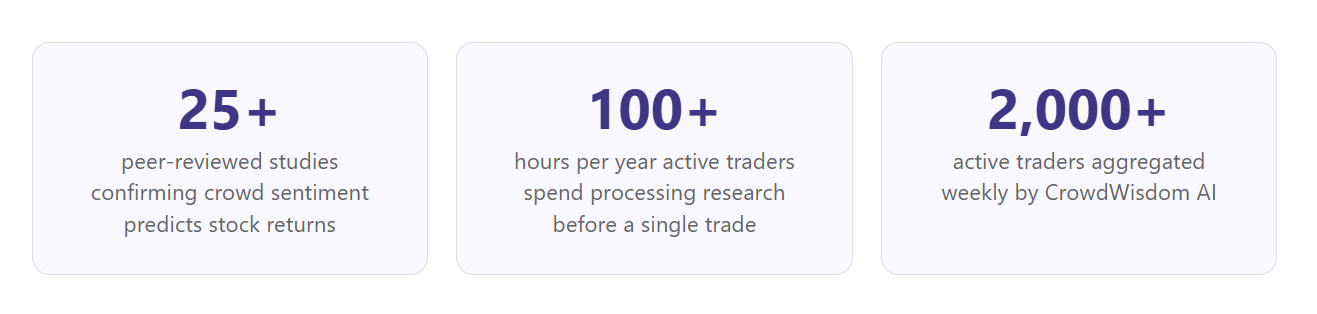
Over 25 peer-reviewed studies confirm it. Aggregate crowd sentiment from online trading communities predicts stock returns more reliably than analyst ratings, research articles, or data portals. Here is the science and what it means for your trading week.
Markets have always been moved by crowds. Long before algorithmic trading and Bloomberg terminals, the traders who gathered at the Tontine Coffee House on Wall Street in 1793 were already proving a fundamental truth: collective sentiment drives price discovery. Their fears, hopes, and shared conviction moved markets then, just as millions of online traders, investors, and analysts move markets today.
The difference is that today, that crowd intelligence is measurable, aggregatable, and actionable. If you have the right tools to access it.
Most traders do not. Instead, they are paying for tools that deliver raw data and leaving the hardest part entirely up to them.
The Problem With How Most Traders Research Today
Walk through a typical trading week and you will recognize the pattern. Sunday evening: open TipRanks, scan analyst ratings and Smart Scores. Flip to Seeking Alpha, skim articles, maybe read one in full. Check Investing.com’s economic calendar. Make notes. Try to synthesize it all into a view. Stare at charts. Two hours later, you are still not sure what to trade Monday morning.
This is not a personal failing. It is a product design problem. These tools were built to deliver information, not decisions. They monetize your time on-platform: more articles, more dashboards, more data to scroll through. None of them have a financial incentive to give you the answer quickly.
“I’m paying for TipRanks, Seeking Alpha, and Investing.com and I still don’t know what the difference is between them.” This is what active traders say. It is not their failure. It is the tools’ failure.
The result is information overload: hundreds of articles a day on Seeking Alpha, thousands of analyst ratings on TipRanks, an overwhelming array of charts and data feeds on Investing.com. Active traders spend well over 100 hours per year just processing market research, before making a single trade.
There is a better model. And the science behind it has been accumulating for over a decade.
The Academic Case for Crowd Wisdom in Markets
The idea that aggregate crowd sentiment predicts future stock performance is not a social media theory. It is one of the most consistently replicated findings in modern financial research.
In “Wisdom of Crowds: The Value of Stock Opinions Transmitted Through Social Media,” researchers from the City University of Hong Kong, Purdue University, and Georgia Tech analyzed roughly 100,000 articles and comments on financial platforms published between 2005 and 2012. Their finding: views expressed in crowd-sourced financial content, including reader commentary, predicted future stock returns across every time frame examined, from one month to three years. They also predicted earnings surprises.
Researchers Liew and Budavari found significant evidence that social media-derived securities characteristics explain daily return time-series with meaningful statistical power. Houlihan and Creamer showed that message volume and sentiment from trading platforms contain reliable information about future price changes. Over 25 peer-reviewed studies have now reached similar conclusions across different platforms, time periods, and asset classes.
The mechanism is intuitive. Online investment communities are self-regulating. Participants voluntarily share their real views because they have a personal financial incentive to be right. This is fundamentally different from traditional survey-based sentiment measures such as the University of Michigan Consumer Sentiment Index or AAII surveys, which suffer from negative bias, low truth-telling incentive, and reporting lags. Social trading communities are real-time, voluntary, and financially motivated.
The data also shows that as the volume of online investment discussion grows, predictive power strengthens. The BUZZ NextGen AI US Sentiment Leaders Index, built on exactly this methodology, has demonstrated consistent outperformance against the S&P 500 since launch, with a strong correlation between rising message volume and improving alpha generation. In 2020 alone, it correctly identified early conviction in Tesla, Nvidia, AMD, Roku, Shopify, and over 170 other stocks, many of which became the defining trades of that year.
This is the power of collective conviction: not one analyst’s opinion, but the aggregated, financially-motivated view of thousands of experienced market participants, processed and distilled by AI.
Why Traditional Research Tools Cannot Access This Signal
The analyst bias problem (TipRanks)
Analyst ratings platforms like TipRanks do a good job of tracking which Wall Street analysts have historically been accurate. But they have a structural problem baked into their data source: Wall Street analysts almost never issue sell ratings. The incentive structure of institutional research, where the same bank covering a stock may also want to underwrite its next equity offering, creates a systematic upward bias that no ranking algorithm can fully correct.
The result is a platform that tracks advisors operating under institutional constraints, none of whom trade with their own capital. The crowd that spotted Tesla’s 2020 breakout was not on a bank’s research desk. It was on Reddit, YouTube, and Twitter, well before any analyst upgraded the stock.
The content quality problem (Seeking Alpha)
Seeking Alpha pioneered crowdsourced financial analysis, and its quantitative ratings system has genuine merit for long-term fundamental investors. But the platform’s core challenge is variable content quality. Contributors are paid based on views, not performance, which creates incentives for clickbait over accuracy. In documented cases, this has enabled coordinated stock manipulation. A peer-reviewed analysis found that publication of negative articles by a coordinated group of writers resulted in over $20 billion in mispricing.
More fundamentally, Seeking Alpha is designed for investors who want to do their own research. The product delivers inputs: articles, ratings, transcripts. Not outputs. If you are an active trader who wants to know what to do Monday morning, reading a fundamental analysis published on Thursday is too slow and too theoretical.
The data without interpretation problem (Investing.com)
Investing.com is the closest thing trading has to infrastructure. Real-time data across 250 exchanges, economic calendars, currency pairs, commodities, indices. It is a genuinely comprehensive data portal. The problem is exactly that: it is a data portal. Every chart, every data point, every economic indicator is an input waiting to be interpreted. The interpretation is entirely your job.
For a trader managing their own research, this means hours of work every week turning raw data into a coherent view. Investing.com’s business model depends on that work happening on their platform. More time spent equals more ad revenue. There is no incentive to make your decision faster.
The CrowdWisdom Approach: From Signal to Decision
CrowdWisdom Trading was built on a different premise: active traders do not need more data. They need the collective signal of the world’s best traders, distilled and delivered as a ready-to-execute decision.
The platform’s AI agents continuously monitor the digital trading landscape: expert YouTube traders with verified track records, active Reddit investment communities, high-signal X accounts, and specialized trading platforms. Their views are aggregated across thousands of sources and combined with real-time financial market data, technical indicator levels, and cryptocurrency exchange signals to produce a composite conviction score for each opportunity.
The output is not a dashboard to navigate or an article to read. Every week, before the market opens, subscribers receive a briefing in their inbox with the highest-conviction opportunities identified by collective trader wisdom, including exact entry points, stop-loss levels, and take-profit targets. Pro subscribers access the full setup details directly on the platform: the aggregated trade plan of 2,000+ experienced market participants, pre-filtered for conviction.
No dashboard to navigate. No 200 articles to read. Just decisions.
Head-to-Head: What the Difference Looks Like in Practice
The question for any active trader is not which platform has the most features. It is which one produces the best risk-adjusted decisions in the least time.
A TipRanks user starts their week with a Smart Score and a list of analyst upgrades. They still have to decide when to enter, where to place a stop, and what position size to take. A CrowdWisdom user starts with an exact entry price, a stop-loss level, and a take-profit target, backed by the aggregate conviction of thousands of traders who have already done that analysis.
A Seeking Alpha user reads articles on Sunday evening and tries to synthesize them into a view. A CrowdWisdom user reads one briefing that has already synthesized thousands of trader views into a ranked set of opportunities.
An Investing.com user opens the economic calendar and starts building a framework. A CrowdWisdom user receives a framework that has already incorporated the calendar, technical levels, and 2,000+ trader opinions into a single coherent trade idea.
The underlying research is the same in each case. The difference is who does it: you, or an AI system processing the collective wisdom of financially motivated traders.
The Crowd Has Always Beaten the Individual
Markets have always been social. Price discovery is a collective process. It has been since the coffee house traders of the 18th century, and it remains true in the Reddit forums and YouTube channels of the 21st. The traders who consistently outperform are not the ones working in isolation with superior individual analysis. They are the ones who best understand what the crowd believes, and position accordingly.
The tools most traders use today were built for a world where institutional research was the only structured source of market opinion. That world no longer exists. Millions of experienced traders share their views in real time, with genuine financial skin in the game, across a growing set of digital platforms. The signal is there. The research proving its predictive value is unambiguous.
The only question is whether you are capturing it, or spending 100 hours a year generating noise.
See the Difference for Yourself
CrowdWisdom Trading offers a free trial briefing. No credit card required. Experience what it feels like to start your trading week with a decision instead of a research project.
CrowdWisdom Trading aggregates insights from 2,000+ active traders and investors worldwide. Content is for informational purposes only and does not constitute investment, financial, or legal advice. Past performance is not indicative of future results. Always conduct your own research before making any trading or investment decisions.