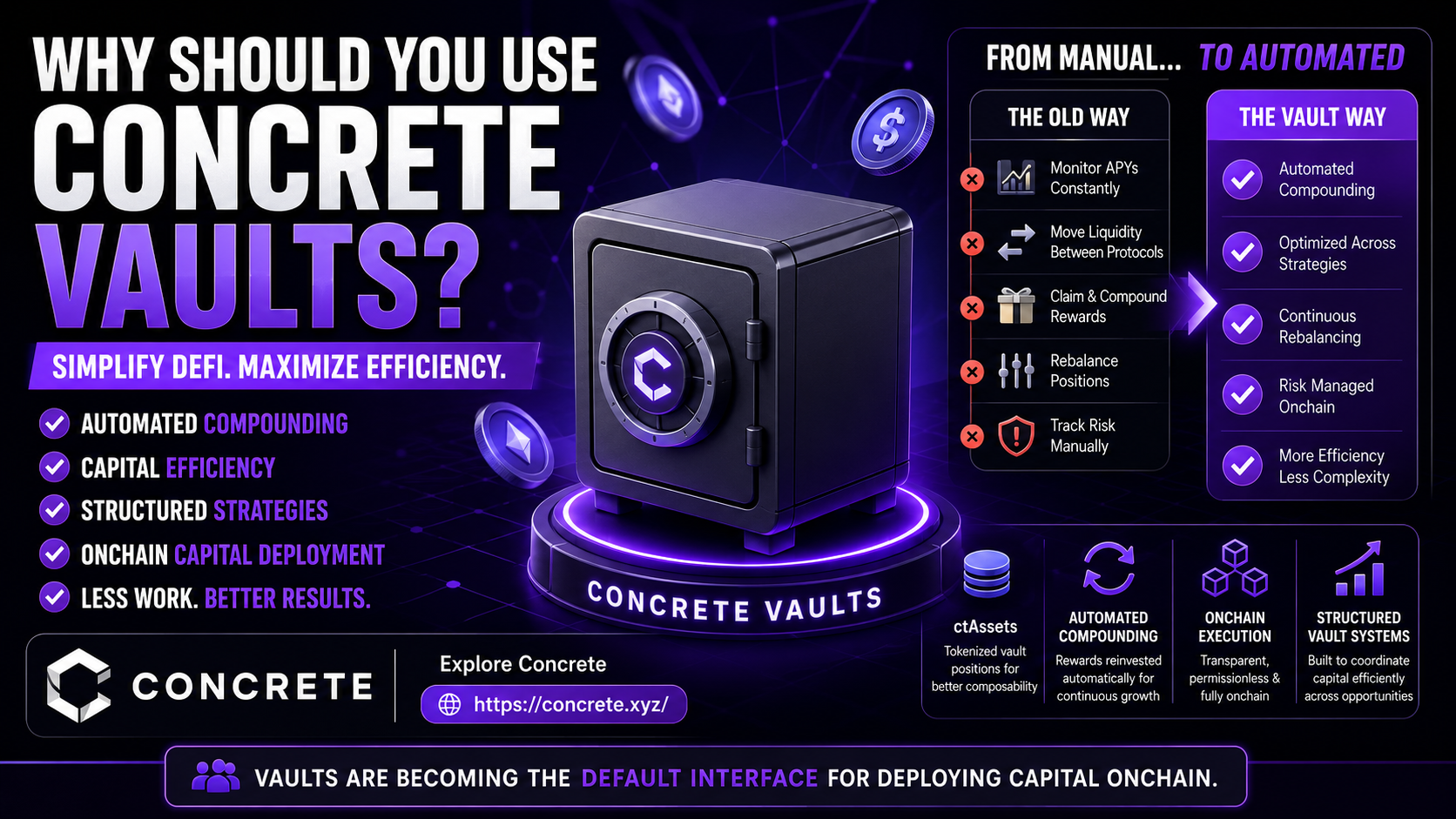
Why Should You Use Concrete Vaults?
 DXxz4 min read·Just now
--
Decentralized finance has created a new way for people to manage capital without relying on traditional financial institutions. Users can lend assets, provide liquidity, farm yield, and move capital across protocols directly onchain.
But as DeFi continues to grow, it also becomes more difficult to manage efficiently.
Today, staying competitive in DeFi often requires constant attention. Users need to monitor APYs across different protocols, move liquidity manually, claim rewards, compound positions, rebalance exposure, and track risk in real time. What started as an open financial system has gradually become a full-time activity for many participants.
This creates friction.
Capital sits idle while users search for better opportunities. Strategies become harder to maintain consistently. Manual repositioning increases operational complexity and often leads to missed opportunities.
This is where DeFi vaults become important.
Rather than requiring users to actively manage every position themselves, vault infrastructure creates a more structured system for deploying and optimizing capital onchain.
>What Do Concrete Vaults Actually Do<
Concrete Vaults are designed to simplify onchain capital deployment.
Instead of manually moving between protocols and strategies every day, users can deposit assets into a vault system that coordinates these processes automatically.
Concrete Vaults help users:
- pool capital together
- automate compounding
- deploy assets across strategies
- optimize positions over time
- reduce operational complexity
This allows users to gain exposure to structured DeFi strategies without constantly managing every step manually.
The goal is not simply convenience. It is efficiency.
By automating repetitive actions and coordinating capital deployment systematically, Concrete Vaults help users spend less time maintaining positions while improving consistency across strategies.
>Why Vault Infrastructure Matters<
As DeFi matures, infrastructure becomes increasingly important.
In the early stages of DeFi, many users managed positions manually because opportunities were relatively simple. But modern onchain markets move quickly. Yield conditions change constantly, liquidity shifts between ecosystems, and efficient positioning requires continuous adjustment.
Manual management does not scale well in this environment.
Vault infrastructure solves several important problems at once.
First, automation reduces the amount of active management required from users. Instead of checking multiple protocols every day, vault systems can automate compounding and position maintenance.
Second, vaults improve capital efficiency. Idle capital is reduced because assets can remain actively deployed within structured strategies rather than waiting for manual repositioning.
Third, vaults simplify the user experience. Users no longer need to understand every individual protocol interaction to participate in sophisticated strategies.
Most importantly, vaults create continuous optimization.
Rather than reacting slowly to market conditions, structured systems can coordinate capital deployment more consistently over time.
This is becoming a critical part of institutional DeFi, where efficiency, structure, and operational reliability matter more than constantly chasing short-term yield spikes.
>Vaults Are More Than Yield Wrappers<
A common misunderstanding is that vaults are simply tools that “auto-compound yield.”
In reality, modern structured DeFi systems are much more sophisticated.
Concrete Vaults are designed with infrastructure that helps coordinate capital deployment across changing opportunities. This includes systems that can rebalance positions, maintain strategy constraints, and adapt to evolving market conditions.
The purpose is to create a more organized framework for participating in DeFi.
Instead of users manually managing every adjustment themselves, the vault architecture handles much of the operational layer in a structured way.
This reduces inefficiencies while helping strategies remain active and optimized over time.
>The Role of Concrete Vault Architecture<
The core strength of Concrete Vaults comes from how the system coordinates capital onchain.
Concrete introduces structured vault systems that integrate automated compounding, onchain execution, and ctAssets into a unified infrastructure layer.
ctAssets help represent structured positions inside the ecosystem while vault systems coordinate deployment strategies behind the scenes. Combined with automated compounding, this creates a more efficient system for managing onchain capital over time.
Rather than isolated positions scattered across multiple protocols, users gain exposure to coordinated capital infrastructure designed for long-term efficiency.
This is one of the reasons why structured DeFi is becoming increasingly important.
As strategies grow more complex, infrastructure itself becomes the competitive advantage.
The ability to coordinate liquidity efficiently, maintain active positioning, and automate execution at scale is becoming more valuable than manual strategy management alone.
>The Bigger Shift Happening in DeFi<
DeFi is entering a new phase.
The industry is no longer defined only by access to yield opportunities. Increasingly, it is defined by how efficiently capital can be coordinated across those opportunities.
Manual strategy management becomes harder as ecosystems expand. Constant repositioning does not scale well for users or institutions operating across multiple protocols and chains.
This is why vault infrastructure is becoming more important.
Concrete Vaults represent a shift toward systems that automate coordination, optimize capital deployment, and simplify participation in complex onchain environments.
The future of DeFi may not belong to users spending all day clicking between protocols.
It may belong to the infrastructure designed to manage capital more efficiently behind the scenes.
Explore Concrete at http://concrete.xyz/