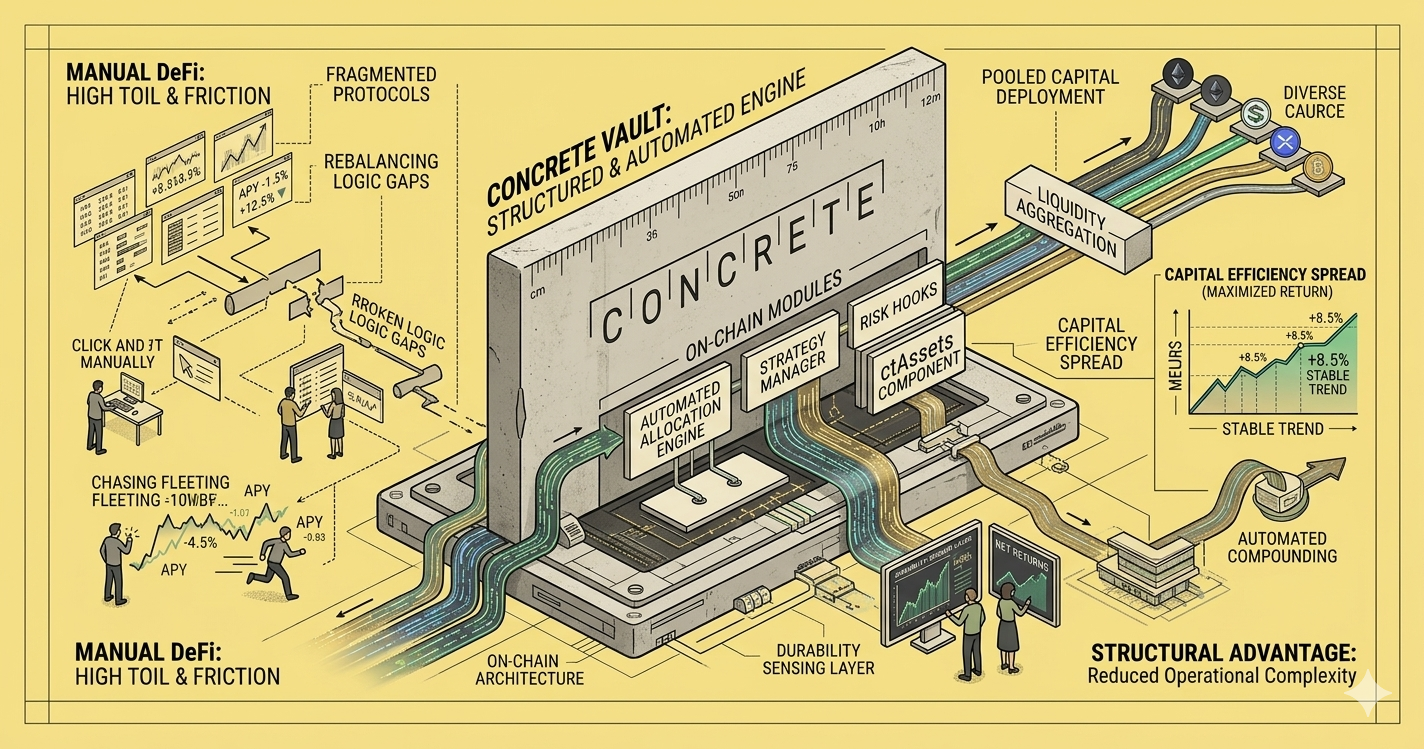
Why Concrete Vaults Could Become the Operating System of DeFi
 Chalobah5 min read·Just now
--
The first version of DeFi gave users something revolutionary: permissionless access to financial tools.
Anyone with a wallet could lend, borrow, stake, farm, provide liquidity, or trade without needing approval from a bank or institution.
But as DeFi matured, one major problem became impossible to ignore:
Most users still have to manually manage everything themselves.
Move liquidity. Rebalance positions. Track APYs. Monitor emissions. Avoid liquidation. Compound rewards. Switch protocols. Optimize yield.
The result?
A system that promises financial freedom often becomes overwhelming, inefficient, and difficult to scale.
This is where Concrete Vaults enter the conversation.
Rather than acting like another “yield farming product,” Concrete Vaults introduce something much bigger:
- Infrastructure designed to coordinate capital more intelligently across DeFi.
And if that model succeeds, vault architecture may become one of the most important layers in the future of decentralized finance.
The Hidden Problem in DeFi
Most DeFi users interact with protocols manually.
Even experienced participants constantly face decisions such as:
- Which protocol currently offers the best yield?
- When should rewards be compounded?
- Is liquidity being used efficiently?
- Should positions be rebalanced?
- Is capital sitting idle?
- Has market volatility changed the risk profile?
This approach creates friction.
Instead of capital operating continuously and efficiently, users spend time managing positions like active operators.
That model may work for a small group of advanced traders.
But it becomes increasingly difficult when DeFi expands to millions of users and billions in capital.
Manual coordination does not scale.
And in finance, systems that fail to scale eventually lose efficiency.
What Exactly Is a Concrete Vault?
A Concrete Vault is best understood as an automated capital coordination system.
Rather than users manually moving assets between opportunities, the vault structure handles optimization in the background.
The goal is not simply to “earn yield.”
The goal is to make capital:
- more efficient
- continuously active
- dynamically managed
- automatically rebalanced
- strategically deployed
Vault systems typically allow users to:
- pool capital together
- automate reward compounding
- rebalance positions over time
- reduce operational complexity
- optimize exposure across protocols
Instead of manually adjusting positions every day, users gain access to a structured system that continuously manages strategy execution.
This changes the relationship between users and DeFi infrastructure.
Users no longer operate every component themselves.
They participate through systems designed to coordinate those operations efficiently.
Why Vault Infrastructure Matters
The importance of vaults goes beyond convenience.
Vault architecture solves one of the biggest inefficiencies in decentralized finance:
- fragmented capital management.
Today, liquidity across DeFi is often scattered.
Users chase incentives manually. Capital moves inefficiently. Strategies become reactive instead of optimized.
Concrete Vaults attempt to organize that process.
The benefits become increasingly important as DeFi grows:
1. Better Capital Efficiency
Idle capital is one of the biggest weaknesses in financial systems.
Vaults aim to keep assets productive through continuous allocation and optimization.
Instead of sitting unused, liquidity can be deployed dynamically where it is most effective.
That creates stronger utilization across the ecosystem.
2. Automated Compounding
Most users do not compound rewards consistently.
Gas fees, timing, and complexity reduce efficiency.
Vault systems automate this process, allowing positions to compound without requiring constant user intervention.
Over time, automation can significantly improve performance consistency.
3. Reduced Operational Complexity
DeFi can feel intimidating because every protocol introduces new mechanics.
Vault infrastructure simplifies participation.
Users interact with a single system while the vault handles execution behind the scenes.
This lowers friction and improves accessibility.
4. Smarter Risk Management
Manual strategies often react too slowly to changing conditions.
Vault architectures can rebalance exposure dynamically based on liquidity conditions, volatility, incentives, or predefined parameters.
This creates more structured risk management compared to purely manual execution.
5. Scalable Coordination
Perhaps the most important advantage is scale.
Human coordination becomes inefficient as ecosystems grow.
Automated vault systems provide a framework capable of coordinating large amounts of capital across multiple opportunities simultaneously.
That infrastructure layer becomes increasingly valuable as DeFi matures.
Concrete Vaults Are More Than “Yield Wrappers”
One mistake many people make is viewing vaults as simple APY tools.
That interpretation misses the bigger picture.
Concrete Vaults are not only designed to maximize yield.
They are designed to coordinate financial activity.
That includes:
- automatic deployment
- strategy execution
- capital routing
- liquidity balancing
- reward optimization
- cross-protocol positioning
In traditional finance, institutions use sophisticated systems to manage capital allocation at scale.
DeFi is slowly building its own version of that infrastructure.
Vault architecture represents a major step in that evolution.
The future of decentralized finance may not depend on users manually making every decision.
It may depend on systems intelligently coordinating those decisions for them.
The Bigger Shift Happening in DeFi
The most important technological shifts usually happen quietly.
People often focus on tokens, hype cycles, and short-term yields.
But underneath the surface, infrastructure layers are being built.
And infrastructure is what determines whether an ecosystem can scale.
Early DeFi was primarily about access.
Now the conversation is evolving toward:
- efficiency
- coordination
- automation
- intelligent capital deployment
- sustainable liquidity systems
Concrete Vaults fit directly into that evolution.
They represent a move away from fragmented user management toward coordinated financial infrastructure.
That transition could fundamentally reshape how liquidity moves through decentralized markets.
Why This Matters Long-Term
If DeFi eventually reaches mainstream scale, manual participation alone will not be enough.
Most users do not want to:
- monitor positions all day
- constantly compare protocols
- manually rebalance exposure
- track emissions every week
- optimize every opportunity themselves
They want systems that operate efficiently in the background.
This is why vault infrastructure may become critical.
Not because automation is trendy.
But because scalable financial systems require coordination.
And coordination becomes increasingly difficult when every user acts independently.
Concrete Vaults introduce a model where capital can operate more intelligently, continuously, and efficiently.
That could become one of the defining infrastructure layers of the next generation of DeFi.
Final Thoughts
DeFi’s future may not belong to the users clicking between protocols all day.
It may belong to systems capable of coordinating liquidity at scale.
Concrete Vaults represent an important step toward that future.
They reduce operational friction. They automate capital management. They improve efficiency. They simplify participation. And they create infrastructure capable of scaling with decentralized finance itself.
The next phase of DeFi will likely be defined less by hype and more by infrastructure.
And vault architecture could become one of the foundational systems powering that transition.
📍Explore Concrete at https://concrete.xyz/ 📍