Why Should You Use a Concrete Vault? (And Why Manual Rebalancing is a Bug)
--
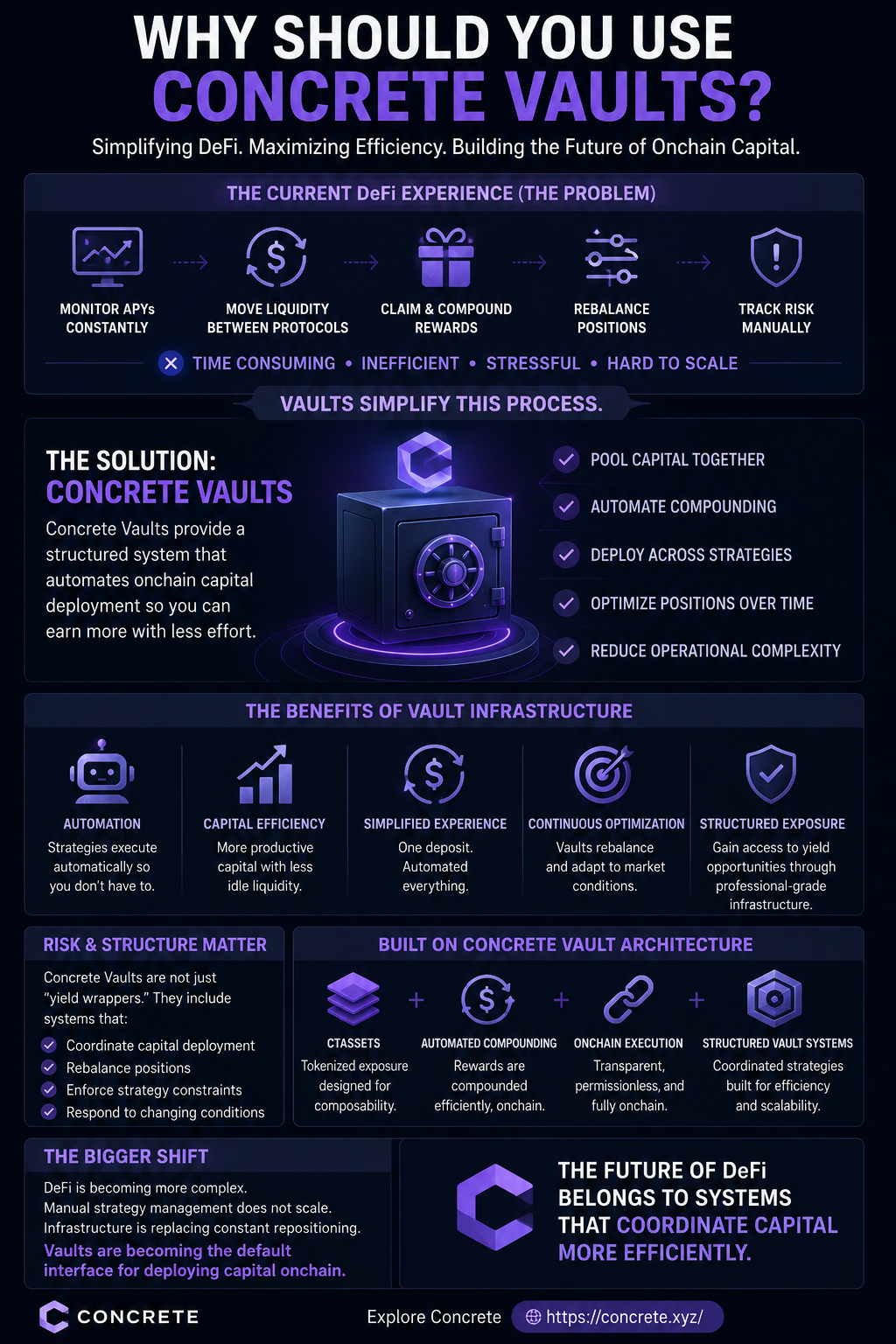
The current DeFi “user experience” is basically a full time job disguised as an investment strategy. If you want to stay competitive, the playbook is exhausting: you’re constantly monitoring APY decay across five tabs, manually bridging liquidity, claiming rewards, and rebalancing positions to avoid being rekt by volatility.
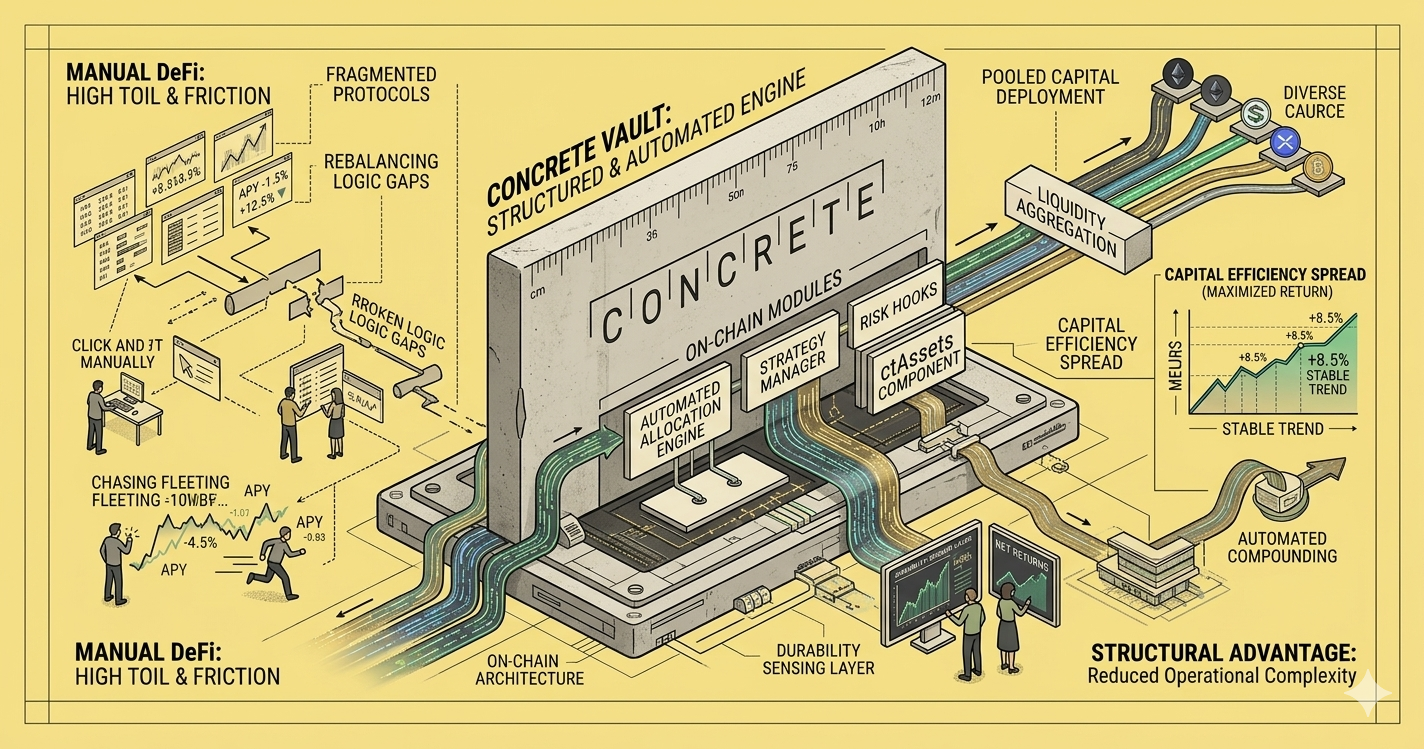
It’s a high-friction, low-efficiency workflow. In any other tech stack, we’d call this “manual toil” and automate it immediately. That’s exactly what a Concrete Vault does it refactors the DeFi experience from a series of manual clicks into a structured, automated system.
1. The Friction of “Phase 1” DeFi
Most users today act as their own manual routers. They track risk on spreadsheets and move capital by hand. This creates two major problems:
- Human Lag: You can’t react to a market spike as fast as a smart contract can.
- Operational Inefficiency: Gas costs and slippage from constant manual repositioning eat into your net returns, often turning a “high yield” play into a break-even one.
2. What a Concrete Vault Actually Does
Instead of you being the person sitting at the terminal 24/7, a Concrete Vault acts as your on-chain execution layer. It allows users to:
- Pool Capital: Combining resources to access strategies that might be gas-prohibitive for individuals.
- Automate Compounding: Programmatic reinvestment of rewards to maximize the power of the math.
- Continuous Deployment: Your capital is never sitting idle in a “zombie” pool; it’s always routed to active, productive strategies.
3. The Benefits: Efficiency over Effort
The goal of vault infrastructure isn’t just to make things “easier” — it’s to make them more consistent.
- Capital Efficiency: By automating the rebalancing process, Concrete ensures your money is always working where the risk-adjusted return is highest.
- Reduced Idle Capital: No more “lazy” money sitting in outdated pools because you were too busy to move it.
- Structured Exposure: You get the benefits of complex DeFi strategies without the technical debt of managing them yourself.
4. More Than a Wrapper: Risk & Structure
A Concrete Vault isn’t just a “yield wrapper.” It’s an architecture designed for resilience. These vaults include internal systems that:
- Coordinate capital deployment across a wide strategy universe.
- Enforce strict strategy constraints to prevent “mission creep.”
- Respond to changing market conditions with deterministic precision.
5. Under the Hood: Concrete Vault Architecture
The efficiency of these vaults comes down to how they are built. By utilizing ctAssets, Concrete creates a liquid representation of your vault position, allowing you to maintain flexibility while your capital stays deployed.
The combination of on-chain execution and structured vault systems means the protocol can coordinate capital across the entire DeFi ecosystem far more effectively than any manual user clicking through a UI could ever hope to.
6. The Verdict: Systems > Scripts
As DeFi becomes more complex, manual strategy management simply won’t scale. We are reaching the limit of what a human with a browser extension can do. Infrastructure is replacing constant repositioning, and vaults are becoming the default interface for institutional-grade DeFi.
The future of on-chain capital doesn’t belong to the users spending all day in Discord chats and dashboard tabs. It belongs to the systems built to coordinate that capital with maximum efficiency.
Stop clicking. Start deploying.
Explore the future of structured DeFi at: https://concrete.xyz/