Why Should You Use a Concrete Vault?
--
Concrete didn’t appear because DeFi lacked yield.
It appeared because DeFi became too exhausting to manage manually.
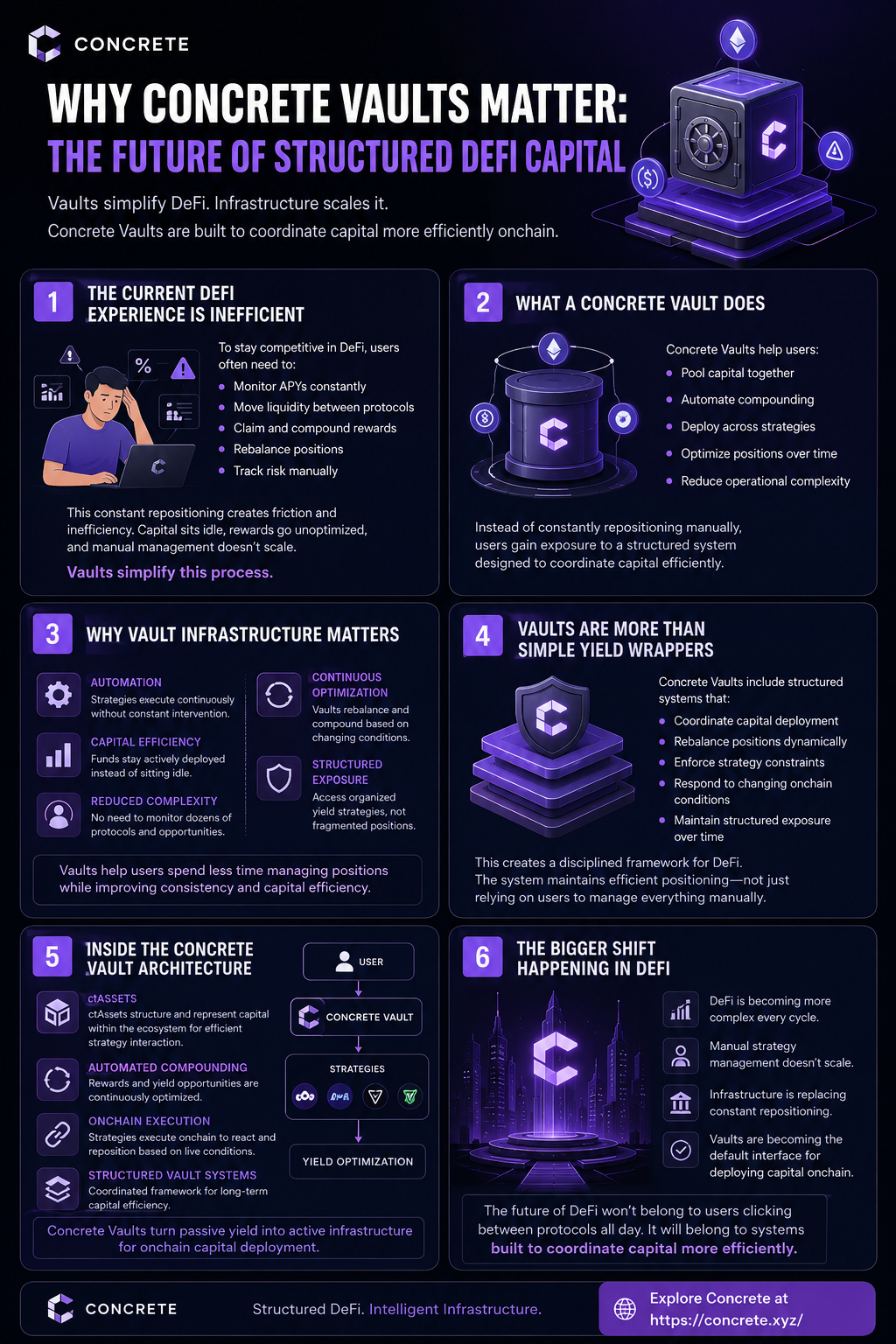
Today, most users who want to stay competitive onchain end up doing the same thing every week:
checking APYs, moving liquidity, chasing incentives, compounding rewards, rebalancing positions, and constantly trying to optimize.
At first, it feels manageable.
But over time, DeFi turns into a second job.
The problem isn’t access to opportunities anymore.
The problem is operational friction.
There are too many protocols, too many moving parts, and too many decisions that need constant attention.
That’s where vault infrastructure starts to matter.
Instead of manually repositioning capital every few days, vault systems are designed to coordinate those processes automatically.
And that’s exactly what Concrete Vaults are built for.
Concrete Vaults simplify onchain capital deployment by turning fragmented DeFi strategies into structured systems.
Rather than managing everything yourself, users deposit into a vault that handles execution in the background.
Capital can be pooled, deployed across strategies, compounded automatically, and continuously optimized over time.
The experience becomes less about micromanaging positions and more about gaining exposure to a structured framework built for capital efficiency.
That shift matters more than most people realize.
A lot of DeFi capital today still sits idle between decisions.
Users wait to reposition.
Rewards go unclaimed.
Liquidity gets moved too slowly.
Strategies become inefficient simply because humans cannot optimize 24/7.
Vault infrastructure solves that problem.
With automated compounding and structured execution, capital can stay productive without requiring constant user intervention.
That doesn’t just improve convenience.
It improves consistency.
Concrete Vaults are also more than simple “yield wrappers.”
Behind the surface, vault systems coordinate how capital is deployed, when positions are adjusted, and how strategy constraints are maintained as market conditions change.
This creates a more structured approach to participating in DeFi.
Instead of emotionally reacting to every APY fluctuation, users gain exposure to systems designed to execute with discipline.
That structure becomes increasingly important as DeFi grows more complex.
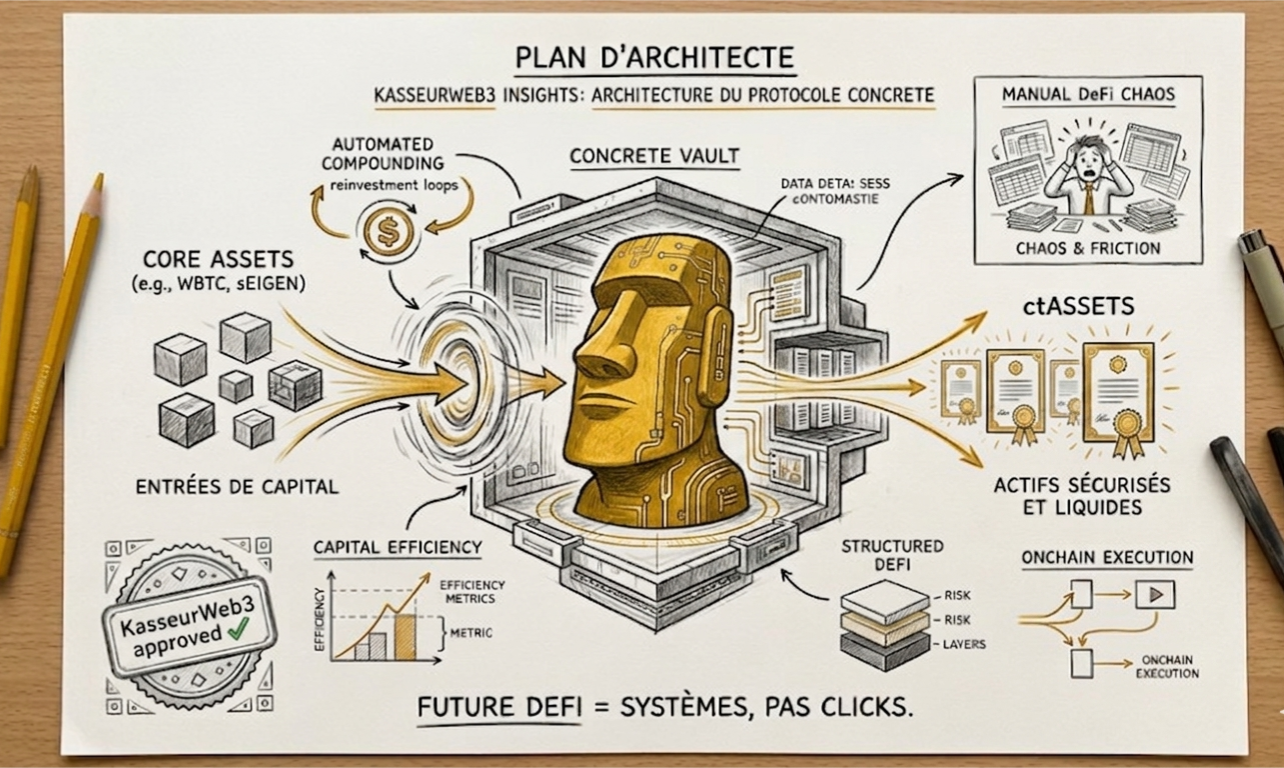
Concrete’s architecture pushes this even further through systems like ctAssets, automated compounding, and structured vault execution.
The goal is not simply to offer another place to park assets.
The goal is to coordinate onchain capital more efficiently across opportunities while reducing operational overhead for users.
That’s the bigger shift happening across DeFi right now.
Manual farming does not scale forever.
As protocols, strategies, and liquidity layers become more complex, infrastructure starts replacing constant repositioning.
The future of structured DeFi may not belong to users jumping between protocols all day trying to chase the next APY spike.
It may belong to systems built to coordinate capital more efficiently in the background.
And that’s the direction Concrete Vaults are moving toward.
Explore Concrete at concrete.xyz