Why Should You Use a Concrete Vault?
--
DeFi was built to give users direct control over capital.
But as the ecosystem evolved, managing positions manually became increasingly difficult.
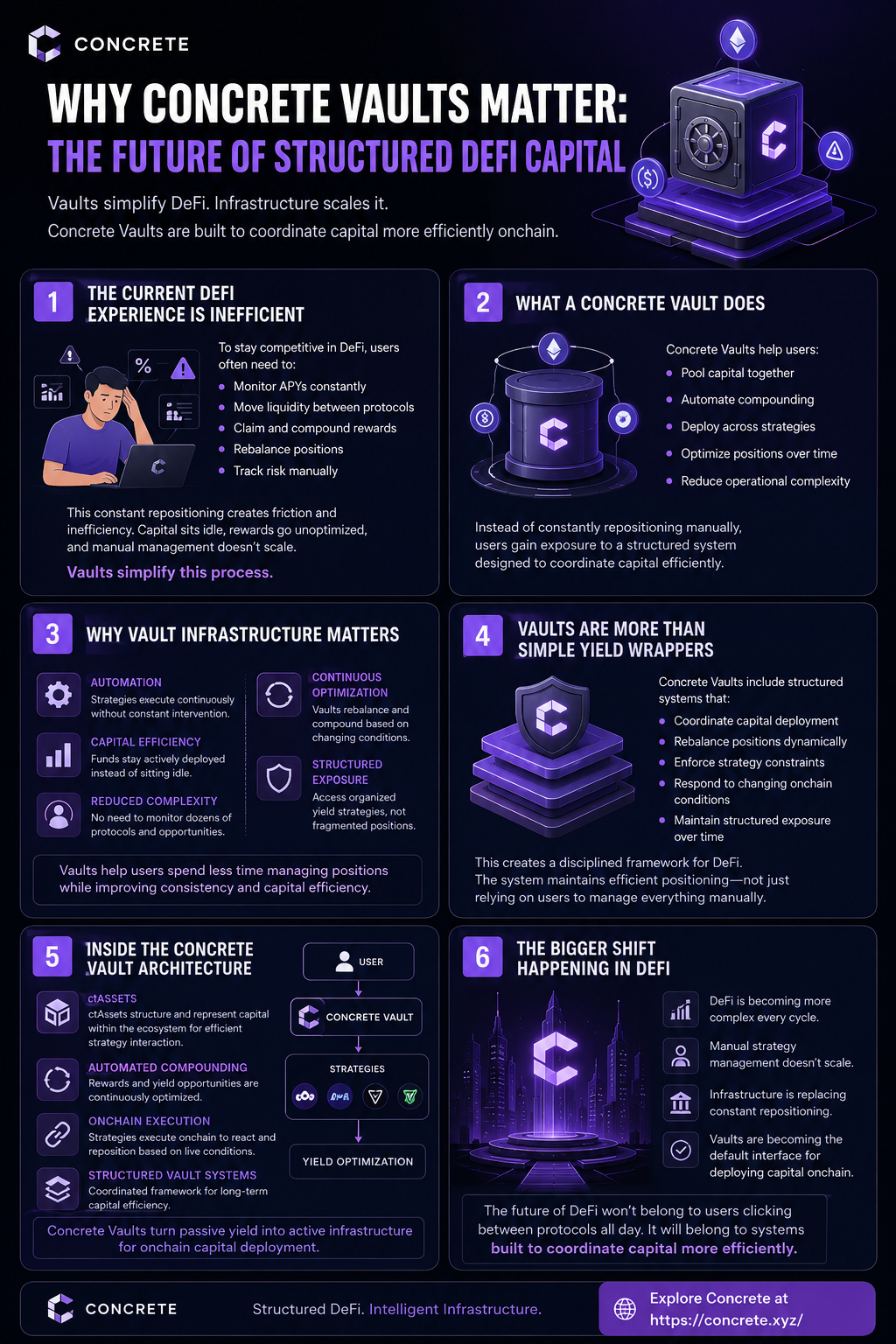
Today, staying competitive onchain often requires users to constantly:
- monitor changing APYs
- move liquidity between protocols
- claim and compound rewards
- rebalance positions
- manage exposure and risk manually
What started as an open financial system has gradually become an environment that demands constant attention.
For many users, this creates a major problem:
The opportunity cost of manual management.
Missing a rebalance window, leaving rewards idle, or failing to reposition liquidity efficiently can significantly reduce overall performance. As DeFi grows more complex, active management becomes harder to sustain for both retail and institutional participants.
This is exactly where DeFi vaults become important.
Instead of forcing users to manually optimize every position themselves, vault infrastructure creates systems that coordinate capital more efficiently.
And that is the core purpose behind Concrete Vaults.
What Are Concrete Vaults?
Concrete Vaults are structured DeFi systems designed to automate and optimize onchain capital deployment.
Rather than manually repositioning funds across opportunities, users deposit capital into a vault structure that manages strategy execution on their behalf.
These vaults help users:
- pool capital together
- automate compounding
- deploy liquidity across strategies
- optimize positions continuously
- reduce operational complexity
Instead of spending hours tracking protocols and yields, users gain exposure to an infrastructure layer specifically built for capital efficiency.
This changes the user experience completely.
The focus shifts from constantly managing positions to participating in a structured system engineered for optimization.
Why Vault Infrastructure Matters
As DeFi matures, infrastructure becomes more important than individual transactions.
The market is no longer just about accessing yield.
It is about coordinating capital efficiently.
This is where vault architecture creates a major advantage.
1. Automation
One of the biggest inefficiencies in DeFi is manual execution.
Users frequently need to:
- claim rewards
- redeploy liquidity
- adjust positions
- rebalance exposure
Concrete Vaults automate much of this process through structured execution systems and automated compounding.
This reduces friction while improving consistency over time.
2. Capital Efficiency
Idle capital is one of the largest hidden inefficiencies in DeFi.
Funds sitting unused between manual reallocations create lost opportunities.
Concrete Vaults are designed to minimize this inefficiency through continuous onchain capital deployment strategies.
Instead of static positioning, vault systems help capital remain active and optimized.
This is especially important as institutional DeFi participation increases and markets demand more efficient liquidity coordination.
3. Simplified User Experience
Most users do not want to spend every day rotating between protocols and monitoring yield fluctuations.
Vault infrastructure abstracts much of this complexity away.
Users gain structured exposure to opportunities without needing to manually execute every strategy adjustment themselves.
This lowers operational overhead while making structured DeFi more accessible.
Concrete Vaults Are More Than Yield Wrappers
A common misconception is that vaults simply aggregate yield.
But advanced vault systems do much more than that.
Concrete Vaults are designed with infrastructure that helps:
- coordinate capital deployment
- rebalance positions dynamically
- enforce strategic parameters
- respond to changing market conditions
- maintain structured execution logic
This creates a far more organized approach to participating in DeFi.
Rather than reactive capital management, users gain exposure to systems engineered around structured execution and optimization.
That distinction matters.
As DeFi scales, infrastructure quality becomes increasingly important.
The Role of ctAssets & Structured Vault Systems
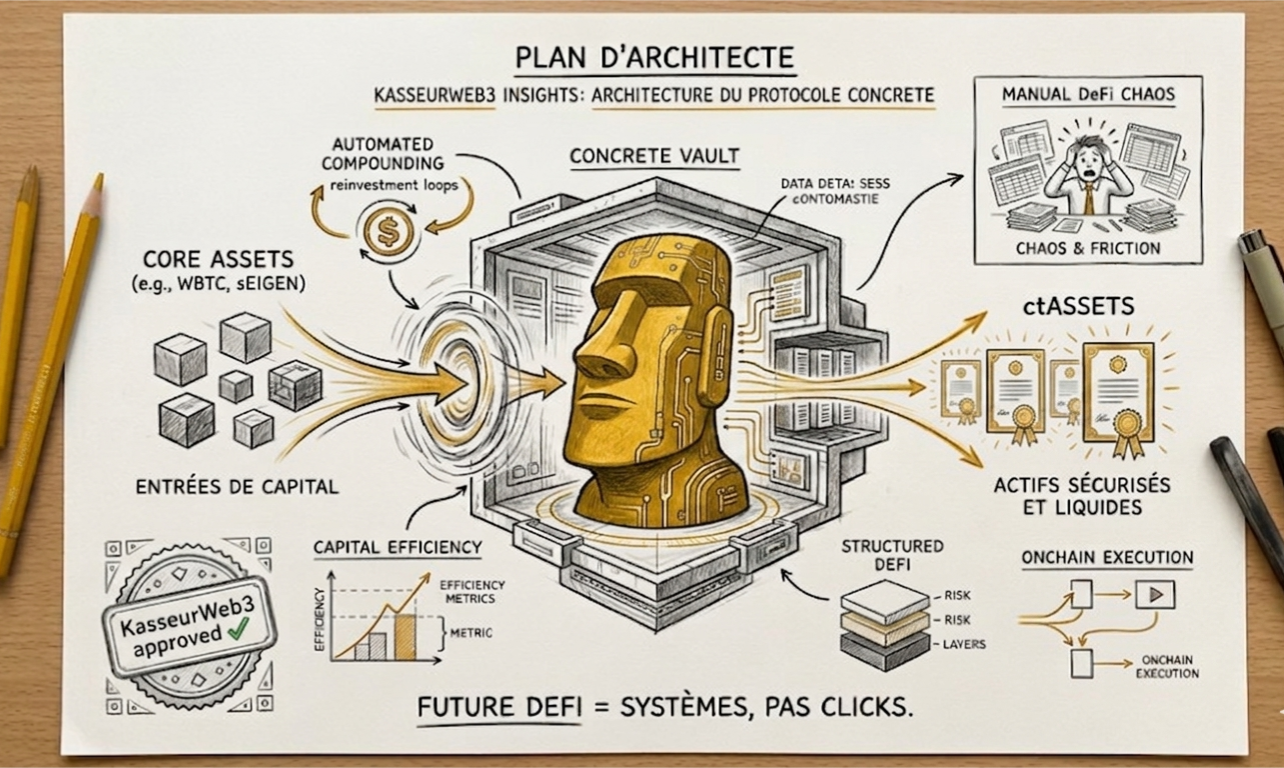
At the center of the Concrete ecosystem are ctAssets and structured vault architecture designed for efficient onchain coordination.
Concrete Vaults leverage:
- ctAssets
- automated compounding systems
- structured DeFi execution
- optimized onchain capital deployment
to create a more efficient framework for capital management.
Instead of isolated liquidity positions scattered across multiple protocols, vault infrastructure enables coordinated strategy execution through unified systems.
This creates several advantages:
- improved capital efficiency
- reduced operational friction
- continuous optimization
- scalable strategy management
- more efficient exposure to yield opportunities
As markets evolve, systems capable of dynamically coordinating liquidity will likely outperform fragmented manual positioning.
That is the broader thesis behind institutional DeFi infrastructure.
The future is moving toward systems that optimize capital at scale.
The Bigger Shift Happening in DeFi
DeFi is becoming increasingly sophisticated.
Strategies are becoming more complex.
Execution requirements are increasing.
And manual management does not scale efficiently anymore.
The industry is gradually shifting from:
manual repositioning → infrastructure-driven coordination
This is why DeFi vaults are becoming one of the most important layers in onchain finance.
The future of DeFi may not belong to users endlessly clicking between protocols trying to chase yield manually.
It may belong to the systems designed to coordinate capital more efficiently through automation, structure, and intelligent execution.
Concrete Vaults represent that transition.
A shift toward structured DeFi infrastructure built for scalable onchain capital deployment.
Explore Concrete at Concrete