Why Should You Use a Concrete Vault?
--
DeFi has opened the door to global, permissionless finance — but participating efficiently is becoming increasingly complex.
Today, staying competitive onchain often requires users to constantly monitor markets, chase the best APYs, move liquidity between protocols, claim and compound rewards, rebalance positions, and manually manage risk exposure.
For many participants, DeFi no longer feels passive.
It feels operational.
As protocols multiply and strategies become more sophisticated, manual portfolio management creates friction, inefficiency, and wasted time. Users can spend hours repositioning capital just to maintain competitive yield exposure.
This is exactly the problem DeFi vaults were designed to solve.
The Role of DeFi Vaults
At their core, vaults simplify onchain capital management.
Instead of every user manually executing strategies themselves, vault infrastructure coordinates capital deployment through structured systems designed to optimize positions over time.
Concrete Vaults help users:
- pool capital together
- automate compounding
- deploy across strategies
- optimize allocations dynamically
- reduce operational complexity
Rather than constantly clicking between protocols and repositioning liquidity manually, users gain exposure to a more structured approach to DeFi participation.
This transforms DeFi from an active management challenge into a more scalable system for onchain capital deployment.
Why Vault Infrastructure Matters
As DeFi evolves, infrastructure becomes increasingly important.
The reality is simple: manual strategy management does not scale efficiently.
Vault systems help solve several major problems across DeFi:
Automation
Users no longer need to manually harvest rewards, compound yields, or rebalance positions constantly.
Automated compounding allows capital to remain productive without requiring continuous oversight.
Capital Efficiency
Idle capital is one of the largest inefficiencies in DeFi.
Structured vault systems are designed to keep assets deployed more efficiently across yield opportunities while minimizing unnecessary fragmentation.
Simpler User Experience
Instead of navigating multiple protocols independently, users can access curated exposure through a single system.
This reduces complexity while improving accessibility for both retail and institutional DeFi participants.
Continuous Optimization
Markets evolve quickly.
Vault infrastructure enables strategies to adapt over time, helping users maintain more consistent exposure without manually reacting to every market shift.
Ultimately, vaults allow users to spend less time managing positions while improving operational consistency.
More Than Just a Yield Wrapper
Concrete Vaults are not simply passive yield containers.
They are structured systems designed to coordinate capital intelligently.
This includes mechanisms that help:
- rebalance positions
- enforce strategic constraints
- optimize deployment
- respond to changing market conditions
- manage liquidity allocation more efficiently
This structured approach is increasingly important as DeFi grows more fragmented and sophisticated.
Instead of relying entirely on manual execution, users gain access to infrastructure built specifically for scalable capital coordination.
How Concrete Vault Architecture Works
Concrete Vaults are designed around efficient onchain capital deployment.
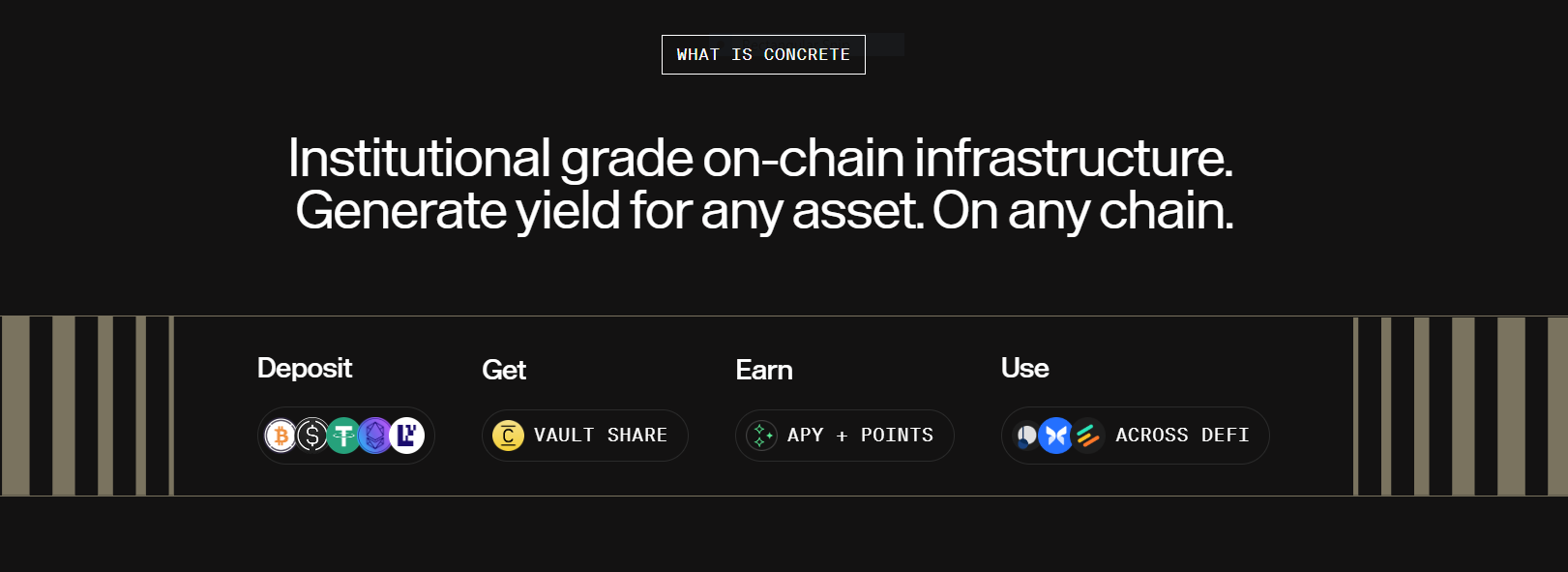
Through systems like ctAssets, automated compounding, and structured vault architecture, Concrete creates infrastructure that helps coordinate liquidity across opportunities more effectively.
Rather than treating yield generation as isolated positions spread across protocols, Concrete Vaults approach DeFi as an integrated system.
This allows capital to move more efficiently while reducing the operational burden placed on individual users.
Key components of the architecture include:
- ctAssets that represent structured onchain exposure
- automated compounding systems that continuously optimize yield
- onchain execution that removes unnecessary manual management
- structured vault systems designed for scalable capital coordination
The result is a more efficient framework for participating in structured DeFi.
As institutional DeFi adoption expands, infrastructure capable of coordinating capital efficiently will likely become increasingly important.
The Bigger Shift Happening in DeFi
DeFi is entering a new phase.
Early onchain participation often rewarded users who spent all day moving between protocols manually. But as the ecosystem matures, complexity continues increasing.
And complexity creates demand for infrastructure.
The future of DeFi may not belong to users constantly repositioning liquidity by hand.
It may belong to systems designed to coordinate capital more efficiently at scale.
This is where Concrete Vaults fit into the broader evolution of DeFi infrastructure — helping transform fragmented manual strategies into more structured, automated systems for capital deployment.
Explore Concrete at https://concrete.xyz/