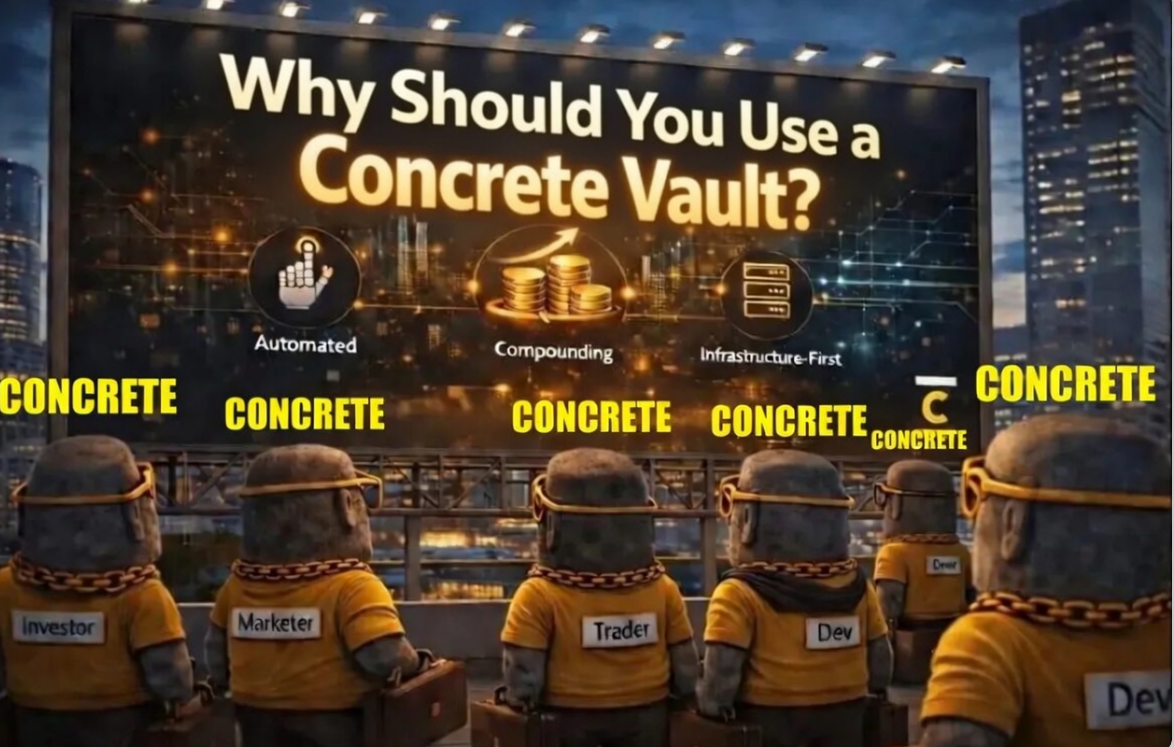
Why Should You Use a Concrete Vault?
 KuaPa - Concrete4 min read·Just now
--
Why Concrete Vaults Represent the Next Evolution of DeFi Infrastructure
DeFi opened the door to permissionless finance, but participating efficiently in today’s onchain markets has become increasingly complex.
For most users, staying competitive means constantly monitoring APYs, moving liquidity between protocols, claiming rewards, compounding yield manually, and rebalancing positions as market conditions change. What once felt innovative now often feels operationally exhausting.
The modern DeFi experience can quickly become a full-time job.
Users are expected to optimize across multiple protocols simultaneously while also managing smart contract risk, liquidity fragmentation, and changing incentives. Even experienced participants struggle to maintain efficiency over time because opportunities shift rapidly and idle capital quietly reduces overall performance.
This growing complexity reveals an important truth:
The future of DeFi is not just about access to opportunities.
It is about infrastructure that coordinates capital efficiently.
That is where Concrete Vaults enter the picture.
The Problem With Manual DeFi Management
Traditional DeFi participation relies heavily on manual execution.
Users often need to:
- monitor yield opportunities continuously
- migrate liquidity between ecosystems
- claim and reinvest rewards
- adjust exposure during volatility
- rebalance positions to maintain efficiency
- track multiple risk variables manually
While this approach may work for highly active users, it creates enormous friction for everyone else.
Capital becomes fragmented.
Strategies become inconsistent.
And users spend more time managing positions than actually benefiting from them.
As DeFi expands, this model simply does not scale.
Infrastructure must evolve beyond constant manual repositioning.
What Concrete Vaults Actually Do
At their core, Concrete Vaults simplify onchain capital deployment.
Instead of requiring users to actively manage every position themselves, vault infrastructure creates a structured system that coordinates capital automatically.
Concrete Vaults help users:
- pool capital together
- automate compounding
- deploy assets across strategies
- optimize positioning over time
- reduce operational complexity
Rather than chasing opportunities manually, users gain exposure to a coordinated framework designed to improve capital efficiency continuously.
This changes the user experience entirely.
Instead of reacting to DeFi markets every day, participants can rely on systems designed to execute strategies more efficiently onchain.
Why DeFi Vaults Matter
The rise of DeFi vaults represents a major shift in how onchain finance operates.
Vault infrastructure solves several important problems simultaneously.
1. Automation
Manual compounding is inefficient.
Rewards often sit idle until users claim and redeploy them manually. Over time, this reduces overall performance and creates unnecessary friction.
Concrete Vaults use automated compounding systems to keep capital active more consistently, allowing strategies to evolve without requiring constant user intervention.
2. Capital Efficiency
One of the biggest inefficiencies in DeFi is idle capital.
Assets frequently remain underutilized because users cannot monitor markets 24/7 or reposition quickly enough when opportunities shift.
Vault systems improve capital efficiency by coordinating deployment dynamically instead of leaving optimization entirely to individuals.
This is especially important as onchain markets become increasingly fragmented across protocols and ecosystems.
3. Simpler User Experience
Structured DeFi should reduce complexity, not increase it.
Vaults abstract away many of the operational tasks that make DeFi difficult for average users:
- manual claiming
- repetitive compounding
- strategy rotation
- liquidity management
- ongoing rebalancing
This allows users to participate in sophisticated strategies without needing to manage every layer themselves.
4. Continuous Optimization
Markets change constantly.
Strategies that perform well one month may become inefficient the next.
Concrete Vaults are designed around continuous optimization rather than static positioning. Instead of remaining fixed, vault systems can adapt capital deployment based on changing opportunities and strategy constraints.
That adaptability becomes increasingly valuable as DeFi matures.
Vaults Are More Than “Yield Wrappers”
Many people initially view vaults as simple yield aggregation tools.
But modern vault infrastructure is much more sophisticated.
Concrete Vaults include systems designed to:
- coordinate onchain capital deployment
- rebalance positions dynamically
- enforce strategy parameters
- manage structured exposure
- respond to changing market conditions
This creates a more disciplined framework for participating in DeFi.
The goal is not simply to maximize yield at all costs.
The goal is to create sustainable and structured systems that improve how capital moves across decentralized markets.
That distinction matters.
As institutional DeFi grows, infrastructure quality becomes just as important as raw yield generation.
The Role of ctAssets & Structured Vault Architecture
Concrete Vaults are built around a broader architecture designed to improve how capital operates onchain.
A key component of this system is ctAssets.
ctAssets help structure exposure within the Concrete ecosystem while enabling more efficient coordination between vault strategies and underlying capital deployment.
Combined with automated compounding and onchain execution, this creates a vault system capable of operating continuously without requiring users to micromanage every position manually.
The result is a more scalable model for structured DeFi.
Instead of isolated users independently chasing yield across fragmented ecosystems, Concrete Vaults coordinate liquidity through infrastructure designed for efficiency.
This is a major evolution in how DeFi capital can function.
Especially as institutional DeFi adoption accelerates, systems capable of structured execution, automated optimization, and coordinated capital deployment will likely become increasingly important.
The Bigger Shift Happening Across DeFi
DeFi is evolving rapidly.
But complexity is growing alongside opportunity.
Manual strategy management does not scale efficiently in an environment where markets move continuously and capital must remain adaptive at all times.
Infrastructure is becoming the new competitive advantage.
The future may not belong to users clicking between protocols all day trying to optimize every basis point manually.
It may belong to systems designed to coordinate capital more intelligently.
Concrete Vaults represent this transition toward automated, structured, and efficient onchain finance.
As DeFi matures, vault infrastructure may become the default interface for deploying capital across decentralized markets.
Because ultimately, the next phase of DeFi is not just about accessing yield.
It is about building systems that make capital work smarter.
Explore Concrete at Concrete