Why Should You Use a Concrete Vault?
--
DeFi unlocked a new financial system, but participating efficiently still remains difficult for most users.
Today, staying competitive onchain often means constantly monitoring yield opportunities, shifting liquidity between protocols, claiming rewards, compounding positions manually, and adjusting exposure based on market conditions. What sounds efficient in theory quickly becomes operationally exhausting in practice.
Most users eventually face the same problem:
DeFi rewards active capital management, but manual management does not scale.
This is where Concrete Vaults change the experience.
The Problem With Manual DeFi Management
The average DeFi user today spends more time managing positions than actually benefiting from them.
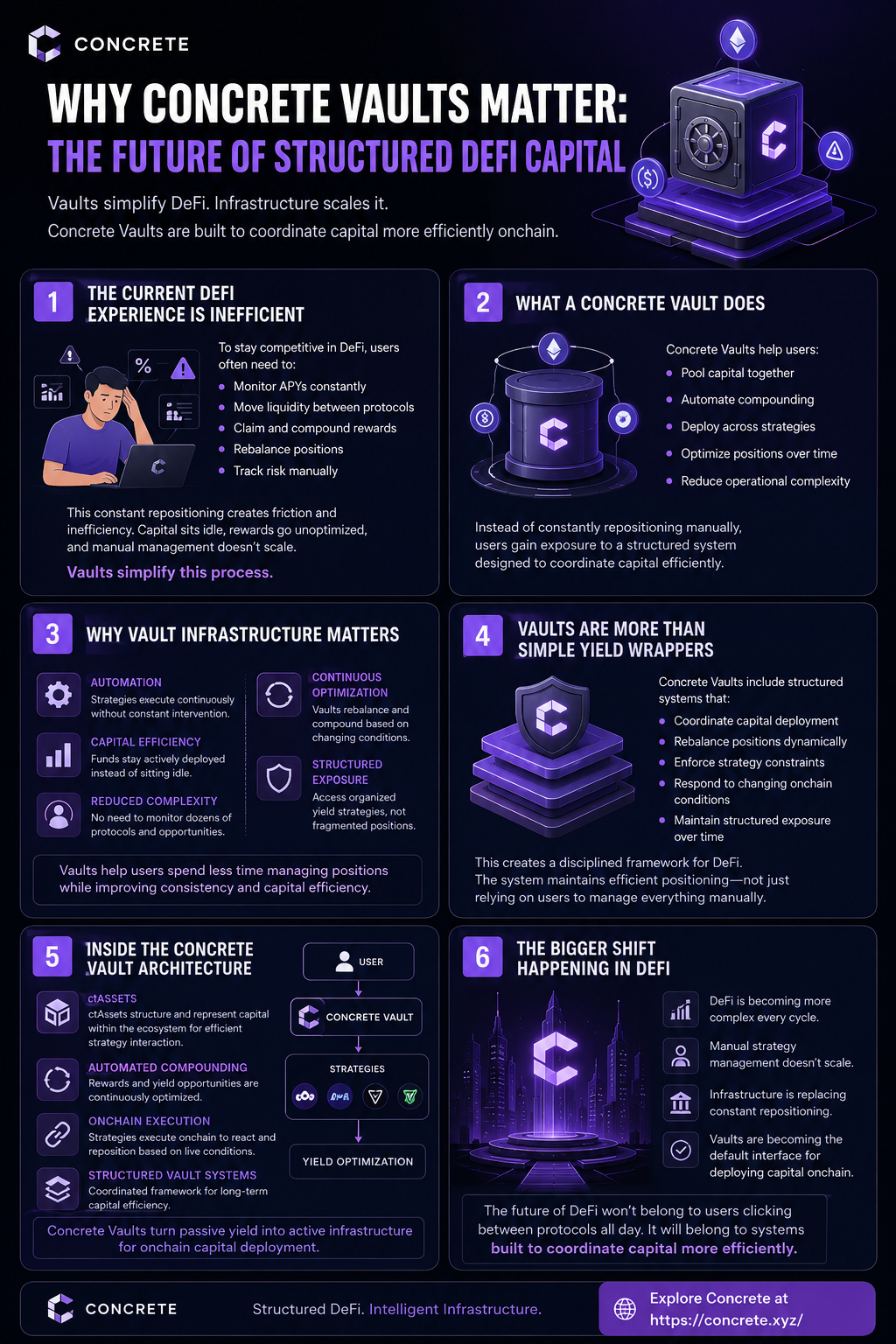
To maintain strong returns, users often need to:
- monitor APYs across multiple protocols
- move liquidity continuously
- rebalance positions manually
- claim and compound rewards
- track changing risks across markets
This creates friction, inefficiency, and large amounts of idle capital.
Opportunities move quickly onchain, but manual execution is slow. Users either spend hours optimizing positions or accept lower efficiency.
As DeFi becomes more complex, this approach becomes increasingly unsustainable.
That is why DeFi vaults are becoming a core layer of modern onchain infrastructure.
What Are Concrete Vaults?
At their core, Concrete Vaults are structured systems designed to automate capital deployment and strategy execution.
Instead of users constantly repositioning funds manually, vaults coordinate capital on their behalf.
Concrete Vaults help users:
- pool capital together
- automate compounding
- deploy assets across strategies
- optimize positions over time
- reduce operational complexity
This creates a more streamlined way to participate in DeFi without needing to micromanage every position manually.
Users gain exposure to structured onchain strategies while the vault infrastructure handles optimization behind the scenes.
Why Vault Infrastructure Matters
Vault infrastructure is not just about convenience.
It is about improving capital efficiency across DeFi.
One of the largest inefficiencies in decentralized finance is idle capital. Funds often sit underutilized because users cannot continuously rebalance or optimize positions fast enough.
Structured vault systems solve this by introducing:
- automated compounding
- continuous optimization
- coordinated onchain capital deployment
- simplified portfolio management
- more consistent strategy execution
Instead of reacting manually to every market change, vault systems are designed to maintain efficient exposure automatically.
This creates a significantly better user experience while also improving how capital moves throughout the ecosystem.
In many ways, vault infrastructure acts as the operational layer that makes scalable DeFi participation possible.
Concrete Vaults Are Built With Structure in Mind
Many people think vaults are simply “yield wrappers.”
But Concrete Vaults are designed as structured systems for managing onchain capital more intelligently.
The architecture includes mechanisms designed to:
- coordinate capital deployment
- rebalance positions dynamically
- enforce strategy constraints
- adapt to changing market conditions
- optimize execution efficiency
This creates a more disciplined and scalable framework for participating in DeFi.
Instead of relying on emotional decision-making or constant manual intervention, users interact with systems designed for structured execution.
That shift matters as DeFi matures toward more professional and institutional DeFi infrastructure.
The Role of ctAssets and Automated Execution
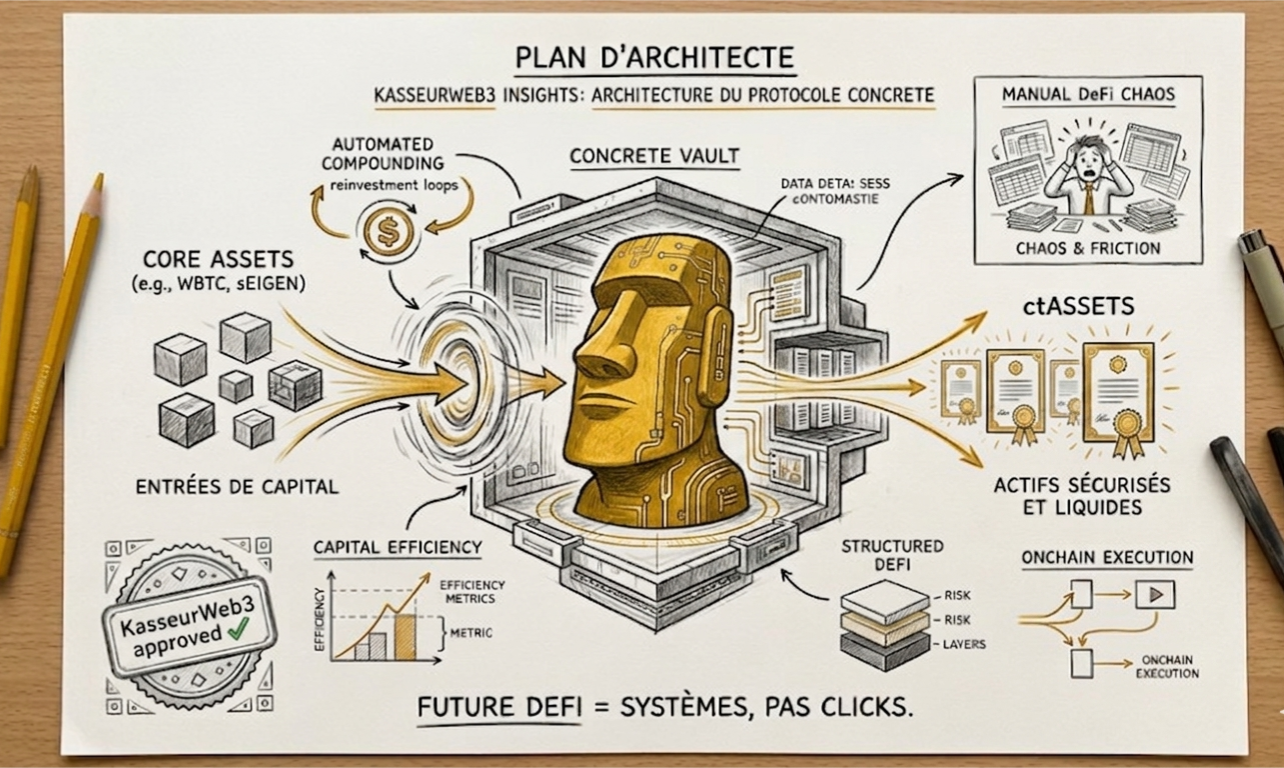
A major component of the Concrete ecosystem is the integration of ctAssets and automated onchain execution.
Concrete Vaults are designed to coordinate assets efficiently across multiple opportunities while maintaining structured deployment logic.
Combined with automated compounding, this allows vault infrastructure to continuously optimize capital usage without requiring constant user input.
The result is a more scalable model for onchain participation:
- capital stays productive
- strategies remain adaptive
- operational burden decreases
- users gain structured exposure to yield opportunities
This is the evolution from manual DeFi interaction toward intelligent infrastructure-driven participation.
The Bigger Shift Happening in DeFi
DeFi is evolving rapidly.
As protocols become more sophisticated, manual strategy management becomes increasingly inefficient.
The future is shifting toward systems that coordinate capital automatically rather than users manually clicking between protocols all day.
This is why structured DeFi infrastructure matters.
Vaults are becoming the default interface for deploying capital onchain because they solve a core scalability problem:
Humans cannot optimize markets continuously, but infrastructure can.
The next phase of DeFi will likely belong to platforms capable of coordinating liquidity, optimizing execution, and improving capital efficiency at scale.
And that is exactly where Concrete Vaults are positioning themselves.
Explore Concrete at Concrete.xyz