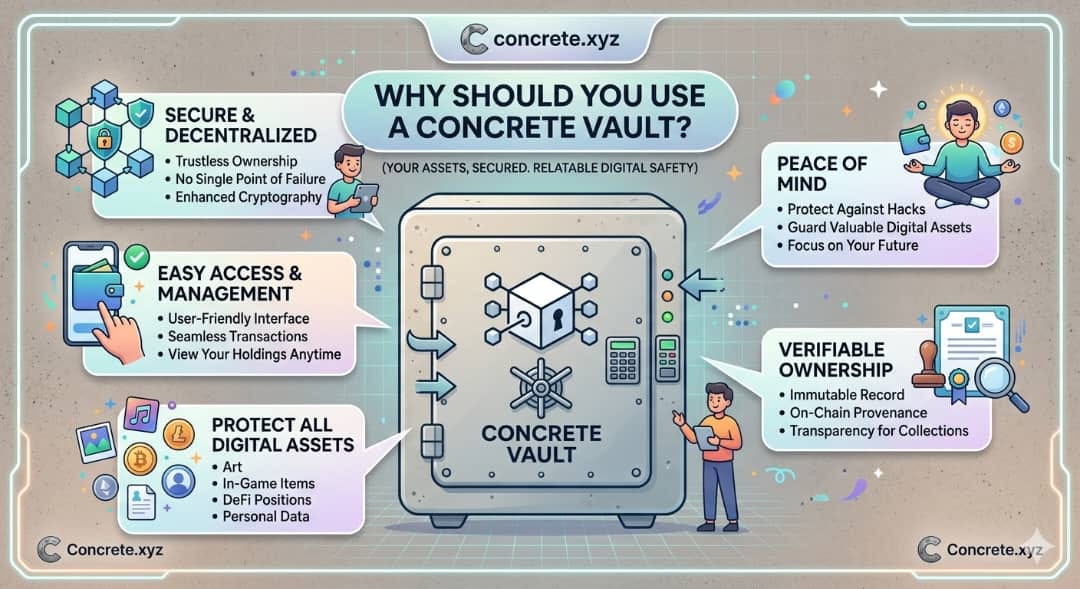
Why Should You Use a Concrete Vault?
--
DeFi promised an open financial system where anyone could deploy capital, earn yield, and access sophisticated strategies without intermediaries. In practice, however, participating effectively in DeFi often feels like a full-time job.
To stay competitive, users are expected to constantly monitor opportunities across protocols, react to changing market conditions, and reposition capital faster than everyone else. What began as “permissionless finance” has gradually evolved into an environment where efficiency depends on execution speed, strategy management, and nonstop optimization.
This is exactly where vault infrastructure becomes important.
Concrete Vaults are designed to reduce the operational burden of DeFi while improving how capital is deployed onchain. Instead of manually managing every position, users gain exposure to a structured system built to coordinate capital more efficiently.
The Current DeFi Experience Is Highly Fragmented
Most DeFi users eventually run into the same problem: managing capital manually becomes exhausting.
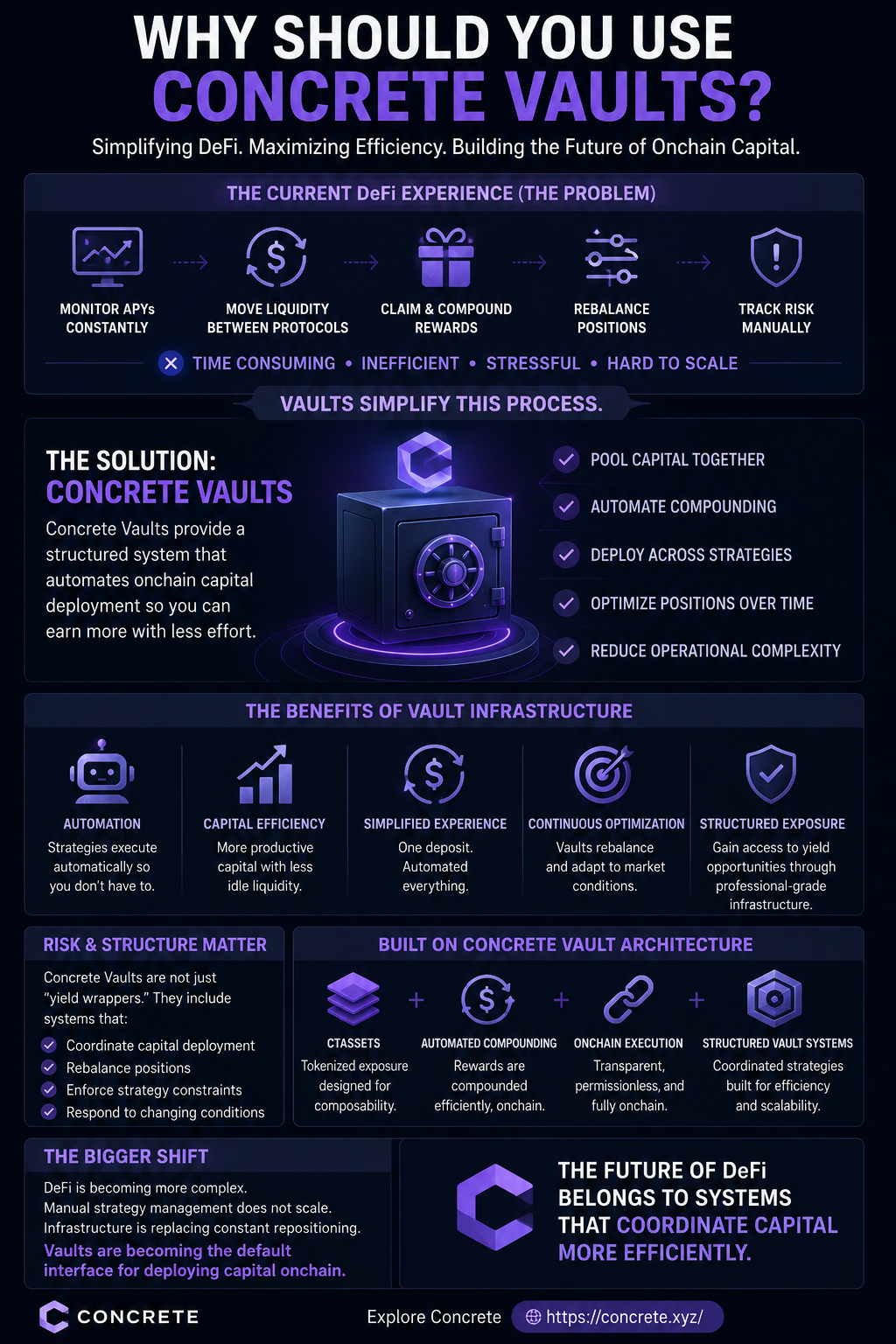
To maintain competitive yields, users often need to:
· monitor APYs across multiple protocols
· move liquidity frequently
· claim and compound rewards manually
· rebalance positions as markets shift
· manage risk exposure themselves
· track gas costs and execution timing
At first, this process can feel manageable. But as DeFi grows more complex, the amount of attention required increases dramatically.
One week, liquidity incentives change. The next week, a strategy becomes less efficient. Then a new protocol launches with higher yields, forcing users to decide whether migrating capital is worth the risk and transaction costs.
The result is friction.
Instead of focusing on long-term capital growth, users spend time constantly repositioning assets and reacting to changing conditions. Large portions of capital often remain idle simply because managing positions efficiently requires too much manual effort.
This is the core problem vaults are designed to solve.
Vaults transform DeFi from an active management experience into a coordinated infrastructure layer.
What Does a Concrete Vault Actually Do?
At a basic level, a Concrete Vault helps users deploy capital through an automated and structured system rather than through constant manual interaction.
Instead of every individual user independently managing strategies, vault infrastructure coordinates capital collectively.
Concrete Vaults help users:
· pool capital together
· automate compounding
· deploy across yield strategies
· optimize positions continuously
· reduce operational complexity
This changes the user experience entirely.
Rather than monitoring dozens of opportunities and manually shifting liquidity between protocols, users deposit into a vault architecture designed to manage these processes onchain.
The vault becomes the execution layer.
Strategies can be adjusted systematically, rewards can be compounded automatically, and capital can be repositioned according to predefined frameworks without requiring users to constantly intervene.
The goal is not simply convenience.
The goal is improving how efficiently capital moves through DeFi systems.
Why Vault Infrastructure Matters
As DeFi matures, infrastructure matters more than individual trades.
Early DeFi users could outperform simply by being active. Today, efficiency increasingly depends on structured systems capable of optimizing capital continuously.
Vault infrastructure introduces several major advantages.
Automation
One of the biggest inefficiencies in DeFi is the amount of manual execution required.
Compounding rewards, reallocating liquidity, and adjusting positions all take time and attention. Many users either fail to optimize consistently or miss opportunities entirely because execution becomes overwhelming.
Vaults automate much of this process.
Instead of relying on constant manual actions, the system can handle repetitive optimization tasks onchain.
Capital Efficiency
Idle capital is one of the largest hidden costs in DeFi.
When users hesitate to reposition assets because of complexity, gas fees, or uncertainty, capital becomes underutilized.
Vault systems are designed to keep assets working more consistently by coordinating deployment strategies more effectively.
This improves overall capital efficiency across the system.
Simplified User Experience
DeFi often suffers from fragmented interfaces and strategy overload.
Users may need to interact with multiple protocols simultaneously just to maintain a single strategy. This creates confusion and increases operational risk.
Vaults simplify this experience by providing structured exposure through a single coordinated framework.
Instead of managing every layer manually, users interact with infrastructure designed to abstract complexity.
Continuous Optimization
Markets move constantly.
Yields fluctuate. Liquidity conditions shift. Incentives change.
Manual strategies struggle to adapt consistently because humans cannot monitor every opportunity at all times.
Vault infrastructure introduces systems capable of continuously evaluating and responding to changing conditions.
This creates more consistent strategy execution over time.
Vaults Are More Than Simple Yield Wrappers
There is a misconception that vaults are simply containers that auto-compound rewards.
In reality, modern vault systems are much more sophisticated.
Concrete Vaults are designed with structured mechanisms that coordinate how capital is deployed, adjusted, and managed across changing environments.
This includes systems that can:
· rebalance positions
· enforce strategic constraints
· optimize allocations
· coordinate liquidity deployment
· react to evolving market conditions
The difference is important.
A basic yield wrapper only automates a small task.
Vault infrastructure creates a coordinated framework for managing onchain capital at scale.
This structured approach reduces the burden placed on individual users while improving how strategies operate collectively.
Instead of every participant independently making decisions in isolation, the vault architecture introduces systematic coordination.
How Concrete Vaults Coordinate Capital Efficiently
Concrete Vaults are designed around the idea that onchain capital should move through structured systems rather than fragmented manual execution.
This is where the architecture becomes especially important.
ctAssets
Concrete Vaults leverage ctAssets as part of their structured system for representing and coordinating vault positions.
Rather than users manually interacting with every underlying strategy layer, ctAssets help create a more streamlined interface for capital deployment and exposure management.
This allows users to participate in optimized strategies while maintaining a more organized framework for tracking and managing positions.
Automated Compounding
Manual compounding is inefficient.
Users often delay claiming rewards because of gas costs, inconvenience, or timing concerns. Over time, this reduces overall yield efficiency.
Concrete Vaults automate this process directly within the vault structure, allowing rewards to be redeployed systematically.
The result is more consistent capital utilization without requiring constant user action.
Onchain Execution
Concrete Vaults operate through onchain execution systems that coordinate strategy implementation transparently.
Rather than relying on users to manually reposition assets every time conditions change, execution can occur directly through the vault architecture itself.
This creates a more responsive and scalable framework for capital deployment.
Structured Vault Systems
The broader advantage of Concrete Vault architecture is structure.
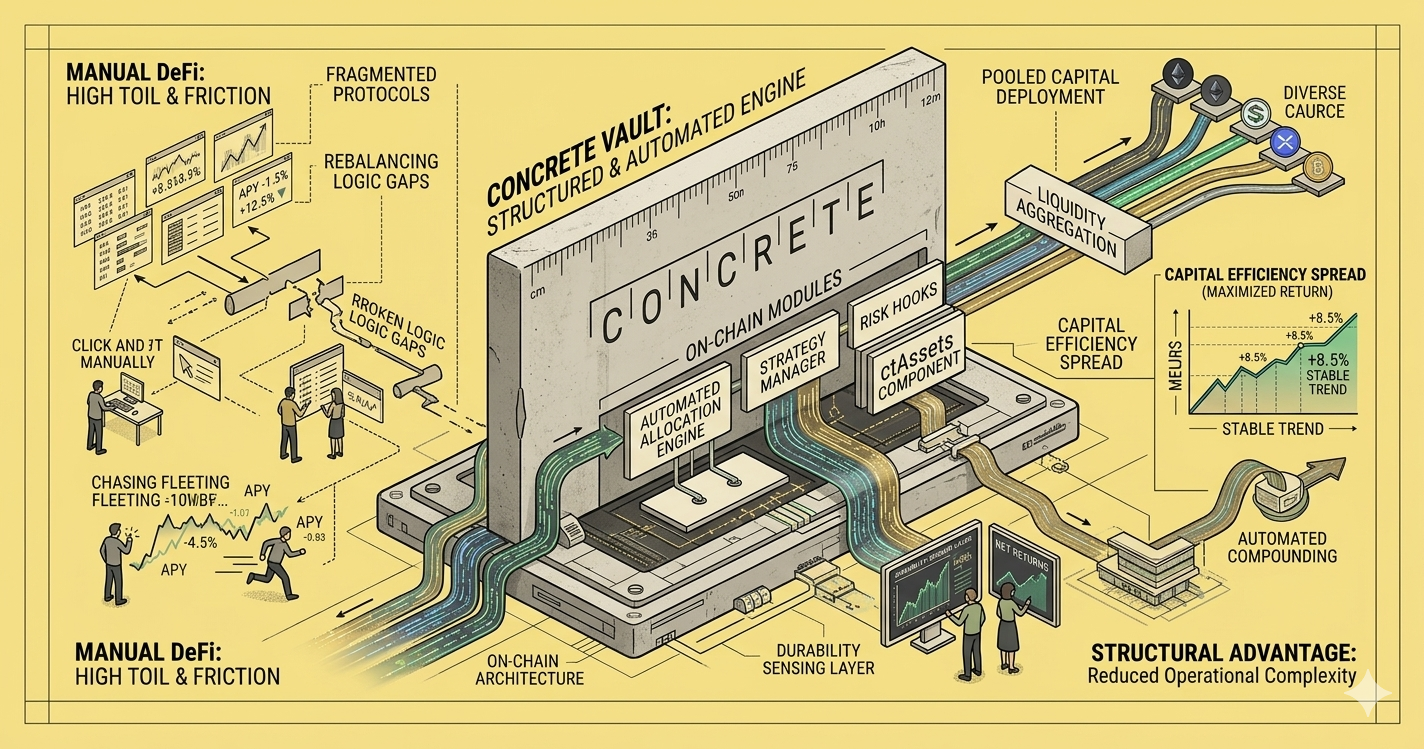
DeFi has historically been fragmented, reactive, and highly manual.
Concrete Vaults introduce systems designed to organize capital deployment through coordinated strategies, automated execution, and continuous optimization mechanisms.
This transforms capital management from a series of isolated user actions into an infrastructure-driven process.
The Bigger Shift Happening in DeFi
DeFi is becoming more sophisticated every year.
Strategies are more complex. Markets move faster. Opportunities fragment across ecosystems and protocols.
In this environment, manual strategy management becomes increasingly difficult to scale.
The future of DeFi may not revolve around users endlessly clicking between protocols, chasing yields, and manually repositioning liquidity.
Instead, the next phase of DeFi is likely to be driven by infrastructure.
Vaults represent that shift.
They reduce operational complexity, improve capital coordination, and create systems capable of managing onchain opportunities more efficiently than isolated manual participation ever could.
Concrete Vaults are part of this evolution.
They are not simply tools for convenience — they are infrastructure designed to improve how capital operates within decentralized finance itself.
As DeFi continues to mature, vault systems may become the default interface for deploying capital onchain.
Not because users want less control.
But because efficient systems outperform fragmented execution over time.
Explore Concrete at https://concrete.xyz/