Why Should You Use a Concrete Vault?
DeFi was supposed to make finance more open and efficient
 Almeraxbt2 min read·Just now
--
But in practice, managing capital onchain has become increasingly complex
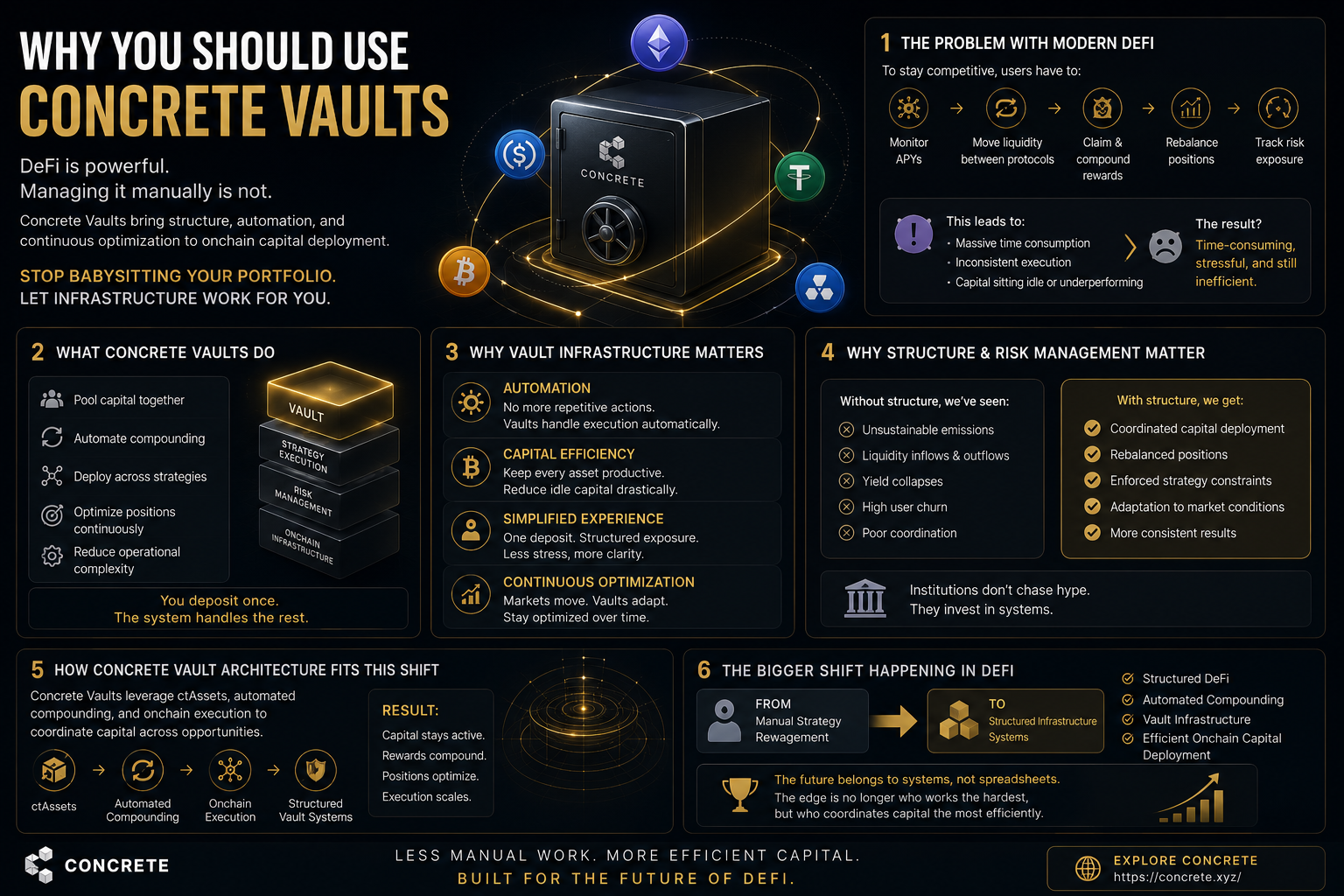
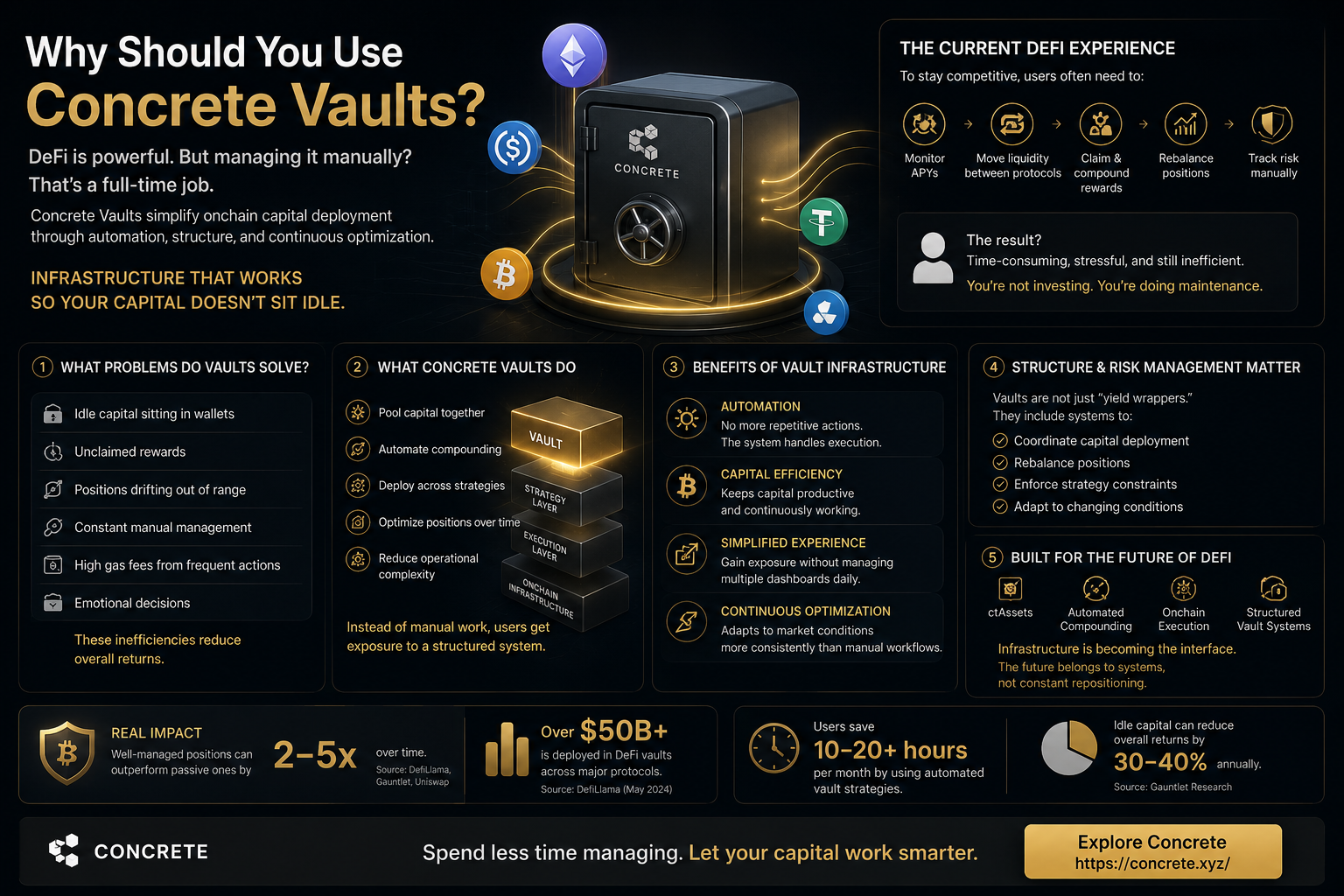
To stay competitive, users often need to:
- monitor APYs constantly
- move liquidity between protocols
- claim and compound rewards
- rebalance positions manually
- track risk across multiple platforms
For most people, this quickly becomes exhausting
And ironically, the more fragmented DeFi becomes, the harder it is to deploy capital efficiently
This is where vault infrastructure becomes important.
Vaults Simplify DeFi Participation
Instead of manually managing every position yourself, vaults coordinate capital through structured systems
Concrete Vaults are designed to help users:
- pool capital together
- automate compounding
- deploy across strategies
- optimize positions continuously
- reduce operational complexity
Rather than clicking between protocols all day, users gain exposure to a system that actively manages capital deployment onchain
This changes the experience entirely,
The goal is not simply convenience,
The goal is capital efficiency.
Why Vault Infrastructure Matters
One of the biggest problems in DeFi is idle capital
Many users leave assets sitting unoptimized because active management requires too much time, attention, and expertise
Vault infrastructure solves this by introducing:
- automated compounding
- continuous optimization
- structured exposure to yield opportunities
- reduced manual repositioning
- simplified strategy management
Instead of reacting manually to every market change, users participate through systems designed to coordinate capital more efficiently
This creates a more scalable model for DeFi participation.
Vaults Are More Than “Yield Wrappers”
A common misconception is that vaults simply automate farming
But modern vault infrastructure is becoming far more sophisticated
Concrete Vaults include systems designed to:
- coordinate capital deployment
- rebalance positions dynamically
- enforce strategy constraints
- respond to changing conditions
- optimize execution over time
This creates a structured framework for participating in DeFi rather than relying on fragmented manual management
In many ways, vaults are becoming operational infrastructure for onchain capital.
How Concrete Vaults Work
Concrete approaches vault design with a focus on structured DeFi infrastructure
Its architecture combines:
- ctAssets
- automated compounding
- onchain execution
- structured vault systems
Together, these systems help coordinate capital deployment across opportunities while reducing operational burden for users
Rather than treating DeFi like a series of disconnected protocols, Concrete Vaults function as coordinated systems for capital allocation
This is especially important as DeFi becomes increasingly complex and institutional-grade infrastructure becomes necessary.
The Bigger Shift
DeFi is evolving
Manual strategy management does not scale forever
As protocols multiply and opportunities fragment, infrastructure becomes more important than constant user intervention
Vaults are emerging as the default interface for deploying capital onchain because they simplify complexity while improving consistency
The future of DeFi may not belong to users endlessly repositioning between protocols
It may belong to systems designed to coordinate capital more intelligently
And that is exactly where Concrete Vaults fit into the next phase of DeFi infrastructure.
Explore Concrete at https://concrete.xyz/