Why Concrete Vaults Matter in the Next Era of DeFi
 MyWell Diet3 min read·Just now
--
DeFi opened the door to permissionless finance, but participating efficiently is no longer simple.
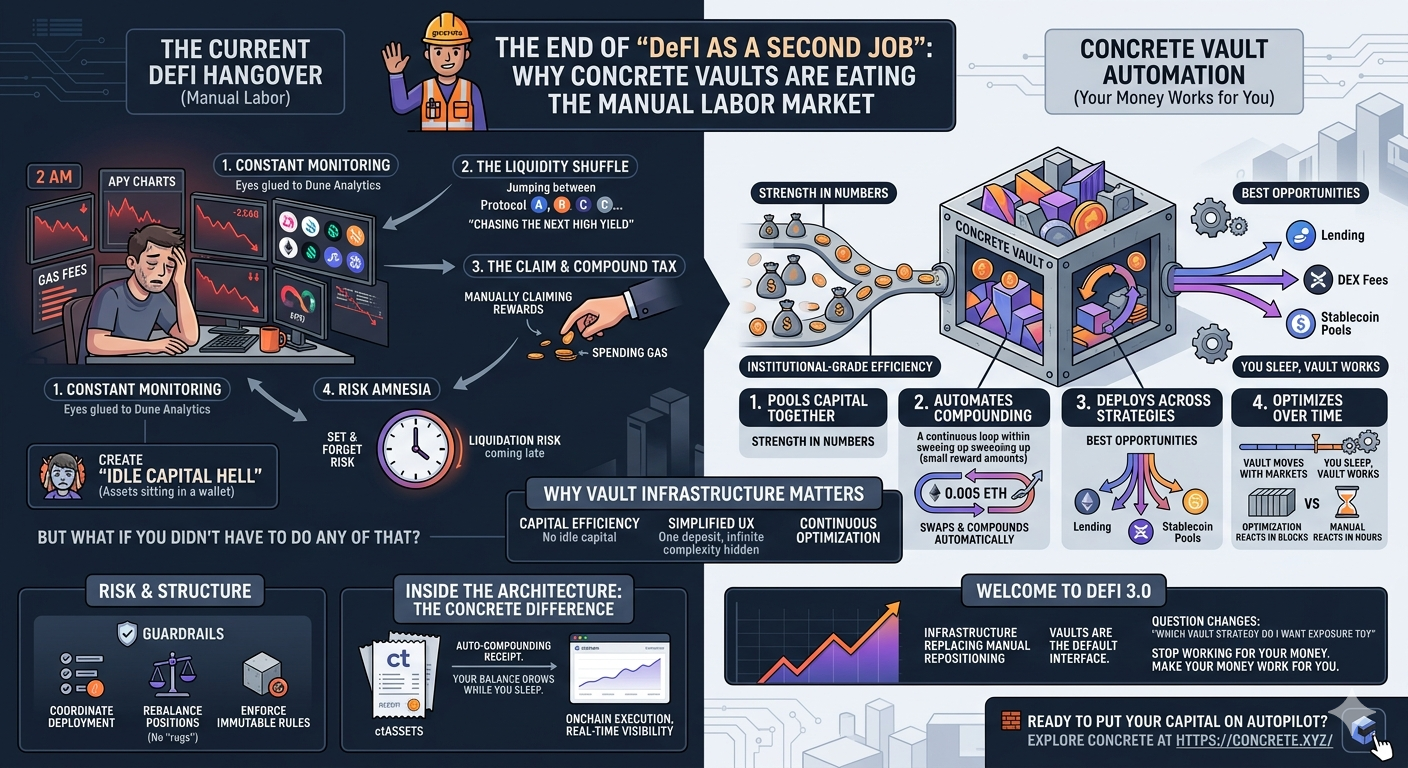
Today, users constantly chase yields across protocols, monitor APYs, rebalance liquidity positions, claim rewards manually, and react to market shifts in real time. What started as open finance has gradually become operationally heavy.
To remain competitive, many users spend hours managing positions that may become outdated within days.
This creates a major problem:
The average DeFi experience is becoming too fragmented and inefficient.
That’s where Concrete Vaults enter the picture.
The Shift From Manual Management to Structured Systems
Traditional DeFi participation often requires users to:
- monitor multiple protocols
- manually compound rewards
- rebalance exposure
- manage idle capital
- track changing risks constantly
This approach does not scale as DeFi grows more sophisticated.
Instead of forcing users to operate like full-time portfolio managers, DeFi vaults introduce automation and structure directly into capital deployment.
Rather than constantly repositioning funds manually, users can access systems designed to coordinate strategies more efficiently over time.
What Concrete Vaults Actually Do
At their core, Concrete Vaults are designed to simplify and optimize onchain capital deployment.
They help users:
- pool capital together
- automate compounding
- deploy assets across structured strategies
- optimize positions continuously
- reduce operational complexity
Instead of micromanaging every movement, users gain exposure to a coordinated system built for long-term efficiency.
This changes the relationship users have with DeFi itself.
The focus shifts away from endlessly clicking between protocols and toward structured participation through automated infrastructure.
Why Vault Infrastructure Matters
The importance of vault infrastructure goes beyond convenience.
As DeFi expands, capital coordination becomes one of the most valuable layers in the ecosystem.
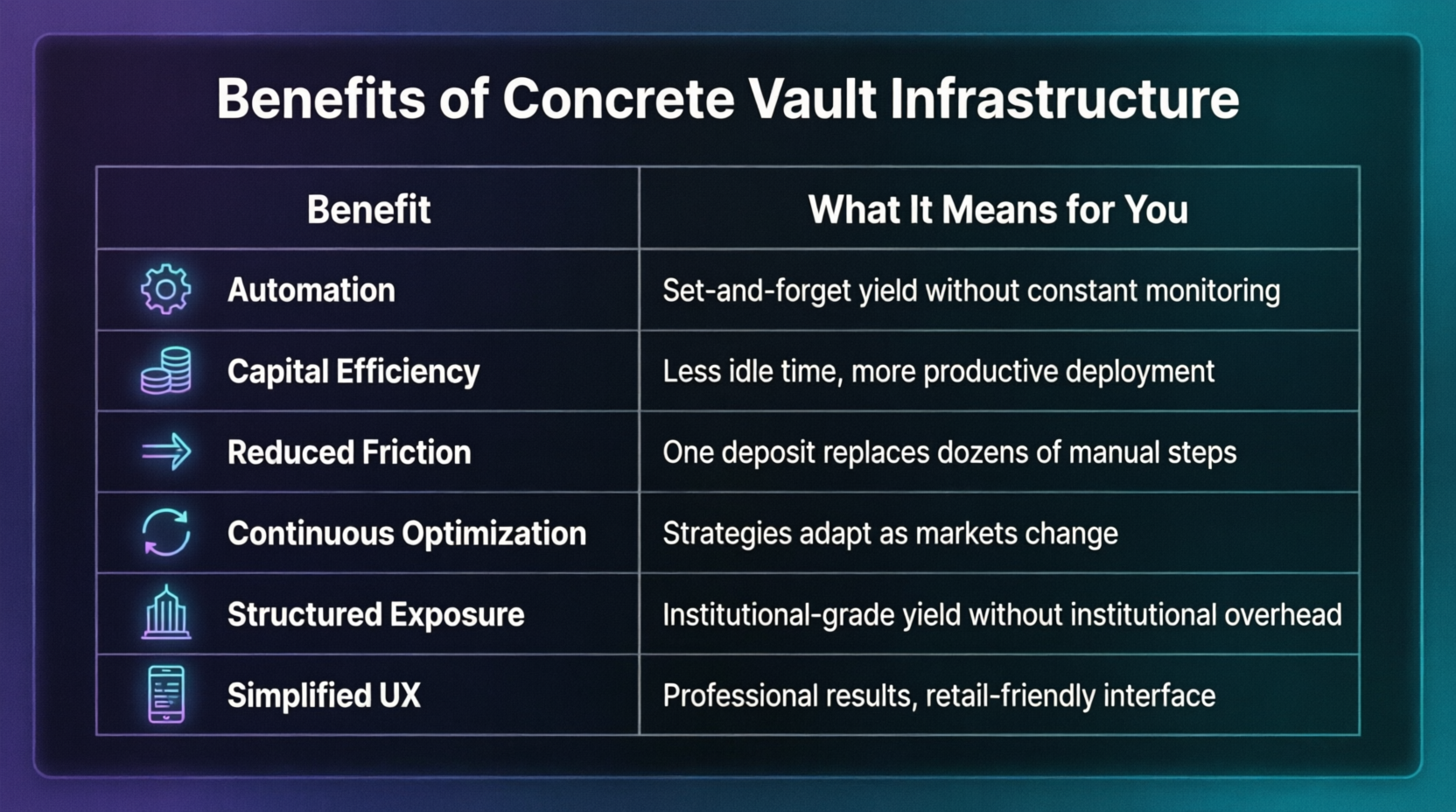
Vault systems improve:
Capital Efficiency
Idle capital is one of the biggest inefficiencies in DeFi. Structured vault systems help ensure assets remain actively deployed across opportunities instead of sitting unused.
Automated Compounding
Manual reward harvesting creates friction and inconsistency. Automated compounding allows strategies to optimize returns continuously without requiring constant user intervention.
Simplified User Experience
Most users should not need to manage every rebalance manually. Vaults abstract complexity while still providing exposure to sophisticated strategies.
Continuous Optimization
Markets evolve rapidly. Vault systems can adapt positions dynamically instead of relying on static user behavior.
The result is a more scalable form of participation in structured DeFi.
Concrete Vaults Are More Than Yield Wrappers
A common misconception is that vaults simply package yield opportunities together.
But modern vault architecture is far more sophisticated.
Concrete Vaults are designed with systems that help:
- coordinate capital deployment
- rebalance positions
- enforce strategy constraints
- respond to changing onchain conditions
- optimize execution efficiency
This creates a framework for more structured participation in DeFi markets.
Instead of relying purely on individual decision-making, users interact with infrastructure purpose-built for capital coordination.
That distinction matters.
Because the future of institutional DeFi will likely depend on systems capable of managing complexity at scale.
The Role of ctAssets and Onchain Execution
One of the key innovations within the Concrete ecosystem is the integration of ctAssets alongside automated vault infrastructure.
Combined with onchain execution systems and automated compounding, Concrete Vaults are designed to coordinate capital efficiently across multiple opportunities while maintaining structured exposure.
This architecture enables:
- more efficient capital routing
- streamlined strategy execution
- reduced operational overhead
- scalable onchain capital deployment
Rather than treating DeFi as a collection of disconnected protocols, Concrete approaches it as a coordinated financial system.
That is a major evolution.
The Bigger Shift Happening in DeFi
DeFi is becoming increasingly advanced.
Strategies are more complex. Liquidity moves faster. Opportunities evolve constantly.
The reality is simple:
Manual strategy management does not scale.
The next generation of DeFi infrastructure will likely prioritize systems that automate coordination, optimize deployment, and reduce friction for users.
In that environment, vaults are no longer optional tools.
They are becoming the default interface for deploying capital onchain.
The future of DeFi may not belong to users spending all day moving liquidity manually between protocols.
It may belong to infrastructure designed to coordinate capital more efficiently than any individual ever could.
Explore Concrete at https://Concrete.xyz