Why Most “Passive” Strategies Break Under Pressure (And What to Watch For) Trading
 Blockchain_Privacy2 min read·Just now
--
Everyone understands returns when markets are calm.
Very few understand what happens when conditions change.
That’s where most “passive income” strategies don’t seem to deliver.
Not because the idea was wrong, but because the system behind it wasn’t built for stress.
Today, we’ll break that down.
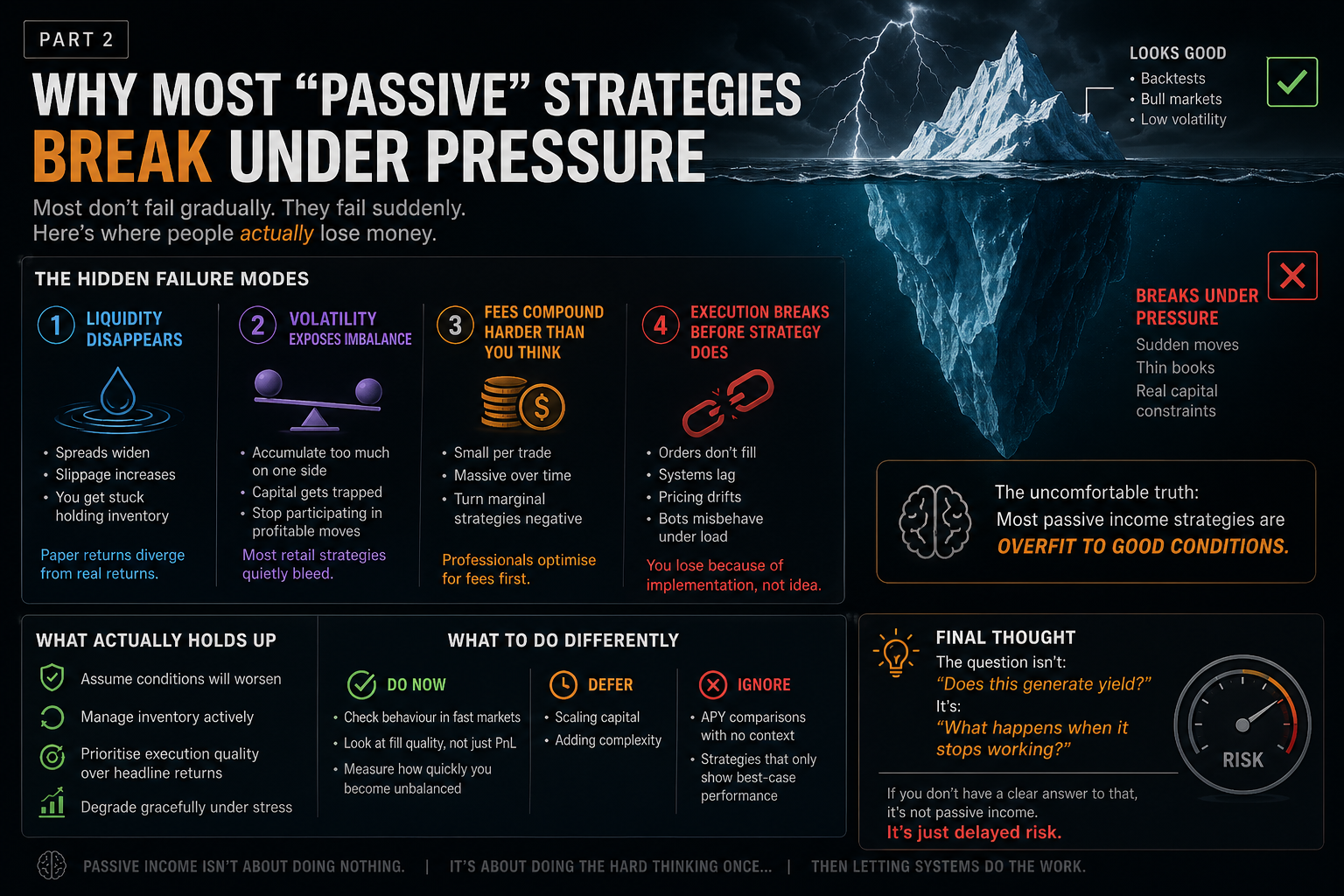
The hidden failure modes
Most passive strategies don’t fail gradually.
They fail suddenly.
And usually for predictable reasons:
1. Liquidity disappears
That 8–15% yield?
It assumes you can enter and exit cleanly.
In reality:
- Spreads widen
- Slippage increases
- You get stuck holding inventory
This is where paper returns diverge from real returns.
2. Volatility exposes imbalance
In stable conditions, most systems look “fine”.
In volatile conditions:
- You accumulate too much on one side
- Your capital gets trapped
- You stop participating in the profitable side of the market
This is where most retail strategies quietly bleed.
3. Fees compound harder than you think
Fees are small per trade.
But across hundreds or thousands of executions:
- They eat edge
- They turn marginal strategies negative
Professionals optimise for fees first, returns second.
Retail does the opposite.
4. Execution breaks before strategy does
This is the one most people miss.
The strategy might be sound.
But:
- Orders don’t fill as expected
- Systems lag
- Pricing drifts
- Bots behave inconsistently under load
You don’t lose because of the idea.
You lose because of how it’s implemented.
The uncomfortable truth
Most passive income strategies are:
Overfit to good conditions.
They look great:
- In backtests
- In bull markets
- In low-volatility environments
But they’re not designed for:
- Sudden moves
- Thin books
- Real capital constraints
That’s the gap between theory and money.
What actually holds up
If you strip it back, resilient systems share a few traits:
- They assume conditions will worsen
- They manage inventory actively
- They prioritise execution quality over headline returns
- They degrade gracefully under stress
Not perfectly.
Just predictably.
What to do differently
If you’re running any “passive” strategy, focus here:
Do now:
- Check how your system behaves in fast markets
- Look at fill quality, not just PnL
- Measure how quickly you become unbalanced
Defer:
- Scaling capital
- Adding complexity
Ignore:
- APY comparisons with no context
- Strategies that only show best-case performance
Final thought
The question isn’t:
“Does this generate yield?”
It’s:
“What happens when it stops working?”
If you don’t have a clear answer to that,
it’s not passive income.
It’s just delayed risk.