Why Most DeFi Users Eventually Burn Out
--
The promise of DeFi was supposed to be freedom.
More control. Better yields. Transparent systems.
But after enough time onchain, most users realize the experience itself becomes the problem.
To stay competitive in DeFi today, people constantly jump between protocols, monitor APYs, claim rewards, move liquidity, rebalance positions, and manually track risks across multiple chains.
At first this feels exciting.
Then it starts feeling like a full-time job.
The deeper DeFi grows, the more fragmented the user experience becomes. Capital ends up scattered across different protocols while users spend hours trying to optimize every small percentage point.
This is exactly where vault infrastructure starts to matter.
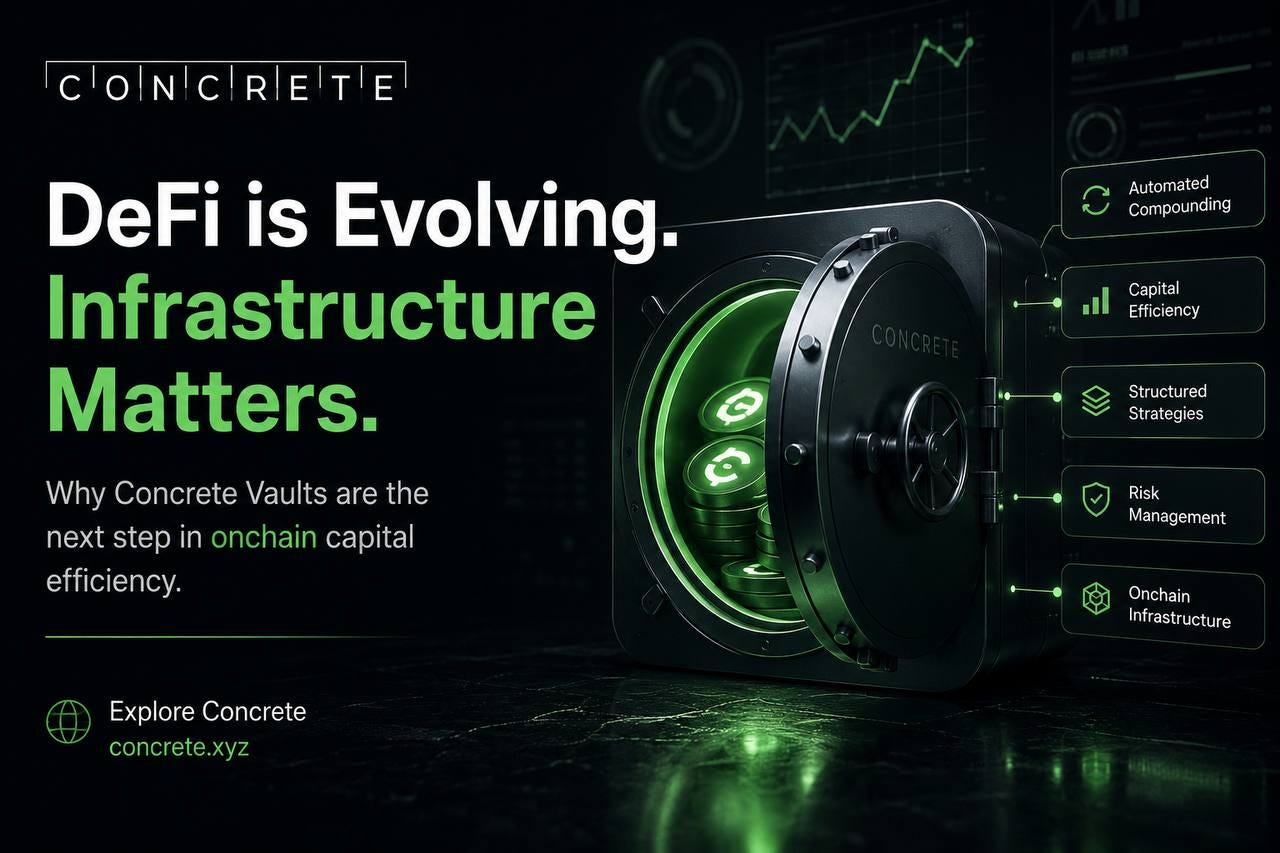
Concrete Vaults simplify the process by turning scattered manual actions into structured automated systems.
Instead of endlessly repositioning funds, users gain access to coordinated vault strategies designed to optimize capital deployment over time.
Concrete Vaults help users:
automate compounding
reduce operational complexity
coordinate capital efficiently
maintain structured exposure to yield opportunities
optimize positions across changing market conditions
The important shift here is not just convenience.
It is efficiency.
Manual strategy management becomes harder as DeFi expands. Users are forced to constantly react, rebalance, and monitor conditions. Vault systems reduce this friction by introducing infrastructure designed to handle these processes continuously.
Concrete’s architecture is built around this idea.
Through ctAssets, automated compounding, and structured vault systems, capital can move through opportunities in a more organized and scalable way.
Rather than treating DeFi like a collection of disconnected protocols, vault infrastructure creates a framework where capital can operate more efficiently.
This also changes how users think about risk.
Concrete Vaults are not simply passive “yield wrappers.”
They include systems designed to:
coordinate capital deployment
rebalance strategies
respond to changing market conditions
enforce structured portfolio behavior
As DeFi matures, infrastructure becomes more important than constant manual execution.
The future of onchain finance may belong less to users endlessly clicking between platforms and more to systems capable of coordinating capital efficiently at scale.
That is why vault infrastructure matters.
Explore Concrete at https://concrete.xyz/