Why Clear Transaction Approvals Matter More Than Most Wallets Admit
 Adrian Vale3 min read·Just now
--
In crypto, many expensive mistakes happen not because users lack access, but because products make critical actions too easy to misunderstand.
A lot of wallet security advice sounds correct and incomplete at the same time.
Protect your seed phrase.
Use a strong password.
Avoid phishing links.
Keep your device clean.
Double-check addresses.
All of that is real advice. All of it matters.
But there is another layer of wallet safety that deserves much more attention than it usually gets: transaction clarity.
Because in crypto, many of the worst mistakes do not happen in some dramatic movie-style hack. They happen in ordinary moments. A user approves too quickly. A network is misread. A destination is assumed rather than verified. A prompt looks familiar enough to trust, even though the details were never really absorbed.
That is why clear transaction approvals matter so much.
They are one of the few places where a wallet can actively shape user behavior in the moment that matters most.
A good wallet should not only make actions possible. It should make actions understandable.
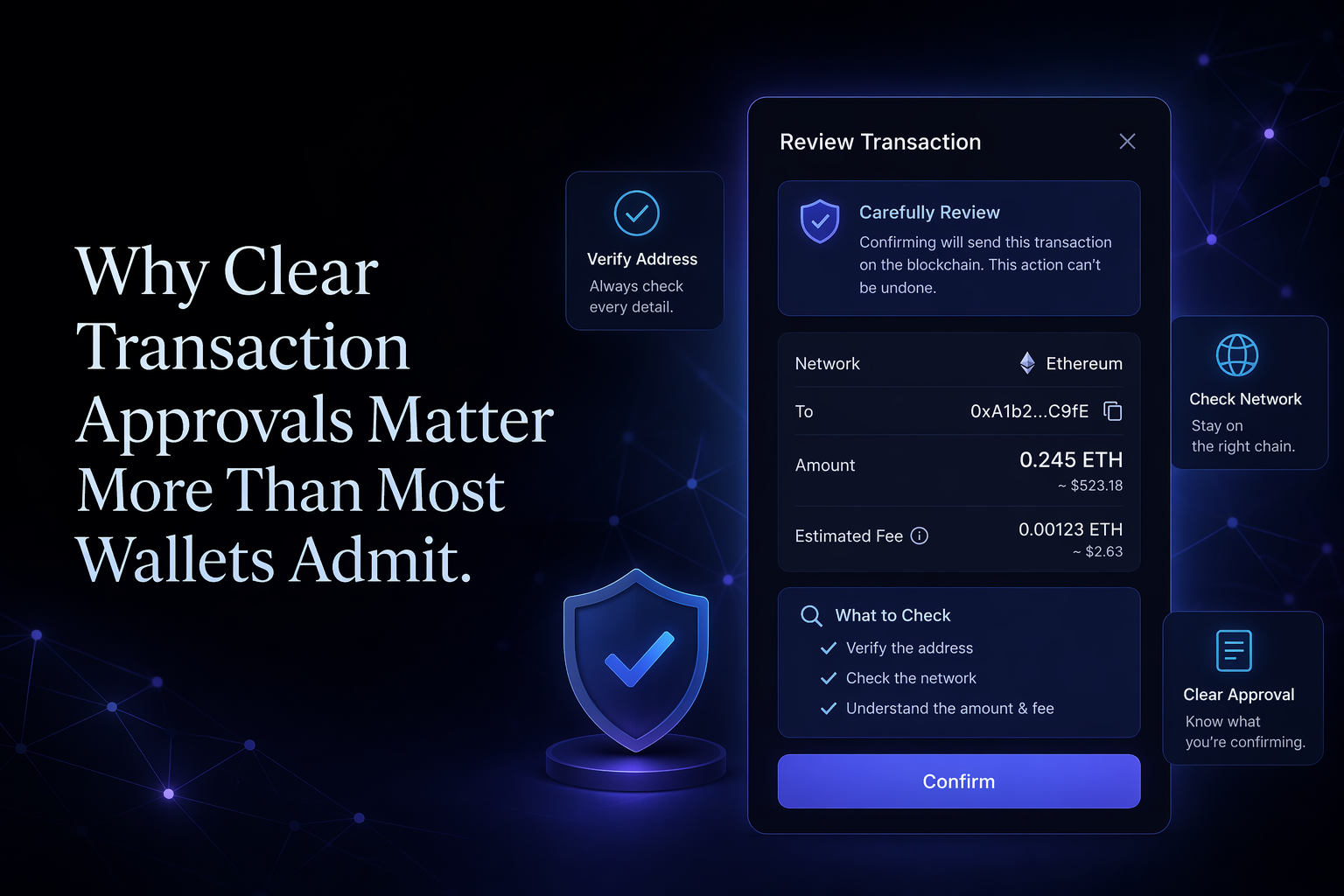
That means users should be able to see what they are approving, what asset is involved, what network is selected, what address is receiving value, and what kind of action is actually being signed. If that information is hard to interpret, then the product is quietly increasing risk even if the underlying security model is strong.
This is one of the less glamorous truths about wallet design: security often depends on whether the final confirmation step is readable enough for a human being to use well.
And that is not a small detail.
Crypto products often place a lot of emphasis on access and flexibility. But once that flexibility reaches the approval layer, the product has a responsibility to become more explicit, not less. It should not rely on speed, habit, or user overconfidence to get actions through. It should help people pause with confidence, not rush with uncertainty.
That is where many products still fall short.
They provide prompts, but not always context.
They show actions, but not always meaning.
They technically ask for approval, but do not always help the user understand what exactly is being approved.
That gap matters because blockchain actions are often final. Once confirmed, many transfers cannot be reversed. That is why careful review of addresses, networks, and amounts matters so much, and why clear transaction prompts are part of real security rather than a nice bonus. The Ethlas security page reflects that same principle by emphasizing deliberate user-controlled actions, careful approvals, address and network verification, recovery safety, and phishing avoidance as practical habits rather than abstract theory.
What makes this especially important is that users do not encounter risk only through obviously dangerous situations. They often encounter it through familiarity.
The interface looks familiar.
The action seems routine.
The prompt appears ordinary.
So the brain relaxes.
That is exactly when clarity has to do its job.
A strong wallet experience should interrupt careless momentum without creating unnecessary friction. It should make important details more visible before commitment happens. It should support a sense of deliberate action instead of passive clicking.
This is why approval design deserves to be treated as part of wallet security, not just part of wallet UX.
The way a product frames approval changes how users behave. It shapes attention. It influences whether someone actually reads the destination, notices the network, or realizes that the action on screen is more sensitive than it first appeared.
In that sense, security is not only about blocking attackers. It is also about reducing the chance that users will misread their own actions.
That is one reason thoughtful wallet products are starting to take a broader view of security. A page like Ethlas wallet security points in that direction by grounding security in user control, readable actions, careful transaction review, and the practical habits that keep non-custodial responsibility manageable.
That broader view feels right.
Because the safest wallet is not simply the one with the strongest invisible architecture.
It is also the one that helps users understand what they are about to do before it is too late to take it back.