A plain-English guide to the financial risks hiding behind productivity headlines.
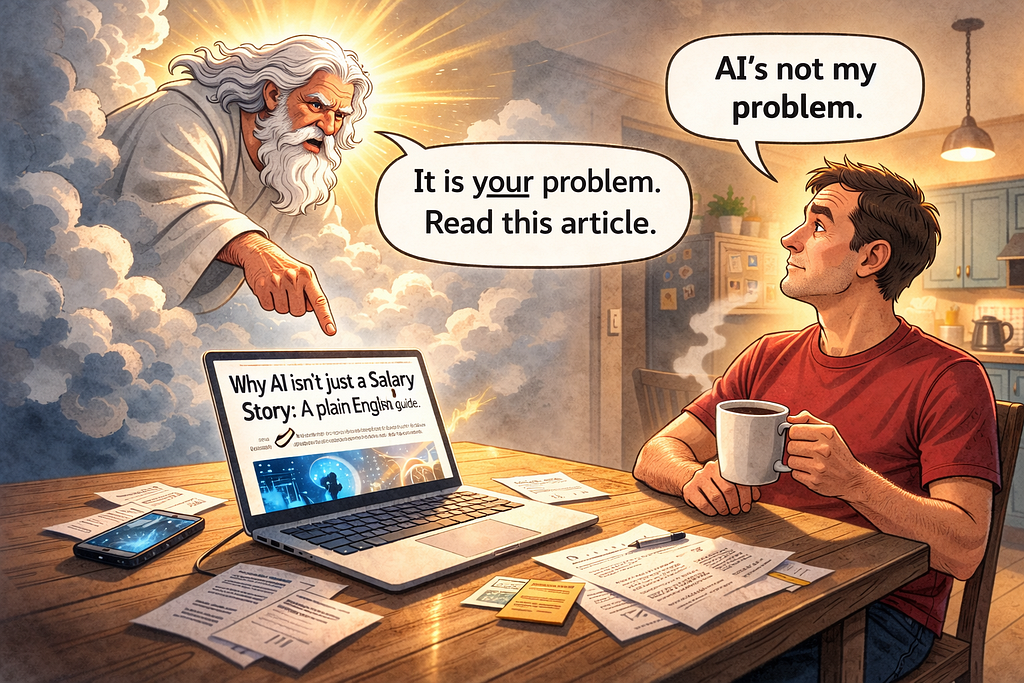
This article is intended for readers who, despite today’s information overload, still enjoy diving a little deeper into how big economic and technological shifts actually connect to everyday life.
TL;DR (because even deep dives benefit from a map):
AI productivity could rise faster than wages and adaptation, while debt remains high across households, companies, and markets. That mismatch doesn’t guarantee crisis, but it creates economic tension worth understanding.
I recently read a fascinating macroeconomic scenario by Citrini about artificial intelligence, finance, and systemic risk. It was intellectually ambitious, clearly aimed at financially sophisticated readers — and honestly, I thought it was brilliant. But I still caught myself rereading sections to fully follow the argument.
That made me realize something: if someone comfortable with finance needs two passes, many smart readers will quietly give up. Not because the ideas are weak — because the language is dense.
So this is a plain-English companion to that article (original here: https://www.citriniresearch.com/p/2028gic). Think of it as a decoder. Keep both open side by side if you want. No PhD required. Coffee optional but recommended.
Along the way I’ll connect it to two previous pieces of mine — “The Economy Is Not God” and The Bathtub Index — because they actually fit this discussion surprisingly well.
1. The Big Idea: When Intelligence Gets Cheap
The article starts with a simple but powerful premise:
AI dramatically lowers the cost of certain kinds of thinking work.
Things that once required:
- analysts
- consultants
- programmers
- legal researchers
- customer support teams
…can increasingly be done by AI systems.
Companies produce more with fewer people.
Productivity rises.
That sounds great — and it often is — but here’s the catch:
Productivity growth does not automatically mean wage growth.
History shows those two can drift apart.
— -
2. “Ghost GDP” — When Growth Doesn’t Feel Like Growth
GDP measures output, not wellbeing.
I’ve written before in “The Economy Is Not God” that GDP is useful but not sacred. A country can show strong growth while households feel financially squeezed.
That’s where my Bathtub Index comes in:
Income = water flowing into the bathtub.
Expenses = the drain.
If the drain opens faster than the tap flows — housing, energy, taxes, groceries, debt — the bathtub empties even if GDP headlines look fantastic.
The article calls this Ghost GDP:
Growth exists statistically.
But people don’t feel richer.
(And if you’ve looked at your electricity bill lately, you probably already understand this emotionally.)
3. Labor Indicators — Translation Without the Jargon
You’ll see technical terms in the original article like:
JOLTS
This measures job openings, hiring, resignations, layoffs.
If openings fall, companies may be slowing hiring.
Jobless claims
Weekly applications for unemployment benefits.
A fast early signal of layoffs.
Unemployment rate
Percentage of people actively looking for work who can’t find it — though discouraged workers sometimes disappear from this statistic.
The author suggests AI may compress white-collar hiring before official unemployment spikes.
Think of it less as mass firing, more as “positions quietly not replaced.”
4. Everyday Money Pressure
If job security weakens:
- discretionary spending drops
- credit card balances rise
- people postpone purchases
- housing demand softens.
One fascinating detail in the original article:
Merchants pay about 2–3% per transaction in credit-card fees.
Normally that’s tolerated.
But in a world where AI agents handle purchases, those agents don’t care about airline miles or cashback points. They optimize cost.
So they may route payments through cheaper digital rails — possibly stablecoins — simply because they’re cheaper and faster.
The big idea:
AI tends to remove friction.
Financial toll booths are friction.
5. Mortgages and White-Collar Exposure
A significant share of mortgages in many developed economies is held by middle- and upper-income professionals:
- tech workers
- consultants
- managers
- engineers
- lawyers
- finance professionals.
If hiring slows in those sectors:
- housing demand weakens
- refinancing slows
- financial institutions feel indirect pressure.
Not automatically a housing crisis.
But a vulnerability.
And a reality check:
Credit rating agencies (Moody’s, S&P, Fitch) usually react late.
By the time ratings change, markets often already sensed trouble.
Indexes lag. Reality rarely sends calendar invites.
6. Software Revenues and Private Credit — Decoded
Many software companies run on subscription revenue.
Key term:
ACV (Annual Contract Value): Recurring yearly subscription income.
Net New ACV Growth: New revenue added minus lost customers.
If AI reduces demand for certain software tools or pushes prices down:
Revenue growth slows.
Debt becomes harder to service.
Defaults become possible.
And here’s where finance enters:
Many of these companies were funded by private credit — loans from investment funds rather than traditional banks.
If revenue assumptions fail, losses ripple outward.
7. The “Daisy Chain” Risk (We’ve Seen Something Like It Before)
When many investors rely on the same optimistic story, risk becomes correlated.
2008 example:
Mortgage securities were widely assumed safe because housing prices were expected to keep rising. When that assumption broke:
- banks struggled
- insurers struggled
- governments intervened
- taxpayers indirectly shared the burden.
The article is not predicting a repeat.
It’s saying:
Shared assumptions can create systemic fragility.
8. Translating a Typical Regulatory Headline
Example headline:
“Regulators move to tighten capital treatment for privately rated credit held by life insurers.”
Plain English:
Regulators suspect some loans insurers hold may be riskier than thought.
They want insurers to keep more financial reserves.
Usually this happens after markets already feel uneasy.
Finance often acknowledges problems late — not early.
9. Geopolitics, Defense Spending, and the AI Era
Another relevant dimension to consider is geopolitics.
AI is not just business competition:
It’s geopolitical competition.
- US leadership in frontier models
- China’s industrial scale and coordination
- Europe’s regulatory emphasis
- semiconductor supply chains
- energy infrastructure
- cybersecurity.
And yes:
Global defense spending is rising.
Fear of conflict — justified or not — shapes investment, industrial policy, and technological priorities. AI overlaps heavily with defense technology, cybersecurity, satellites, and advanced manufacturing.
That spending can stimulate economic sectors even while automation pressures others.
Technology disruption rarely exists outside geopolitics.
10. What This Scenario Actually Is (And Isn’t)
This is best read as a stress test:
What happens if AI makes work more efficient faster than people can adjust — while households, companies, and investors are all carrying significant debt?
It’s not prophecy.
It’s not doom.
It’s a thought experiment about interconnected risks.
History suggests economies adjust — sometimes painfully, often unevenly, but rarely in straight lines.
Understanding these dynamics shouldn’t require specialized financial training. If AI is reshaping jobs, finance, geopolitics, and daily costs, the conversation should stay accessible.
And ideally, understandable without needing to reread every paragraph twice.
If this scenario were to unfold — not dramatically, but gradually — what could individuals realistically do?
First, reduce fragility where possible. High debt levels make any transition harder, whether the trigger is technology, geopolitics, or a slowdown. Financial flexibility is not pessimism; it is resilience. Of course, that’s easier said than done. Real life is rarely a textbook.
Second, diversify skills. AI does not eliminate all work, but it reshapes it. People who combine domain expertise with technological literacy tend to adapt faster than those who ignore the shift entirely.
Third, diversify income streams where possible. Even modest additional sources of income can reduce dependence on a single vulnerable sector.
Fourth, stay informed without becoming overwhelmed. Markets adjust. Economies reconfigure. Panic rarely improves decision-making.
None of this guarantees insulation from disruption. But adaptability has historically been more powerful than prediction.
If UBI (Universal Basic Income) really turns out to work perfectly, I won’t complain — and I suspect most of us won’t either.
Written by me, with thoughtful assistance from AI.
Why AI Isn’t Just a Tech Story — It’s an Income Story was originally published in DataDrivenInvestor on Medium, where people are continuing the conversation by highlighting and responding to this story.