Token launches in 2026 look very different from the ICO boom years. The market still has capital, users, builders, and strong new categories. But it no longer rewards noise with the same patience. CoinGecko reported that the total crypto market cap closed Q1 2026 near $2.4 trillion after a 20.4% quarterly drop. Centralized exchange spot volume fell 39.1% in the same quarter. That drop says something clear: traders became more selective.
Stablecoins tell the other side of the story. DeFiLlama data placed stablecoin supply above $320 billion in May 2026. RWA.xyz placed tokenized real-world assets above $27 billion. Capital has not left crypto. It has moved toward assets and projects that show clearer use, stronger rails, and better market discipline.
This shift changes token launches.
The old ICO model sold belief first. A team wrote a whitepaper, created urgency, opened a sale, and promised delivery later. Some strong projects came from that period. Many weak ones did too. The 2026 market does not treat that model with the same trust.
Proof-first TGEs now sit closer to the center of serious crypto launches. A token generation event is no longer just a sale date. It is a public test of product readiness, token logic, user demand, legal clarity, and market timing.
The new launch question is simple: what proof already exists?
Table of Contents
· Brief Market Context
· The ICO Era Was Built Around Belief
· Proof-First TGEs Changed the Order
· Why Hype-First Launches Struggle in 2026
· What Proof Means Before a TGE
· The New TGE Readiness Stack
· Why RWA, AI, DePIN, and Utility Tokens Fit This Shift
· How Launchpads and Exchanges Changed the Rules
· What Founders Need Before a 2026 TGE
· What Investors Now Check Before Joining
· The Role of Marketing in a Proof-First TGE
· Mistakes That Still Hurt Token Launches
· What a Strong Proof-First TGE Looks Like
· What This Means for Crypto Founders
· Conclusion
Brief Market Context
Crypto entered 2026 with stronger infrastructure and tighter judgment. Bitcoin ETFs, stablecoin payment rails, tokenized assets, AI-linked crypto networks, DePIN systems, and real-world asset platforms gave the market more mature categories to compare. That made shallow token launches easier to spot.
Regulation added pressure. MiCA’s crypto-asset service provider rules became active in the EU from 30 December 2024. Exchanges, launchpads, and institutional partners now ask sharper questions about sale terms, disclosures, token rights, KYC, and market risk.
Retail users changed too. They now check token unlocks, liquidity depth, audit status, team delivery, wallet activity, and community quality. The market still likes strong stories, but stories now need proof behind them.
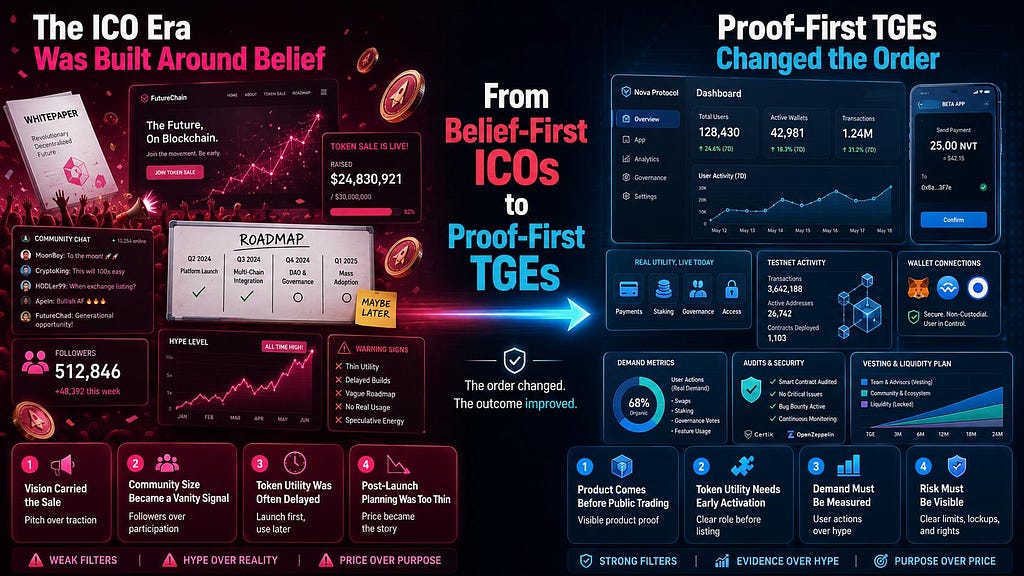
The ICO Era Was Built Around Belief
The first wave of ICOs moved fast. A project could raise funds from a whitepaper, a Telegram group, a landing page, and a bold roadmap. The method worked in a young market where users had fewer tools to check claims.
That model created speed. It also created weak filters.
Vision Carried the Sale
ICO buyers often funded future products, not working systems. The project pitch mattered more than user traction. Many teams sold the possibility of a platform before a product existed.
That worked for a short period. It became weaker once users saw delayed builds, failed roadmaps, and thin token utility.
Community Size Became a Vanity Signal
Telegram members, X followers, and whitelist numbers became proof substitutes. A large community looked strong from the outside. Real participation often told a different story.
The 2026 market looks past raw numbers. It checks wallet activity, campaign quality, task completion, and user return rate.
Token Utility Was Often Delayed
Many ICOs placed utility far into the roadmap. The token launched first. Product use came later, or never arrived. That gap created sell pressure after listing.
A token with no early use becomes a trading object first. That weakens trust after the first wave of attention fades.
Post-Launch Planning Was Too Thin
Many ICO campaigns focused on the sale. The first 30 to 90 days after listing received less planning. Price action then became the main story.
Modern TGEs need a stronger plan after launch. Users now expect product updates, utility activation, exchange communication, and clear market support.
Proof-First TGEs Changed the Order
A proof-first TGE reverses the old sequence. It does not ask the market to trust a future product with no evidence. It brings product, usage, token logic, security, and communication into view before public trading begins.
The TGE becomes a market entry point, not only a fundraising event.
Product Comes Before Public Trading
A project does not need a finished platform before launch. But it needs visible product proof. That can be a beta app, testnet, dashboard, pilot program, game build, RWA portal, or wallet flow.
Users want to see how the token fits into a real system.
Screenshots alone are weak. Working flows speak louder.
Token Utility Needs Early Activation
The token must carry a clear role near launch. That role can involve access, payments, staking, rewards, governance, settlement, collateral, or fee discounts.
The market asks a direct question: why does this project need a token?
A strong TGE answers that question before listing.
Demand Must Be Measured
Demand proof comes from user action, not hype. Waitlists, wallet connects, beta users, deposits, testnet activity, partner signups, and early revenue carry more weight than loud claims.
Demand proof gives the market something real to discuss.
Risk Must Be Visible
The best launches do not hide risk. They explain sale limits, lockups, vesting, contract permissions, treasury use, liquidity plans, and user rights.
That clarity does not weaken the launch. It builds trust with users who now read the details.
Why Hype-First Launches Struggle in 2026
Hype still matters in crypto. Attention starts conversations. But hype without proof now fades faster. Users have better tools, sharper memory, and less patience for vague promises.
A loud launch can still trend. A weak launch struggles to stay alive.
Users Have Seen the Pattern
Many users have watched projects raise funds, list tokens, delay products, and lose momentum. That history changed behavior.
They now ask harder questions before joining.
Who is building? What is live? Who uses it? What does the token do? What happens after listing?
Liquidity Is Not Spread Evenly
Lower spot volume in Q1 2026 made one point clear. Liquidity is pickier. It moves toward stronger narratives, better market access, and clearer catalysts.
A token with weak proof must fight harder for every buyer.
Strong proof does not guarantee success. It improves the chance of serious attention.
Exchange Screening Is Stricter
Exchanges and launchpads protect their own reputation. Weak listings hurt users and damage platform trust. That makes due diligence more detailed.
Projects now face questions about audits, vesting, legal structure, team background, liquidity plans, and post-launch activity.
On-Chain Data Exposes Weak Launches
The market can see wallet movement, liquidity changes, token transfers, holder concentration, and smart contract behavior. Weak design becomes public fast.
A project can no longer control the story through announcements alone.
The chain speaks too.
What Proof Means Before a TGE
Proof-first does not mean the project must be fully mature. It means the team has enough evidence to justify public token access. That evidence should cover product, demand, token need, security, and market planning.
A TGE should feel earned.
Proof of Product
A working product gives users something to test and judge. It turns the launch from a promise into a visible build.
Useful proof includes:
- Beta access
- Testnet activity
- Product demo
- Pilot results
- User feedback
- Real interface flows
The product does not need to be perfect. It needs to be real.
Proof of Demand
Demand proof shows that users care before the token trades. This matters more than follower count.
Good demand signals include:
- Waitlist growth
- Wallet connections
- Test transactions
- Early deposits
- App usage
- Partner interest
- Community task completion
These signals help the market separate interest from empty noise.
Proof of Token Need
Some projects do not need a token. The market knows this now. A strong TGE explains why the token improves the system.
The token may coordinate users, price access, secure participation, support settlement, reward contribution, or manage governance.
A forced token weakens the launch.
A needed token strengthens the model.
Proof of Security
Smart contract risk can damage a launch before the market understands the product. Audits, permission checks, admin role clarity, and safe contract design now matter from the start.
Security is part of the launch story.
A completed audit is not a promise of total safety. It still shows discipline.
Proof of Market Planning
A TGE needs liquidity planning, listing timing, market maker coordination, communication rules, unlock tracking, and post-launch updates.
A strong plan reduces confusion during launch week.
Confusion costs trust.
The New TGE Readiness Stack
A modern token launch joins many moving parts. Product, legal, tokenomics, marketing, liquidity, and community teams must work from the same plan.
The TGE is no longer one campaign. It is a readiness stack.
Product Readiness
The product team must show what users can do at launch or soon after. The roadmap should link each token function to a product release.
This helps users understand the timing.
It also prevents utility claims from sounding empty.
Tokenomics Readiness
Tokenomics must explain supply, allocations, unlocks, vesting, treasury use, rewards, and market support. The model should reduce short-term pressure where possible.
Weak tokenomics can damage even a strong product.
Fair structure gives the market more reason to stay.
Legal Readiness
Token sales need cleaner documentation. Sale terms, user restrictions, KYC rules, risk language, token rights, and jurisdiction limits should be prepared early.
Legal clarity helps avoid rushed edits during launch week.
It also gives launch partners more comfort.
Liquidity Readiness
Liquidity needs more than a pool. The team must plan DEX depth, CEX timing, market maker activity, treasury reserves, and unlock pressure.
Poor liquidity planning turns launch excitement into chaos.
A calm first market phase supports trust.
Communication Readiness
The market needs simple answers. What is live? What does the token do? Where can users buy it? What risks exist? What comes next?
Strong communication turns proof into a story people can repeat.
Weak communication makes even good work harder to understand.
Why RWA, AI, DePIN, and Utility Tokens Fit This Shift
The strongest 2026 launch categories often have one shared trait: they can show proof beyond price. RWA, AI infrastructure, DePIN, gaming, and utility-led DeFi projects give users more ways to judge real activity.
These categories still carry risk. But they offer clearer proof paths.
RWA Launches Need Asset Proof
RWA projects must prove custody, valuation, ownership logic, reporting, compliance controls, and transfer rules. A token is not enough.
The asset structure must make sense.
Tokenized assets above $27 billion show demand for the category. That growth also raises the standard for proof.
AI Crypto Launches Need Usage Proof
AI branding alone is weak in 2026. Strong AI token launches show model access, agent activity, compute demand, data flows, API use, or enterprise pilots.
The market wants to see where AI connects with on-chain value.
A label is not proof.
DePIN Launches Need Network Proof
DePIN projects need real participation. Nodes, devices, coverage, usage, reward logic, and network reliability matter before launch.
The token should reward useful contribution.
No network, no strong token story.
Gaming Launches Need Retention Proof
Gaming tokens need more than a trailer and reward promise. They need active players, repeat sessions, wallet use, in-game demand, and marketplace behavior.
A game token survives only with player interest after rewards slow down.
Retention is proof.
DeFi Launches Need Economic Proof
DeFi tokens need clear capital flows, risk controls, fee logic, liquidity depth, and user behavior. A yield claim alone will not carry a launch.
Users now ask where yield comes from.
That question needs a clean answer.
How Launchpads and Exchanges Changed the Rules
Launchpads and exchanges now work with more caution. They have seen weak projects harm users and damage platform trust. That makes screening more detailed.
A project needs more than a pitch deck to pass.
Deeper Project Checks
Launch partners review team history, product status, audits, tokenomics, community quality, legal setup, and market plans.
A clean data room helps the process.
Missing files slow the launch.
Better Sale Design
Public sale structure now gets more attention. Launchpads review allocation size, vesting, eligibility, pricing, bot protection, and refund rules.
Fairer sale design helps reduce early anger.
It also improves holder trust.
Stronger Post-TGE Plans
Launch partners want to know what happens after listing. Product releases, staking dates, campaign plans, partnership news, and exchange updates should be ready.
A launch with no next step looks weak.
The first 90 days matter more than the first hour.
Clearer User Education
Launchpads need users to understand the token. Confusing token pages create support problems and lower trust.
Strong education improves conversion.
It also reduces rumor-driven community pressure.
What Founders Need Before a 2026 TGE
Founders planning a token launch in 2026 need proof across five areas. Each area supports the next one. Missing pieces create doubt fast.
A good launch starts long before the listing date.
Product Evidence
Founders should prepare proof that the product works at some level. This can include demos, beta data, screenshots, testnet records, user interviews, or partner pilots.
The goal is simple.
Show that the idea has moved into build mode.
Token Logic
The token must have a clear job. It should not sit outside the product like a fundraising badge.
Founders should explain:
- Main token use
- User reason to hold
- User reason to spend
- Reward logic
- Governance rights
- Fee or access role
Clear token logic protects the launch from weak questions.
Market Evidence
Market evidence shows that users care. This can include waitlists, wallet connects, social engagement quality, beta activity, community retention, and early conversions.
The stronger the evidence, the easier it becomes to build launch confidence.
Risk Controls
Founders should prepare audits, contract reviews, permission details, vesting charts, legal notes, and sale restrictions.
Users do not expect zero risk.
They expect honest risk handling.
Launch Operations
The team should prepare listing steps, community scripts, scam warnings, support flow, liquidity actions, content timing, and emergency response.
Launch week is too late to build order.
Order must exist before attention arrives.
A proof-first TGE needs more than a token contract and a launch date. It needs product readiness, tokenomics, smart contract review, listing support, community planning, liquidity coordination, and clear market communication working together before public trading begins. This is where Blockchain App Factory provides TGE launch services for crypto projects that need structured support across token creation, launch planning, exchange readiness, marketing, and post-launch activity. For founders, that kind of launch support helps turn a token release into a planned market entry instead of a rushed sale event.
What Investors Now Check Before Joining
Investors in 2026 read more than the pitch. They compare token terms, product status, team behavior, community health, and market structure.
The average buyer has become more careful.
Reason to Hold
A token needs a reason to stay in user wallets after listing. Access, fees, staking, rewards, collateral, governance, or platform use can support that reason.
No hold reason means price depends too much on promotion.
That is fragile.
Fair Unlocks
Unlocks shape trust. Investors look for team cliffs, private sale vesting, public sale fairness, treasury controls, and ecosystem reward timing.
Bad unlocks can become the main story.
Fair unlocks keep attention on product growth.
Real Product Status
Investors now check what has shipped. A live demo carries more weight than a long roadmap.
A small working product beats a large promise.
Delivery history matters.
Clear Valuation
Launch valuation must match the project stage. A high fully diluted valuation with limited traction invites pressure.
A fairer valuation gives the market more room to support the token.
It also reduces early disappointment.
Post-Launch Roadmap
Investors want to know the next steps after the TGE. Staking, product releases, exchange plans, community campaigns, and governance activation need dates or clear windows.
A TGE should open the market phase.
It should not feel like the final event.
The Role of Marketing in a Proof-First TGE
Marketing still matters. It just has a different job. The best 2026 launch marketing does not cover weak fundamentals. It organizes proof so users can understand the project faster.
Marketing turns evidence into trust.
Strong Narrative
A launch narrative should match the product stage. Overstated claims create pressure the team cannot meet.
Good messaging explains:
- What is live
- What is tested
- What the token does
- What users can expect
- What risks remain
Clear claims travel better than loud claims.
Product Education
Users need to understand the product before they care about the token. Explainers, demos, founder notes, FAQs, product videos, and token utility posts support that education.
Complex projects need more teaching.
RWA, AI, DePIN, and DeFi launches need this most.
Better KOL Briefs
KOLs need real information. Weak briefs create shallow posts. Strong briefs explain product status, token role, launch timing, risk notes, and user actions.
Good KOL content should answer questions.
It should not only repeat slogans.
Community Preparation
Community teams need approved answers before launch. They should handle wallet setup, sale access, vesting, utility, scam alerts, listing details, and support steps.
A prepared community team protects trust.
A confused team spreads doubt.
Proof-Led Content
Proof-led content uses facts, not empty claims. It highlights user numbers, audit status, beta activity, partner categories, product flows, and launch terms.
Specifics make the story stronger.
Generic claims fade fast.
Mistakes That Still Hurt Token Launches
Many 2026 launches still fail for avoidable reasons. The problem often starts early. Teams rush the token before the product, market, and communication are ready.
Proof-first planning helps reduce these errors.
Launching Too Early
Some projects launch before users can do anything useful with the token. This creates a gap between buying and using.
That gap invites sell pressure.
A better launch connects token access with product use.
Using Loud Claims
Loud language can damage trust. Users now notice words that sound bigger than the proof.
Specific claims work better:
- Beta users
- Wallet connects
- Testnet activity
- Audit completion
- Asset reporting
- Product milestones
Numbers beat noise.
Hiding Unlock Pressure
Token unlocks should be clear before launch. Hidden or confusing unlock schedules create anger after listing.
The market can forgive risk.
It rarely forgives surprise.
Skipping Legal Review
Legal structure matters more in 2026. Sale terms, user restrictions, risk language, and token rights need review before public promotion.
A rushed legal setup can create long problems.
Clean documents help the launch feel serious.
Neglecting the First 90 Days
Many teams plan the TGE and forget the quarter after it. That is a costly mistake.
The first 90 days shape trust, holder behavior, exchange interest, and community mood.
Post-launch work must start before launch.
What a Strong Proof-First TGE Looks Like
A strong proof-first TGE feels controlled, clear, and earned. Users can see what exists, what comes next, and why the token matters.
It does not depend on one viral moment.
Before Launch
The project has product access, audited contracts, tokenomics, legal review, liquidity planning, and community education ready.
The team has already answered the hardest questions.
That lowers launch-week pressure.
During Launch
The project communicates with one clear message across website, social channels, community rooms, launchpad pages, and exchange updates.
Users know where to go.
They know what to do.
They know what risks exist.
After Launch
The team ships updates, tracks market behavior, supports users, activates token utility, and reports progress.
The project does not vanish after the sale.
That matters more than launch-day volume.
Across the Full Launch
The strongest TGEs connect four parts:
- Product reality
- Token logic
- Market timing
- User trust
Miss one part, and the launch weakens.
Connect all four, and the market has a stronger reason to pay attention.
What This Means for Crypto Founders
Founders entering 2026 need to treat the TGE as a public proof event. The market no longer accepts a token sale as proof of progress.
Progress must come first.
Build Before Selling
A founder should show a working product path before asking users to join a token market. Even a small live product can change how the market reads the launch.
Build evidence first.
Then sell the token story.
Design the Token With Restraint
A token should serve the system. It should not carry every idea at once. Too many promises create confusion.
A clear token with fewer roles can be stronger than a token with ten weak claims.
Plan Liquidity Early
Liquidity needs planning before the sale. DEX pools, CEX talks, market maker terms, treasury rules, and unlock timing should connect.
Late liquidity planning creates avoidable stress.
Educate Before Listing
Users need time to understand the project. Education should begin before the token goes live.
A strong content plan can reduce confusion, improve community quality, and support better launch decisions.
Treat Launch as the Start
A TGE starts the open market phase. It does not complete the project.
The team must be ready to ship, answer, adjust, and report after listing.
That is where trust grows.
Conclusion
The move from hype-first ICOs to proof-first TGEs shows how much the token launch market has matured in 2026. Users still want new projects. Investors still watch early opportunities. Launchpads and exchanges still support strong teams. But the market now asks for proof before it gives trust.
That proof can come from a working product, real users, clear token utility, fair unlocks, audited contracts, legal clarity, liquidity planning, and a strong post-launch plan.
Hype can start attention.
Proof keeps it alive.
The strongest 2026 token launches will not be the loudest ones. They will be the ones that give users enough evidence to believe before the first trade begins.
Why 2026 Token Launches Are Moving From Hype-First ICOs to Proof-First TGEs? was originally published in DataDrivenInvestor on Medium, where people are continuing the conversation by highlighting and responding to this story.