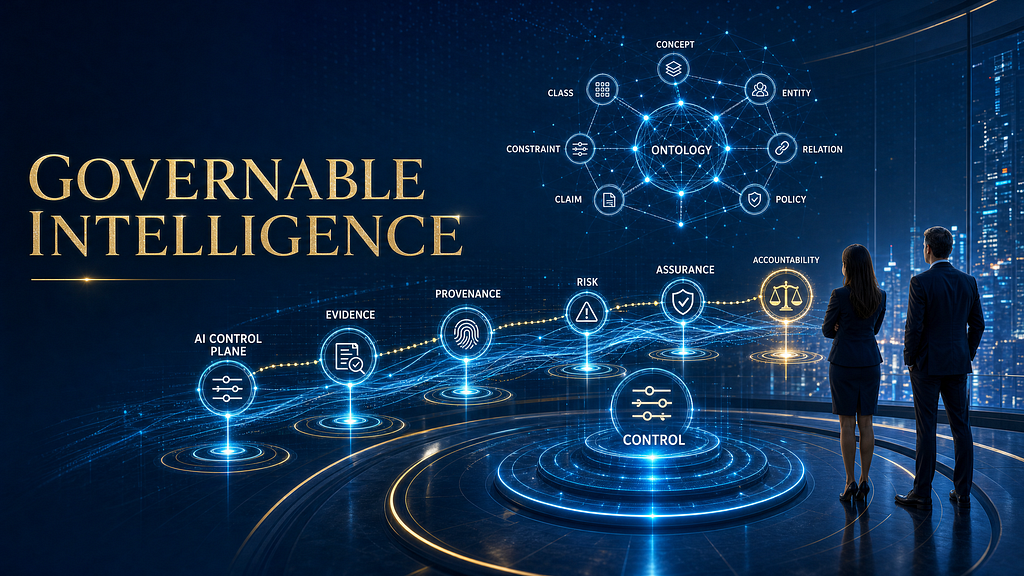
The last phase of the AI race was measured in parameters, benchmarks, demo velocity and how convincingly a model could simulate expertise. The next phase will be measured by something less theatrical and far more valuable: whether an organization can prove what its AI system knew, why it acted, who authorized it, which controls were active, and what evidence survives after the decision.
That is the strategic sequel to the argument made in the prior article, The AI Control Plane Is the New Cyber Battlefield: Why Claude Mythos Forces Boards to Govern AI at Runtime (Sant Anna, 2026). If the new breach is not merely a stolen credential or a leaked database but a collapse of the AI control plane, then the next advantage is not simply a more powerful model. It is governable intelligence: AI capability that remains observable, accountable and controllable as it moves from recommendation to action.
The distinction matters because the model-performance race is becoming less sufficient as a business strategy. Frontier models are still improving, but the economics of raw scale are changing. Epoch AI estimates that the amortized hardware and energy cost for final frontier-model training runs has grown at roughly 2.4x per year since 2016, with the largest training runs potentially exceeding USD$1 billion by 2027 if historical trends continue (Cottier et al., 2024). At the same time, regulators, boards, insurers and enterprise buyers are asking harder questions about risk, accountability and post-deployment behavior. Stanford HAI’s 2025 AI Index reports that 78% of organizations used AI in 2024, up from 55% the year before, while also noting that the responsible-AI ecosystem remains uneven and standardized evaluations are still rare among major model developers (Stanford Institute for Human-Centered Artificial Intelligence, 2025).
The implication is blunt: model access is becoming abundant, but governance coherence is scarce. The companies that win the next AI cycle will not be those that merely attach the largest model to the fastest workflow. They will be those that convert legal requirements, risk thresholds, operational controls, security evidence and business intent into a living governance system that can operate at machine speed.
Governance is no longer the paperwork around AI. It is the infrastructure that determines whether AI can be trusted to act.
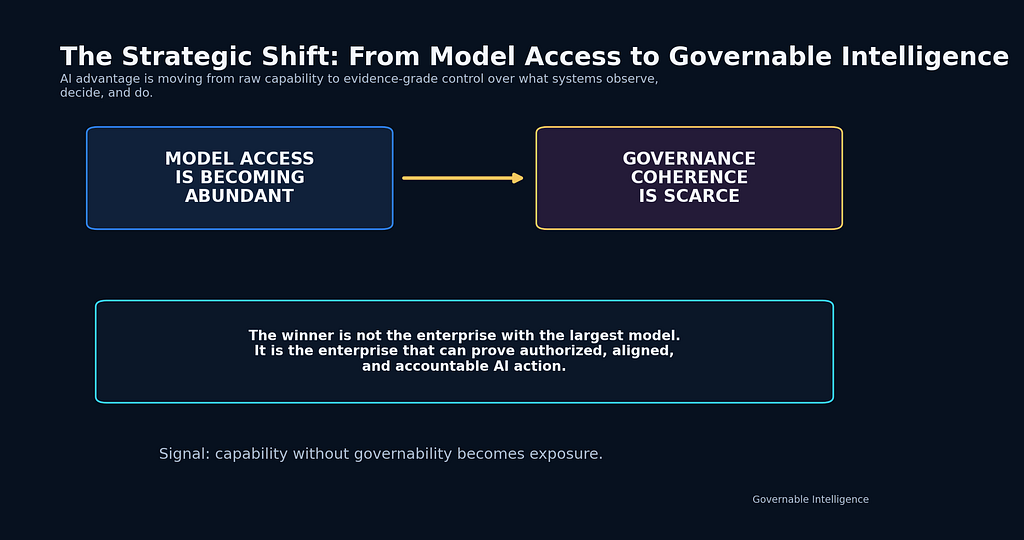
AI advantage is shifting from model access to evidence-grade governability.
Observe: The Model Race Is No Longer Enough
For more than a decade, AI progress followed a simple executive narrative. More data produced better models. More compute produced better capabilities. More parameters produced more impressive demos. The pattern was not wrong. It created the foundation for today’s generative AI economy. But enterprise advantage does not come from capability in the abstract. It comes from capability that can be deployed, defended, audited, insured, purchased and trusted.
That is where the old model race begins to show its limits. In high-consequence settings such as finance, healthcare, hiring, insurance, cybersecurity, public administration and critical infrastructure, the question is not only whether an AI system can produce a useful answer. The question is whether the organization can demonstrate that the answer was generated under the right policy, using the right data, within the right authority boundary, with the right monitoring, and with a defensible record of what happened.
This is why the next wave of AI competition will look less like a leaderboard and more like an operating discipline. NIST describes its AI Risk Management Framework as a voluntary framework intended to help organizations incorporate trustworthiness considerations into the design, development, use and evaluation of AI systems (National Institute of Standards and Technology [NIST], 2023). ISO/IEC 42001:2023, described by ISO as the world’s first AI management-system standard, specifies requirements for establishing, implementing, maintaining and continually improving an Artificial Intelligence Management System, with benefits including traceability, transparency and reliability (International Organization for Standardization [ISO], 2023). The European Union’s AI Act moves even more explicitly toward lifecycle accountability, requiring providers of high-risk AI systems to establish and document post-market monitoring systems that actively and systematically collect, document and analyze relevant performance data throughout the system’s lifetime (European Commission, 2024).
The pattern is visible. AI governance is shifting from aspiration to evidence. Compliance teams can no longer rely on policy statements alone. Product teams can no longer assume that a strong demo creates trust. Engineering teams can no longer treat governance as a late-stage review gate. Security teams can no longer separate AI risk from the runtime conditions under which models retrieve context, call tools and trigger workflows.
The enterprise question is changing from “How capable is the model?” to “How governable is the system?”
The strategic basis of AI competition shifts from access to impressive models toward evidence-grade governability at runtime.
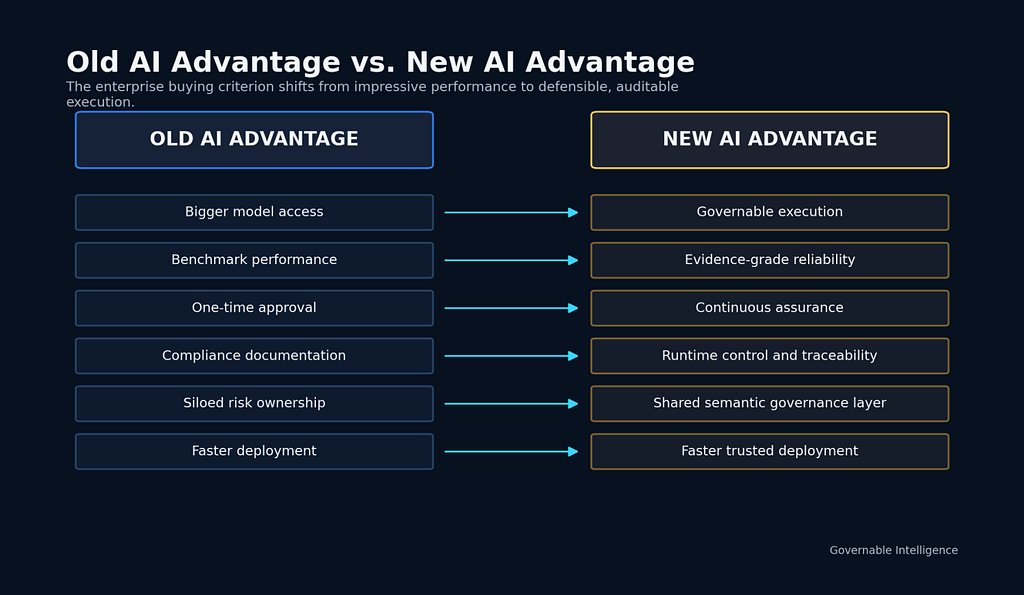
The executive buying criterion moves from impressive model performance to defensible execution.
This does not mean model quality stops mattering. It means model quality becomes one input into a broader system of trust. In enterprise markets, the buyer does not only buy intelligence. The buyer buys accountability.
Orient: Regulation Is Becoming a Runtime Problem
The most important feature of modern AI regulation is not that it is becoming stricter. It is that it is becoming more operational. The EU AI Act does not merely regulate algorithms as mathematical objects. It regulates systems, use cases, lifecycle obligations, documentation, monitoring, record-keeping, human oversight and responsibility. Its official text states that the regulation aims to promote human-centric and trustworthy AI while ensuring a high level of protection for health, safety, fundamental rights, democracy, the rule of law and environmental protection (European Parliament and Council of the European Union, 2024).
That wording should change how executives think about AI governance. The object of governance is not the model alone. It is the socio-technical system around the model: data pipelines, retrieval policies, prompts, tool permissions, user roles, monitoring signals, escalation paths, incident response, evidence trails and post-deployment correction.
The prior article, The AI Control Plane Is the New Cyber Battlefield: Why Claude Mythos Forces Boards to Govern AI at Runtime (Sant Anna, 2026), framed this as a control-plane problem. The control plane is the layer that determines what an AI system can observe, how it orients, what it is permitted to decide, what tools it can use and what evidence is generated after action. That argument becomes even more urgent when viewed through the lens of regulation. A company may have an AI policy, an inventory and an approval committee. But if it cannot connect those artifacts to runtime behavior, it has governance theater, not governance.
The EU AI Act’s post-market monitoring requirement makes this point concrete. Providers of high-risk AI systems must establish documented monitoring systems that collect and analyze data on performance throughout the system’s lifetime in order to evaluate continuous compliance (European Commission, 2024). Continuous compliance cannot be proven by a static document if the system is changing, learning, integrating new data or operating in shifting environments. It requires a way to connect live signals to obligations.
This is the crucial strategic pivot. AI governance is not moving from “soft ethics” to “hard law” only. It is moving from principles to operations. The winning organization will be the one that can translate law, policy and risk appetite into system behavior.
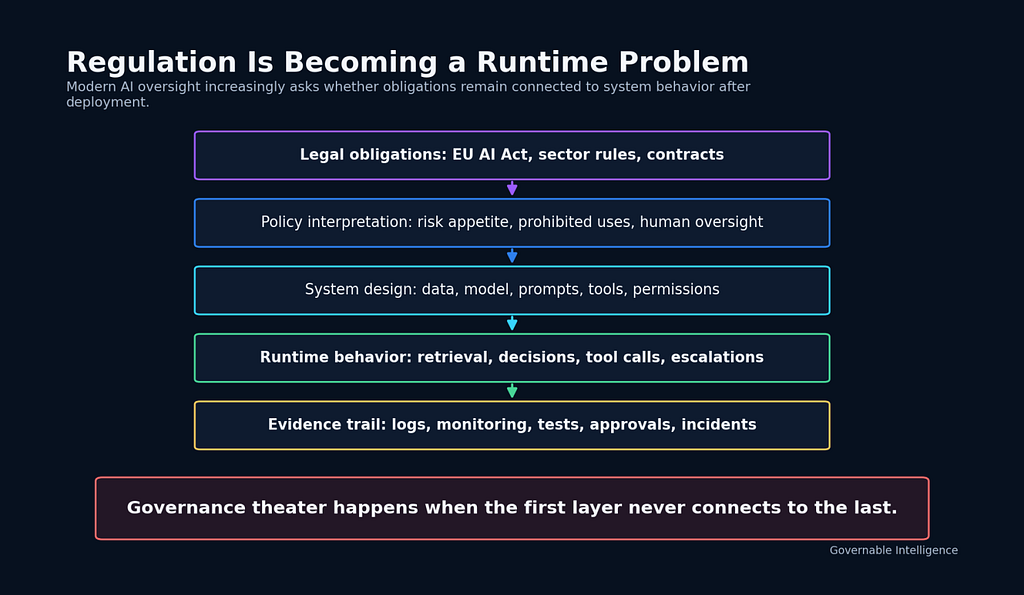
Regulatory obligations only matter operationally when they remain connected to runtime behavior and evidence trails.
Decide: The Hidden Bottleneck Is Organizational Coherence
Most AI governance failures will not begin with malicious intent. They will begin with fragmentation.
Legal teams interpret statutes and contractual obligations. Security teams map threats and vulnerabilities. Data teams define lineage and quality. Engineers optimize systems for performance and latency. Product teams push for adoption and market fit. Compliance teams prepare evidence for audit. Business leaders demand speed. Each function is rational inside its own frame. The system as a whole becomes incoherent.
That incoherence is dangerous because AI systems are not ordinary software artifacts. They combine probabilistic reasoning, unstructured context, changing data, tool access and human feedback. In that environment, ambiguity becomes operational. A term such as “high risk” may mean one thing to legal, another to security, another to product and another to engineering. A phrase such as “human oversight” may appear in a policy, but remain undefined inside the workflow. A control may exist in a spreadsheet, but not in the path between retrieval and tool invocation.
The result is what might be called semantic risk: the risk that an organization uses the same governance words while meaning different things in different systems.
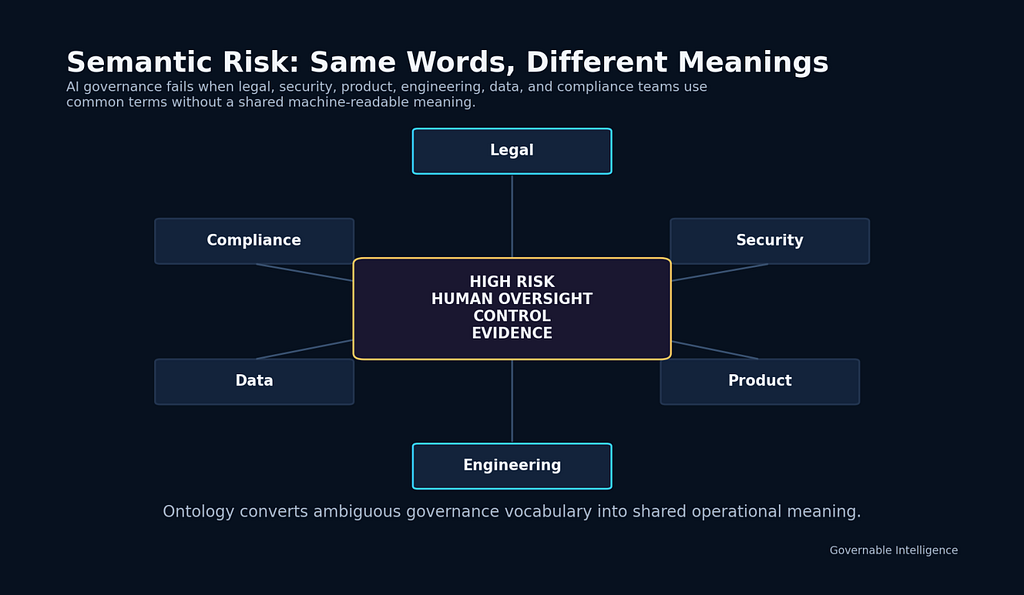
Semantic risk emerges when governance language is shared rhetorically but not operationally.
This is why we must consider ontologies at the center of AI governance. Ontologies are often misunderstood as academic abstractions or knowledge-management luxuries. In the next AI economy, they become coordination infrastructure. The W3C describes ontologies as formalized vocabularies of terms, often covering a specific domain and shared by a community, that specify definitions by describing relationships with other terms (W3C OWL Working Group, 2012). In governance terms, that is exactly what enterprises lack: a shared, machine-readable structure that links obligations, risks, controls, evidence, system behavior and accountable owners.
Lewis, Filip and Pandit warned that the lack of mappings among AI standards, regulations and organizational policies could create a fragmented global landscape for trustworthy AI, undermining rather than building trust. Their proposed answer was an ontology for checking consistency and overlap across standards, regulations and policies (Lewis et al., 2021). That insight becomes more valuable in the agentic era because fragmentation is no longer just an audit inconvenience. It is a runtime hazard.
If an AI agent can retrieve data, reason over context, call tools and initiate workflows, then governance language must become operationally precise. The enterprise needs to know which risks attach to which use cases, which controls mitigate which risks, which evidence proves which control, which logs support which audit requirement, and which accountable owner is responsible when the system crosses a threshold.
Without that structure, governance becomes a collection of beautiful documents and brittle meetings. With it, governance becomes executable.
Act: Ontologies Are Becoming the Operating System of AI Governance
The strongest version of the governance argument is not that enterprises need more policies. They already have policies. They have AI principles, data policies, security standards, vendor questionnaires, model inventories, acceptable-use rules, audit plans and risk registers. The problem is that these artifacts often live in different formats, owned by different departments, written in different vocabularies and updated on different cadences.
An ontological governance layer changes the architecture. It creates a shared map of meaning across the AI lifecycle. A high-risk hiring model, for example, can be linked to applicable regulations, internal fairness policies, training-data requirements, monitoring signals, bias controls, human-review thresholds, vendor obligations, incident definitions and audit evidence. A cybersecurity agent can be linked to tool permissions, scope boundaries, defensive-use policies, human authorization gates, vulnerability-handling procedures and evidence retention rules. A medical decision-support system can be linked to intended use, clinical validation, data provenance, safety monitoring, human oversight and post-market performance obligations.
This is not theoretical elegance. It is operating leverage.
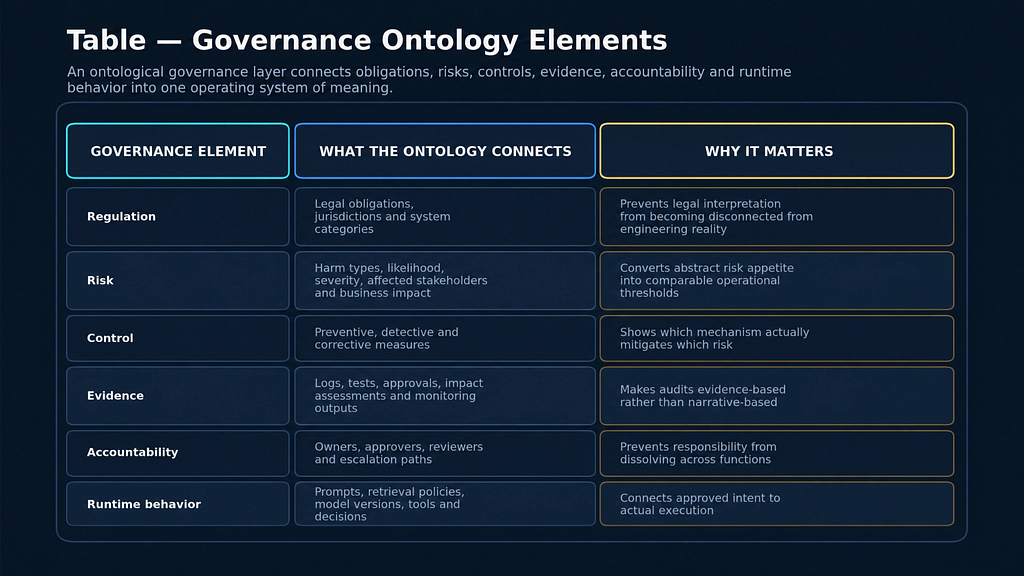
The ontological governance layer connects obligations, risks, controls, evidence, accountability and runtime behavior into one operating system of meaning.
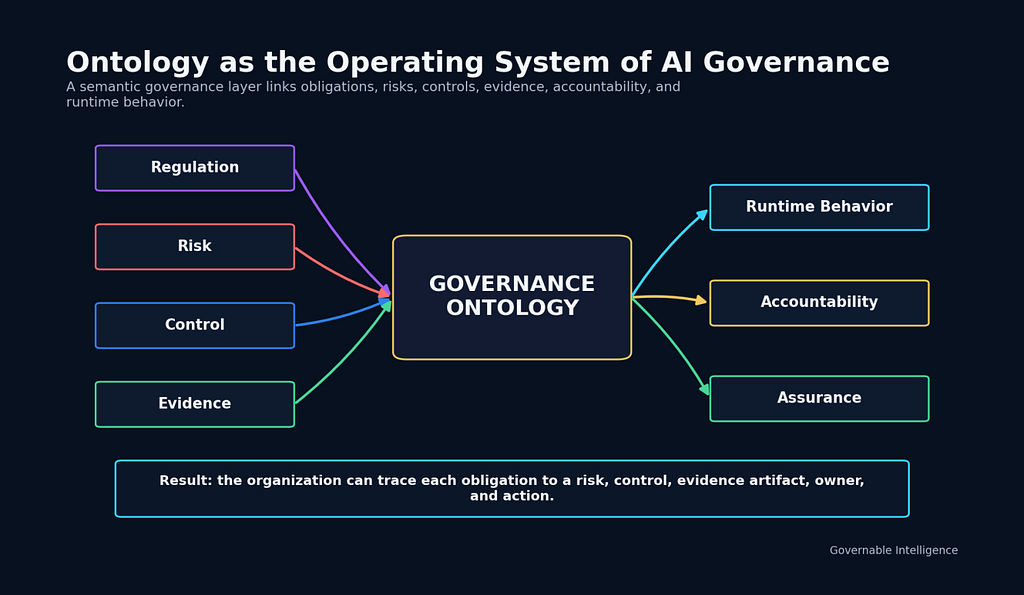
The ontology acts as the semantic routing layer between obligations, risks, controls, evidence, accountability and runtime behavior.
A useful analogy is identity and access management. In a small company, permissions can be managed informally. In a large enterprise, identity becomes infrastructure because every system needs to know who someone is, what they can access and under what conditions. AI governance is reaching the same threshold. Informal coordination may work for pilots. It will not work for autonomous systems operating across regulated workflows.
Ontologies become the identity layer for governance meaning. They tell the organization what a concept is, how it relates to other concepts, which obligations it triggers and which evidence proves compliance. They also create a foundation for automation. Once risks, controls and evidence are semantically linked, monitoring systems can generate meaningful alerts instead of raw noise. Audit systems can assemble evidence without heroic manual work. Procurement teams can compare vendors against structured governance requirements. Boards can see risk posture as a living map instead of a quarterly slide.
This is where provenance becomes essential. W3C’s PROV-O provides a way to represent and exchange provenance information generated in different systems and contexts (Lebo et al., 2013). For AI governance, provenance is not a technical footnote. It is the difference between saying “the system was governed” and proving which data, activity and agent contributed to a decision.
W3C’s PROV-O is especially valuable because it sits at the intersection of RDF, OWL, and Turtle. In practice, PROV-O is expressed as an ontology in OWL and represented as RDF data, which makes provenance information machine-readable, interoperable, and ready for semantic querying. When serialized in Turtle (.ttl) files, this same provenance graph becomes both human-readable and easy to exchange across tools and platforms, allowing organizations to trace how an AI output was produced, by whom, from which inputs, and under what process conditions.
The future governance stack will therefore need two layers that many enterprises still lack. The first is a semantic layer, which defines the meaning of risks, controls, obligations and evidence. The second is a provenance layer, which records how a specific AI outcome came into being. Together, they transform governance from static documentation into continuous assurance.
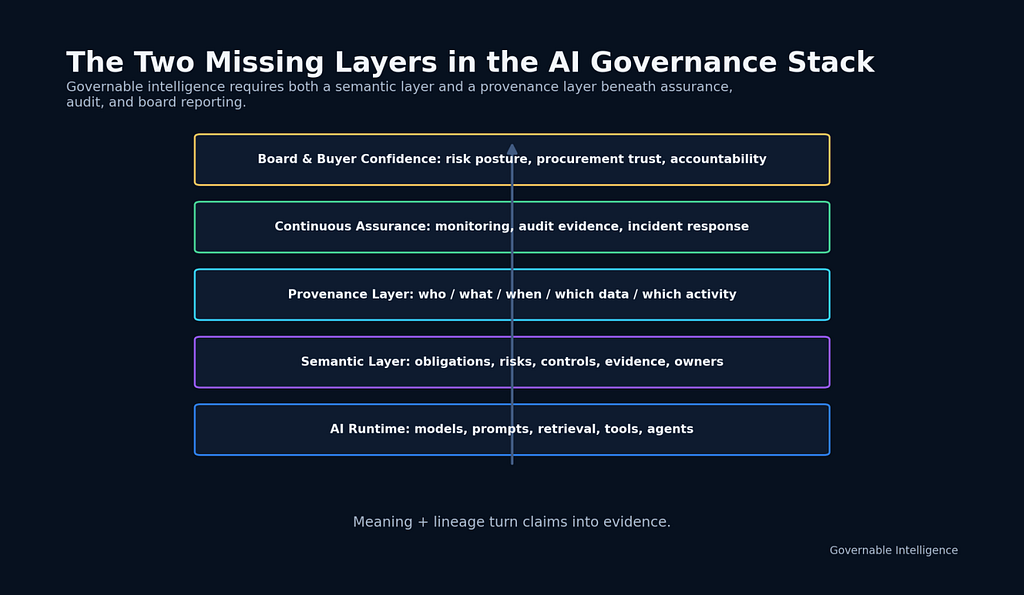
The semantic layer defines meaning; the provenance layer preserves how each AI outcome came into being.
From Static Compliance to Continuous Assurance
Traditional compliance assumes that the thing being reviewed is relatively stable. AI systems are not stable in the way conventional systems were stable. Models are updated. Prompts are modified. Retrieval indexes expand. User behavior changes. External content shifts. Adversaries adapt. Business processes evolve. Vendors revise terms. A system that was appropriate at approval may behave differently six months later without any single change looking dramatic enough to trigger a governance alarm.
That is why continuous assurance is becoming the new enterprise control model. Continuous assurance does not mean continuous bureaucracy. It means the organization can continuously connect what the system is doing to what the organization said the system was allowed to do.
This is the point at which governance becomes a competitive asset rather than a cost center. A static compliance program creates friction because every new use case becomes a custom negotiation among legal, security, engineering and product teams. A continuous-assurance architecture reduces friction because the organization has reusable governance primitives: approved risk categories, control mappings, evidence requirements, monitoring patterns and escalation rules.
In practice, continuous assurance asks five questions repeatedly:
- First, what is the AI system’s intended purpose, and has that purpose drifted?
- Second, what obligations apply in this jurisdiction, sector and use case?
- Third, what controls are active at the point of execution?
- Fourth, what evidence proves that those controls functioned?
- Fifth, what happens when observed behavior diverges from approved intent?
These questions map directly to the OODA logic used in the prior article, The AI Control Plane Is the New Cyber Battlefield: Why Claude Mythos Forces Boards to Govern AI at Runtime (Sant Anna, 2026). The enterprise must observe live system behavior, orient it against a shared governance ontology, decide whether the action remains within authority, and act through escalation, rollback, remediation or approval. The advantage comes from shortening that governance loop without weakening it.
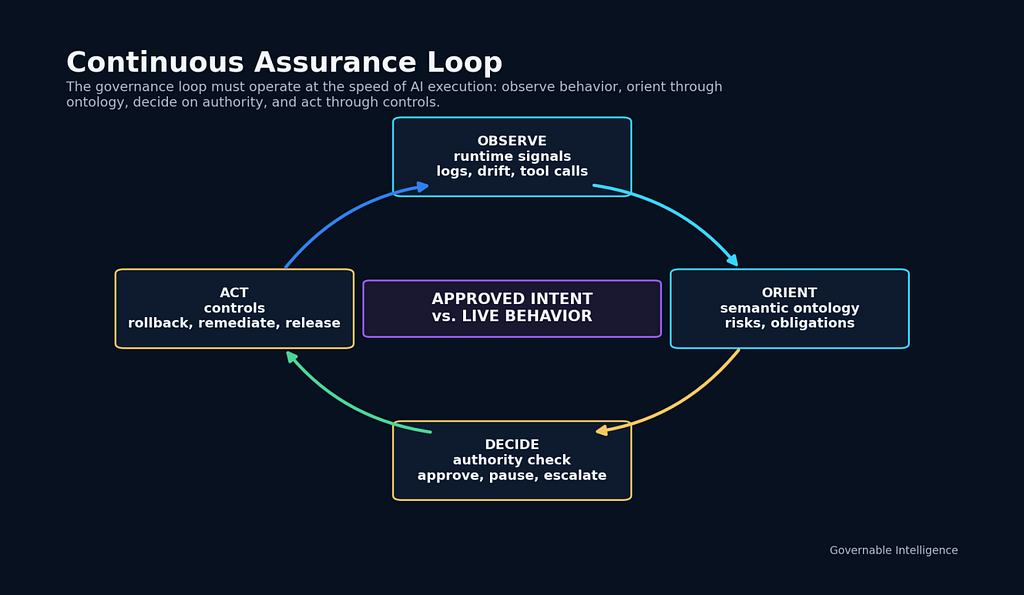
Continuous assurance turns the OODA loop into an operational governance cycle for AI systems.
Governance as Competitive Strategy
The most underpriced idea in AI strategy is that governance will become a sales accelerator.
Enterprise buyers are no longer impressed by capability claims alone. They want to know how the system is monitored, how failures are detected, how data is protected, how decisions are logged, how human oversight works, how vendors manage updates, how regulators would inspect the system and who is accountable when something goes wrong. In regulated markets, the buyer is not only buying software. The buyer is importing risk.
A company that can answer these questions structurally reduces procurement drag. It gives legal teams reusable evidence. It gives security teams concrete controls. It gives audit teams traceability. It gives boards a governance narrative grounded in system behavior rather than aspiration. It gives customers confidence that the vendor can scale responsibly.
This is why governance is becoming a market signal. Two AI vendors may offer similar model performance. The one that can prove control will win the more durable enterprise relationship.
The same logic applies internally. Organizations with weak governance will accumulate hidden AI debt. They will create pilots that cannot scale, workflows that cannot be audited, vendors that cannot be compared, models that cannot be explained and controls that cannot be tied to evidence. They may move quickly at first, but speed without coherence compounds into fragility.
Organizations with strong governance will move differently. They will still innovate, but they will reuse structured governance assets. They will know which controls are required for a new use case. They will know which evidence must be generated before launch. They will know when a model update changes risk posture. They will know which human approvals are necessary before an agent can act. Their governance will not be slower because it is more serious. It will be faster because it is less improvised.
The Emerging Global Divide: Capability Maximizers vs. Coherence Builders
The AI market is beginning to split along a new axis. On one side are capability maximizers: organizations that treat AI advantage as a race to deploy the most powerful model into the largest number of workflows as quickly as possible. On the other side are coherence builders: organizations that treat AI advantage as the ability to connect models, data, controls, evidence, people and rules into a governable system.
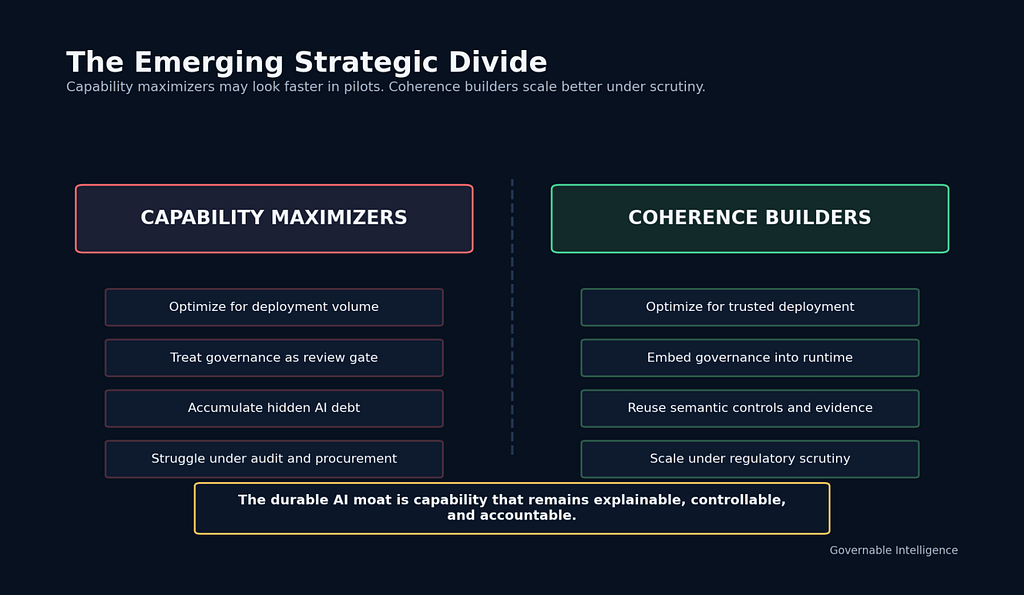
Capability maximizers may win the pilot race; coherence builders are better positioned to scale under scrutiny.
The first group will often look faster in the short term. The second group will scale better under scrutiny.
This divide will matter most in markets where trust is not optional. Banks cannot deploy AI credit systems on vibes. Hospitals cannot rely on undocumented clinical reasoning. Insurers cannot price risk without evidence. Governments cannot automate public decisions without accountability. Critical infrastructure operators cannot permit autonomous cyber tools to act without scope, isolation and provenance. In those environments, the governance layer becomes part of the product.
The uncomfortable truth for executives is that AI governance cannot be delegated entirely to compliance. Compliance can interpret obligations, but it cannot alone design runtime controls. Legal can define risk boundaries, but it cannot alone enforce them inside retrieval systems and toolchains. Security can monitor threats, but it cannot alone resolve ethical, regulatory and business tradeoffs. Engineering can build the system, but it cannot alone define accountable authority.
Governance advantage is cross-functional by design. It requires a shared semantic backbone that lets each function see how its decisions affect the whole.
Final Considerations
Executives often speak about trust as if it were a brand outcome: the market either trusts the company or it does not. In AI, trust is becoming more like reliability engineering. It can be designed, instrumented, measured and degraded.
A system is more trustworthy when it has clear intended use, controlled context, known data provenance, bounded tool authority, observable behavior, documented decisions, human escalation and evidence-grade logs. It is less trustworthy when these elements are ambiguous, fragmented or reconstructed after the fact.
That means trust is not merely a communications problem. It is an architecture problem.
The deeper implication is that governance teams should stop asking only whether the organization has AI principles. The more strategic question is whether those principles have been translated into enforceable relationships among obligations, risks, controls and evidence. If they have not, then the organization possesses governance language without governance machinery.
The companies that understand this will begin treating ontologies, provenance, monitoring and control-plane design as board-level assets. The companies that do not will discover that the most expensive AI failure is not a bad answer. It is an answer nobody can explain, authorize, reproduce or defend.
Reflection
The draft that inspired this article was correct in its central intuition: the next AI advantage is governance. But the stronger version of the argument is more radical. Governance is not becoming important because regulators are demanding more paperwork. Governance is becoming important because AI systems are acquiring the ability to act inside complex organizations faster than organizations can explain themselves.
That mismatch creates the defining management problem of the agentic era. Enterprises have spent decades optimizing functions. AI forces them to optimize coherence. The model may be intelligent, but the organization around it may still be semantically confused. The result is not merely inefficiency. It is risk.
The solution is not to slow AI down until committees feel safe. The solution is to build governance systems that can keep up with AI execution. That means shared ontologies, continuous assurance, provenance-aware evidence, runtime control gates and board-level accountability for the control plane.
The next AI economy will reward organizations that can move quickly without losing the thread of responsibility.
Non-Obvious Insights
- Governance is becoming infrastructure, not oversight. The winning enterprise will not bolt governance onto AI systems after deployment. It will embed governance into the operating layer that determines what systems can observe, decide and do.
- Ontologies are not academic abstractions. They are the coordination layer that lets legal, security, engineering, compliance and product teams mean the same thing when they use the same governance words.
- Continuous assurance is replacing one-time certification. AI systems change too quickly for static approvals to remain sufficient. The relevant question is not only whether the system was approved, but whether it remains within approved intent during operation.
- Provenance is becoming a board-level control. If a company cannot reconstruct how an AI outcome was produced, it cannot credibly claim accountability for that outcome.
- Trust is becoming measurable. Organizations will increasingly compete on their ability to produce evidence of control, not merely statements of responsibility.
- The control plane is becoming the real attack surface. The most damaging AI incidents will increasingly emerge from compromised permissions, uncontrolled retrieval, unsafe tool access, weak escalation logic and broken evidence trails rather than from model weights alone.
- Regulation is becoming a systems-engineering requirement. Laws and standards will matter operationally only when they are translated into active controls, monitoring signals, ownership models and auditable runtime evidence.
- Semantic fragmentation is a hidden form of enterprise risk. When legal, security, product, compliance and engineering teams use the same words with different meanings, the organization creates ambiguity that AI systems can amplify at machine speed.
- Governance will accelerate procurement rather than delay it. Vendors and internal teams that can present reusable evidence, traceable controls and clear accountability will reduce buyer uncertainty and move faster through enterprise approval cycles.
- The durable AI advantage will belong to coherence builders. Capability maximizers may win pilots, but organizations that connect models, data, controls, people, evidence and rules into a governable system will be better positioned to scale under scrutiny.
Key Takeaways
The next AI advantage will belong to organizations that understand a simple but demanding principle: capability without governability is not strategy; it is exposure.
- The model race is becoming economically and operationally insufficient as a standalone strategy.
- Regulation is moving toward lifecycle accountability, post-deployment monitoring and evidence of continuous compliance.
- The hidden bottleneck in AI governance is organizational coherence, especially semantic fragmentation across functions.
- Ontologies can serve as the operating system of AI governance by linking obligations, risks, controls, evidence and accountability.
- Continuous assurance will replace static compliance as AI systems become more dynamic, agentic and embedded in high-consequence workflows.
- Governance will become a competitive signal in enterprise procurement, customer trust, insurance, audit readiness and board risk management.
- The strategic divide will not be between companies that use AI and those that do not. It will be between companies that can prove control and companies that merely claim innovation.
The first AI race was about building systems that could answer. The second is about building systems that can act. The third, and most consequential, will be about building organizations that can prove those actions were authorized, aligned and accountable.
Not smarter models alone. Governable intelligence.
References
Cottier, B., Rahman, R., Fattorini, L., Maslej, N., & Owen, D. (2024). How much does it cost to train frontier AI models? Epoch AI. https://epoch.ai/blog/how-much-does-it-cost-to-train-frontier-ai-models
European Commission. (2024 ). Article 72: Post-market monitoring by providers and post-market monitoring plan for high-risk AI systems. AI Act Service Desk. https://ai-act-service-desk.ec.europa.eu/en/ai-act/article-72
European Parliament and Council of the European Union. (2024 ). Regulation (EU) 2024/1689 laying down harmonised rules on artificial intelligence. Official Journal of the European Union. https://eur-lex.europa.eu/legal-content/EN/TXT/HTML/?uri=OJ:L_202401689
International Organization for Standardization. (2023 ). ISO/IEC 42001:2023: Information technology — Artificial intelligence — Management system. https://www.iso.org/standard/42001
Lebo, T., Sahoo, S., & McGuinness, D. (Eds. ). (2013). PROV-O: The PROV ontology. World Wide Web Consortium. https://www.w3.org/TR/prov-o/
Lewis, D., Filip, D., & Pandit, H. J. (2021 ). An ontology for standardising trustworthy AI. In Factoring ethics in technology, policy making, regulation and AI. IntechOpen. https://www.intechopen.com/chapters/76436
National Institute of Standards and Technology. (2023 ). Artificial intelligence risk management framework (AI RMF 1.0). U.S. Department of Commerce. https://www.nist.gov/itl/ai-risk-management-framework
Sant Anna, R. A. (2026, May 18 ). The AI Control Plane Is the New Cyber Battlefield: Why Claude Mythos Forces Boards to Govern AI at Runtime. LinkedIn. https://www.linkedin.com/pulse/ai-control-plane-new-cyber-battlefield-why-claude-azevedo-sant-anna-7otdf
Stanford Institute for Human-Centered Artificial Intelligence. (2025 ). The 2025 AI Index report. Stanford University. https://hai.stanford.edu/ai-index/2025-ai-index-report
W3C OWL Working Group. (2012 ). OWL 2 web ontology language: Document overview (2nd ed.). World Wide Web Consortium. https://www.w3.org/TR/owl2-overview/
About Renato Azevedo Sant Anna
Architect in Digital Innovation and AI Products, author of Forjando Carreiras de IA, speaker and strategic consultant for retail, technology and SaaS companies. My mission is to help your organization thrive in the new digital era through conscious, strategic and human‑centered innovation.
“The future belongs to those who anticipate, adapt and build.” — Renato Azevedo Sant Anna
The Next AI Advantage Is Not Smarter Models. It Is Governable Intelligence was originally published in DataDrivenInvestor on Medium, where people are continuing the conversation by highlighting and responding to this story.