When Payments Meet Relationships: The Rise of Payment + CRM Integrated SaaS
How unified commerce systems are quietly reshaping the way businesses earn, retain, and understand customers
 Christine Soliman5 min read·Just now
--
In a small business office in 2026, a founder is doing something that would have seemed oddly fragmented just a few years ago. She is checking payment settlements in one dashboard, customer follow-ups in another tool, and campaign performance in a third. The numbers do not disagree with each other, but they do not talk to each other either.
A customer pays for a subscription upgrade, but the CRM does not automatically reflect the new plan. A high-value customer churns, but the payment system never signals the account manager. Marketing runs a discount campaign, but has no idea which users actually completed payments and which dropped off mid-way.
This disconnect is no longer a minor inconvenience. It is a structural inefficiency that quietly drains revenue, slows decision-making, and weakens customer relationships.
This is exactly where Payment + CRM integrated SaaS platforms are emerging as a category-defining shift rather than just another software upgrade.
The Problem: Businesses Are Running on Fragmented Truth
Most modern businesses already use digital tools for payments and customer management. The issue is not lack of software, but lack of synchronization.
When systems do not communicate, companies operate on partial truths:
- Payments show what was paid
- CRM shows who the customer is
- Marketing tools show what was sent
- Analytics tools show what was clicked
But none of them explain the full customer journey in one continuous thread.
This fragmentation creates real business friction:
- Revenue leakage due to failed or untracked renewals
- Poor customer experience because support teams lack payment context
- Inefficient marketing spend targeting users who already converted
- Delayed response to churn signals hidden inside payment behavior
In subscription-driven and SaaS-heavy markets, this gap becomes even more expensive because customer lifetime value depends on continuous alignment between engagement and billing.
The Shift: From Tools to Unified Revenue Intelligence
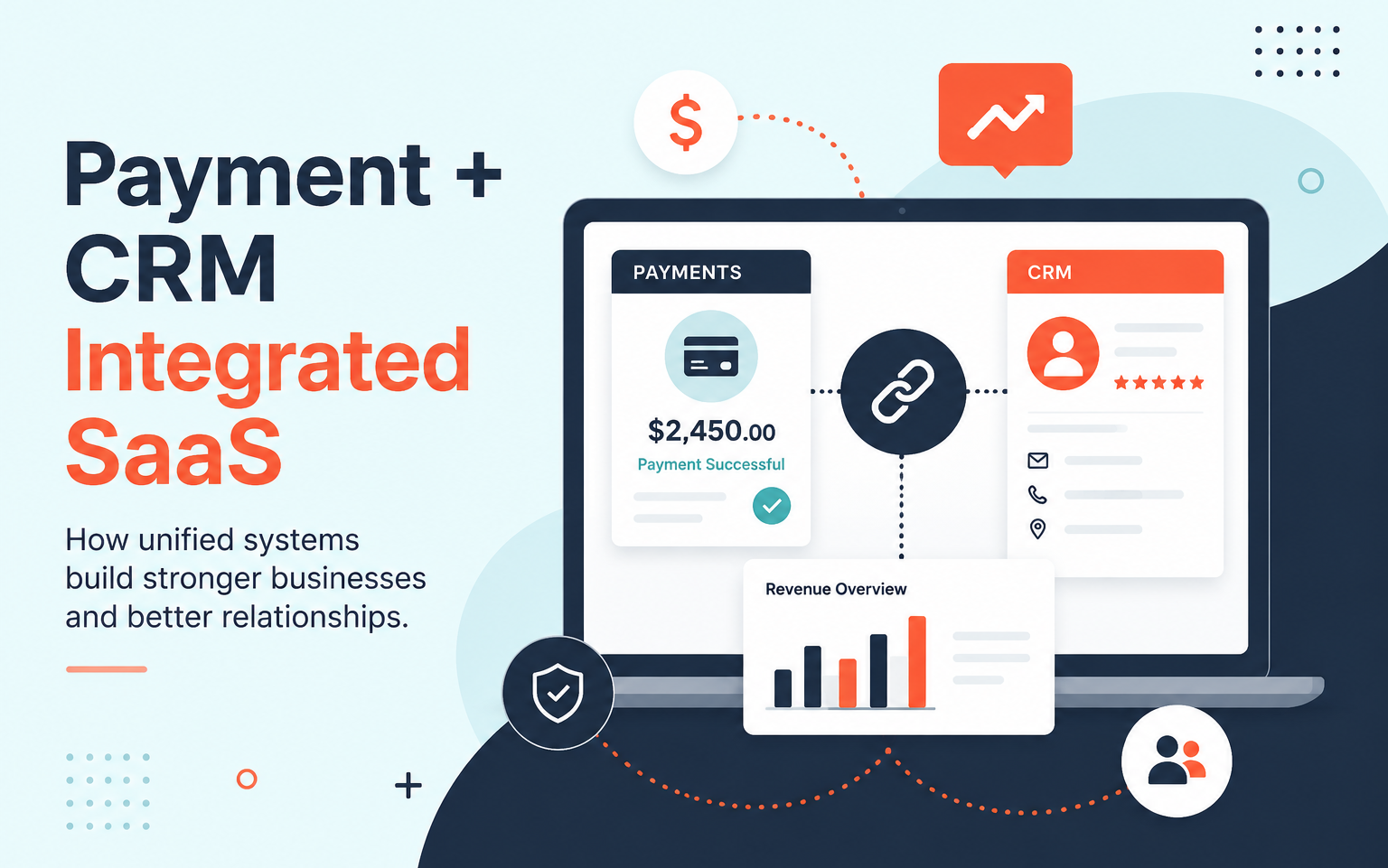
Payment + CRM integrated SaaS platforms are designed to collapse this gap.
Instead of treating payments and customer data as separate systems, they unify them into a single operational layer where every transaction is automatically tied to a customer profile, and every customer action can influence payment logic.
At a high level, this means:
- Every payment event updates the CRM in real time
- Every CRM action can trigger billing or pricing changes
- Every customer interaction is financially contextualized
This is not just integration. It is convergence.
The SaaS model itself evolves from being a collection of modules into a connected intelligence system where revenue, behavior, and engagement are continuously mapped against each other.
What an Integrated Payment + CRM SaaS Actually Does
To understand its impact, it helps to break down its core capabilities:
- Real-time payment syncing with customer profiles
- Automated subscription lifecycle management
- Behavioral triggers tied to billing events
- Unified customer and revenue dashboards
- Intelligent segmentation based on payment history
- Embedded invoicing and collections inside CRM workflows
This allows businesses to stop switching between systems and instead operate from a single source of truth.
Real-World Use Cases That Are Driving Adoption
The value becomes clearer when applied to actual business scenarios.
1. Subscription Businesses
- Auto-renewal failures instantly update CRM status
- Sales teams get alerts when high-value accounts downgrade
- Win-back campaigns trigger based on payment inactivity
2. E-commerce Platforms
- Purchase history directly influences customer segmentation
- Abandoned carts are linked with payment intent signals
- Loyalty rewards are automatically calculated from transaction data
3. B2B SaaS Companies
- Contracts, invoices, and renewals are tied to account lifecycle stages
- Account managers see payment risk scores alongside engagement metrics
- Upsell opportunities are triggered by usage plus payment behavior
4. Fintech and Digital Services
- Risk scoring improves using combined payment and behavioral data
- Fraud detection benefits from CRM-level identity context
- Customer onboarding is streamlined with embedded payment flows
These use cases highlight a simple truth: payment data becomes far more powerful when it is connected to customer context.
Why Businesses Are Moving Toward This Model
The shift is not just about convenience. It is about compounding efficiency.
Key advantages include:
- Faster decision-making due to unified dashboards
- Reduced operational overhead from fewer tool integrations
- Improved customer retention through proactive engagement
- Higher revenue accuracy through real-time reconciliation
- Better personalization driven by financial behavior data
More importantly, it reduces the cognitive load on teams. Instead of asking “What happened in payments?” and “What happened in CRM?”, teams ask a single question: “What is happening with this customer?”
Under the Hood: How These Systems Are Built
While the user experience is simple, the architecture behind Payment + CRM SaaS platforms is layered and data-intensive.
Typical components include:
- Event-driven architecture for real-time syncing
- Payment gateway integrations with multiple providers
- CRM database with unified customer identity resolution
- Middleware layer for workflow automation
- Analytics engine for revenue and behavioral insights
- API-first design for third-party extensibility
A simplified flow looks like this:
- Customer initiates payment
- Payment gateway processes transaction
- Event is pushed to integration layer
- CRM record is updated instantly
- Automation engine triggers relevant workflows
- Analytics system logs behavioral impact
This continuous loop is what enables real-time intelligence rather than delayed reporting.
Challenges That Still Need Solving
Despite its advantages, this model is not without complexity.
Some ongoing challenges include:
- Data consistency across multiple payment providers
- Regulatory compliance across regions and currencies
- Identity resolution for multi-channel customers
- Migration difficulty from legacy CRM systems
- Handling failed or partial payment states accurately
- Ensuring system reliability at high transaction volumes
Security also becomes a major concern because financial and customer data now live in the same ecosystem, increasing the stakes for encryption, access control, and auditability.
The Future: From Integration to Autonomous Revenue Systems
The next evolution of Payment + CRM integrated SaaS is likely to move beyond dashboards and automation into autonomous decision systems.
We are already seeing early signals of:
- AI-driven revenue forecasting based on combined datasets
- Automated pricing adjustments based on customer behavior
- Predictive churn prevention using payment anomalies
- Smart contract-based subscription enforcement
- Self-healing billing systems that correct failed transactions
In the long term, businesses may no longer manually manage payment workflows at all. Instead, systems will continuously optimize revenue flows in the background while teams focus on strategy and growth.
Conclusion: The End of Silos in Revenue Systems
Payment systems used to be where money moved. CRM systems used to be where customer stories lived. For a long time, these were separate worlds with separate logic.
That separation no longer reflects how modern businesses operate.
Payment + CRM integrated SaaS represents a structural correction to that mismatch. It brings money and meaning into the same system, allowing companies to understand not just who their customers are, but how they behave financially in real time.
The result is not just better software. It is a more accurate view of the business itself.
And in an economy where timing, retention, and personalization decide winners, that accuracy is no longer optional.