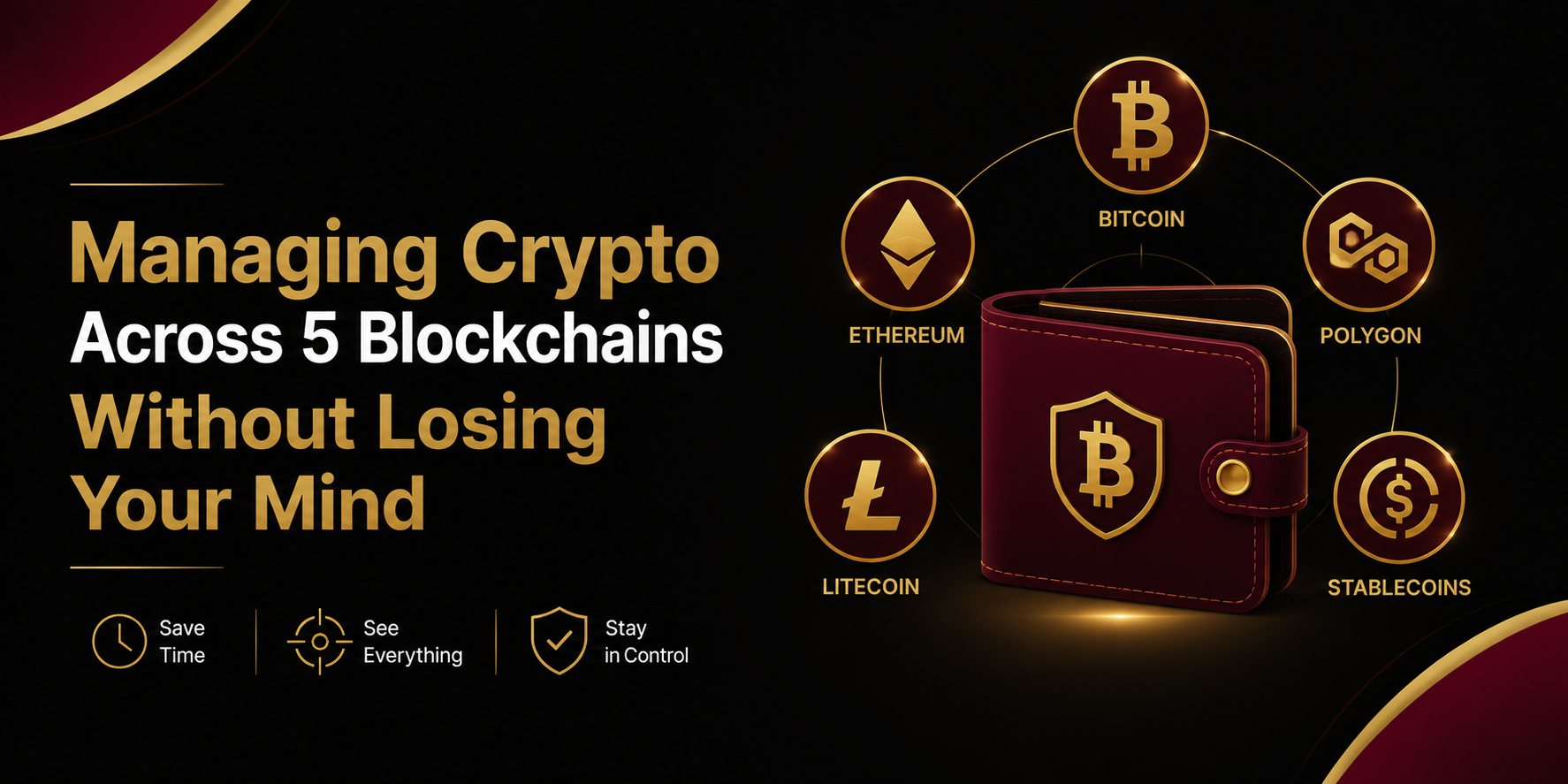
Managing Crypto Across 5 Blockchains Without Losing Your Mind
 BancWall10 min read·Just now
--
Picture this. You wake up on a Tuesday morning, open your phone, and start your usual routine of checking your crypto portfolio. Except it is not a routine anymore. It is a scavenger hunt. You check MetaMask for your Ethereum and Polygon tokens. You switch to a different app for your Bitcoin. Your Litecoin is sitting in yet another wallet you downloaded eight months ago. Your stablecoin position is on an exchange. And somewhere in the back of your mind, you are almost certain there is a small amount of something on a network you cannot quite remember. By the time you have a rough picture of what you own, fifteen minutes have passed, you have entered four different passwords, and you still are not entirely sure the numbers are current.
This is not an edge case. This is the daily reality for the majority of crypto investors in 2026, and it is a problem that the industry created entirely for itself.
The blockchain ecosystem has expanded at a pace nobody could have predicted. Over a thousand independent blockchain networks now operate simultaneously, each with its own rules, token standards, and transaction mechanics. Bitcoin, Ethereum, Polygon, Litecoin, BNB Chain, Solana, Avalanche and dozens of Layer 2 networks have all carved out genuine utility. The result is a world where a thoughtfully diversified crypto portfolio almost inevitably spans multiple chains. And for years, the only way to manage that portfolio was to juggle multiple apps, multiple wallets,
and multiple sets of recovery phrases while hoping you did not mix something up.
The good news is that this fragmentation is a solved problem. The tools to manage your entire crypto life in one place exist, and they are better in 2026 than they have ever been. The bad news is that most investors have not made the switch yet, either because they do not know what to look for, or because they got used to the chaos. This piece is about helping you fix that.
Around 62% of crypto users manage more than one wallet. Most of them are doing it the hard way.
The Real Cost of Fragmented Wallets
When people talk about the risks of multi-chain investing, they usually focus on smart contract exploits, bridge hacks, or phishing attacks. These are real and worth taking seriously. But there is a quieter, more mundane risk that gets almost no coverage: the cost of not knowing where you stand.
Consider what actually happens when your portfolio is scattered. You make decisions on incomplete information. You check one wallet, see a token is down sharply, and make a move without realising your overall position is healthier than it looks because another chain is performing well. You forget about a small holding somewhere, and when you need liquidity, you do not even factor it into the picture. You miss a run on an asset because by the time you logged into the right app, the moment had passed.
These are not catastrophic failures in isolation. They are slow, grinding inefficiencies that compound quietly over time and erode returns in ways that are almost impossible to track.
There is also the operational burden to consider. Managing multiple wallets means managing multiple recovery phrases, multiple passwords, multiple security setups, and multiple points of potential failure. Every additional wallet you maintain is another surface area for error. Sending tokens to the wrong network address is one of the most common and entirely irreversible mistakes in crypto, and it becomes more likely every time you are switching between interfaces mid-transaction. The complexity is not just inconvenient. It is genuinely dangerous for your assets.
On top of all of this sits the mental overhead. Crypto markets move fast. The window between a meaningful signal and a meaningful price move can be very narrow. If your response time is slowed by having to open three apps, verify balances across four networks, and mentally reconcile numbers that are all in different places, you are perpetually a step behind the market. Clarity is a competitive advantage, and fragmentation destroys it.
Why the Multi-Chain Reality Is Not Going Away
Some investors respond to this problem by deciding to simplify their exposure, pulling back to one or two chains and letting the rest go. This is a reasonable approach if you have a specific investment thesis that only requires Bitcoin and Ethereum. But for most investors in 2026, it is not actually viable.
Different blockchains have developed genuine and distinct strengths. Ethereum remains the backbone of DeFi and smart contract infrastructure, handling millions of transactions daily. Polygon has become the go-to network for low-cost, high-speed transactions and is home to a growing ecosystem of consumer-facing apps. Bitcoin is the most liquid, most widely held, and most institutionally recognised store of value in crypto. Litecoin continues to offer fast, low-fee payments. Stablecoins do their most useful work when they can move across chains fluidly to meet liquidity needs
wherever they arise.
The idea that you can get full exposure to what crypto has to offer while staying on a single chain has become increasingly difficult to defend. The opportunity set is distributed. The ecosystem is multi-chain by design. Trying to participate fully while confining yourself to one network is like deciding to only travel within a single city because switching between modes of transport is complicated. The complication is real, but the solution is better transit, not staying home.
Industry data confirms that the market has already figured this out. The global crypto wallet market is projected to reach $100 billion by 2033, growing at over 26% annually, driven in large part by demand for wallets that can navigate multiple networks without requiring users to become infrastructure engineers. The direction is clear. Multi-chain is not a phase crypto is passing through. It is the permanent state of the ecosystem, and the tools need to match.
The opportunity set in crypto is distributed across chains. Your wallet should be too, and your dashboard should make that feel effortless.
What a Unified Dashboard Actually Changes
The phrase ‘unified dashboard’ gets used a lot in crypto product marketing, and like most overused phrases, it has lost some of its meaning. So let us be specific about what it actually means to have a genuinely unified view of your multi-chain portfolio, and why the difference matters.
A real unified dashboard aggregates every asset you hold, across every blockchain you hold it on, and presents it as a single coherent picture. Not approximate numbers pulled from a cached sync. Not a display that requires you to switch between network views to see the full picture. A live, accurate, complete representation of your financial position in crypto, updated in real time as prices move and transactions confirm. You see your total portfolio value. You see how each asset is performing. You see your allocation across chains. You see market cap, circulating supply, all-time high data, and price trends without switching apps or doing arithmetic in your head.
The practical impact of this is larger than it sounds. When your information is consolidated, you make better decisions. You catch overexposure to a single asset before it becomes a problem. You notice idle capital on one chain that could be working harder somewhere else. You respond faster to market movements because you understand your full position at a glance rather than assembling it from memory. For active investors, this difference in decision quality adds up significantly over time. For investors who check in less frequently, it simply means less stress and fewer missed signals.
There is a deeper benefit too, one that is harder to quantify but very real. When managing your portfolio feels manageable, you engage with it more thoughtfully. You are less likely to make panicked decisions based on partial information. You are more likely to stick to a strategy. The psychological effect of clarity should not be underestimated. Most bad crypto decisions happen when investors are operating in a fog, reacting to incomplete information with a sense of urgency they would not feel if
they could see the full picture.
The Problem With Using External Trackers
A common workaround for the fragmentation problem is to use a separate portfolio tracking app alongside your various wallets. Apps like CoinStats, Zerion, DeBank, and Delta have built real audiences by solving exactly this problem, and for many users they are genuinely useful. But this approach comes with trade-offs that are worth understanding.
First, portfolio trackers are observers, not operators. They can show you what you own, but they cannot do anything about it. If you see that an asset has moved and you want to act, you still need to go back to the relevant wallet or exchange and execute there. You have added a layer of visibility, but not eliminated any of the operational friction. You are still juggling multiple tools.
Second, connecting external trackers to your wallets and exchange accounts requires varying degrees of data sharing. Most reputable trackers access wallet data through read-only public addresses or limited API keys, but you are still feeding information about your holdings into third-party systems. For users who are thoughtful about privacy and security, this is a consideration worth weighing.
Third, and most practically, keeping a tracker in sync with your actual holdings requires discipline. Wallets need to be connected and kept current. Manual entries need to be made for assets or networks that are not automatically detected. The tracker is only as accurate as the maintenance you put into it, and for busy investors, it becomes one more thing to manage rather than one less.
The cleaner solution is not to add a layer on top of fragmented wallets. It is to start with a wallet that is already designed to present your full multi-chain picture in one place. When the dashboard and the custody are unified, the observer and the operator are the same tool. Nothing is out of sync because there is nothing to sync.
How BancWall Approaches This Problem
BancWall was built around the understanding that modern crypto investors do not live on one blockchain, and their wallet should not either. The multi-chain reality shaped the architecture from the beginning, not as an afterthought added to a single-chain product, but as the foundational design principle.
From a single BancWall account, you can store, manage, buy, sell, swap, and earn with assets across all major blockchain networks, including Bitcoin, Ethereum, Polygon, and Litecoin, alongside stablecoins and tokenised assets. This includes BancWall’s native tokens, BancCoin (BCCN) and BancX (BANCX), which operate on the Polygon network and bring a gold-anchored, low-volatility asset class into the same unified view. Every asset, regardless of which chain it lives on, appears in one dashboard.
That dashboard is not just a list of balances. It is a real-time intelligence layer over your full portfolio. Every asset is tracked with live price data, market capitalisation, circulating supply, and all-time high information, updated continuously as markets move. You can see your total portfolio value at any moment, understand how each position is performing relative to its own history, and spot allocation imbalances before they become meaningful. The kind of context that used to require multiple apps and significant manual effort is now available in a single view, always current, always complete.
BancWall is fully non-custodial, which means you are not trading visibility for custody risk. Your private keys remain entirely under your control. The unified dashboard does not require you to hand your assets to a third-party platform in order to see them. You own the assets, you hold the keys, and you see everything in one place. These things are not in tension here. They are designed to coexist.
The base wallet service is free to sign up and use. Swap fees apply at standard network rates, as they do with any blockchain transaction, and there are no platform charges layered on top for the privilege of seeing your own portfolio. The experience is intentionally accessible. BancWall is built for the investor who takes crypto seriously but also has other things to do with their Tuesday morning.
Complexity Is a Choice You No Longer Have to Make
The fragmentation of the multi-chain ecosystem is real, and it is not going anywhere. Over a thousand blockchains are not going to consolidate into one. Bitcoin is not going to merge with Ethereum. The diverse, distributed nature of the crypto landscape is a feature of how it was built, and the opportunities it creates are genuine. The question is not whether to engage with a multi-chain world. The question is whether you are going to do it the hard way or the smart way.
Jumping between five apps, maintaining multiple wallets with separate security setups, and trying to hold a complete picture of your holdings in your head is the hard way. It worked when portfolios were simpler and the stakes were lower. In 2026, it is an unnecessary source of friction, risk, and missed opportunity.
A unified dashboard that gives you real-time visibility across all your chains, without requiring you to sacrifice custody of your keys or pay a premium for the privilege, is the smart way. It exists. The technology is mature. The only thing left is to use it.
If you have been managing your portfolio across multiple wallets and wondering when it was supposed to get easier, the answer is now. BancWall is free to get started, and your first look at your full portfolio in one place might be the most useful thing you do for your crypto strategy this week.
Get started at bancwall.com and see your entire crypto portfolio in one unified dashboard. Free to sign up. All chains. Real-time. Yours.