When Identity Became Infrastructure
 Strategy Piku6 min read·Just now
--
There was a time when the internet felt largely transactional. You logged on to search, to browse, to communicate, perhaps to purchase something. Platforms were tools, identities were relatively stable, and digital behaviour, while expansive, still remained tethered to the logic of the physical world. Brands spoke. Consumers responded. Communities formed, but mostly around shared interests that existed independently of the platforms hosting them.
Increasingly, that no longer feels true. The internet today appears less like a layer placed over reality and more like an environment within which identity itself is continuously constructed, negotiated, and performed. And as technologies such as AI, blockchain, and decentralised systems slowly move from abstraction toward everyday utility, the nature of that construction seems to be shifting again. Not dramatically or all at once, but gradually enough that the implications are easy to miss while they are happening.
What makes this particularly interesting from a marketing perspective is that the shift does not appear to be technological alone. It appears behavioural.
The Internet No Longer Reflects Culture. It Produces It.
Much of early digital marketing was built on the assumption that the internet functioned primarily as a distribution layer. Brands created narratives, platforms amplified them, and users consumed or responded to them within relatively predictable structures.
But somewhere over the last decade, the relationship inverted. Platforms stopped merely hosting culture and began actively shaping it. Algorithms influenced visibility. Recommendation systems altered discovery. Online communities developed their own languages, aesthetics, and systems of validation that increasingly operated independently of institutional media or traditional brand authority.
In many ways, internet culture ceased to be a subculture. It became the culture-producing mechanism itself. And once that happened, identity began to behave differently online.
Identity as Performance, Then as Participation
What initially emerged through social platforms was performative identity. Carefully curated versions of the self shaped through images, posts, affiliations, and visible signals of taste or status. Platforms such as Instagram accelerated this logic by making identity increasingly visual, measurable, and comparative.
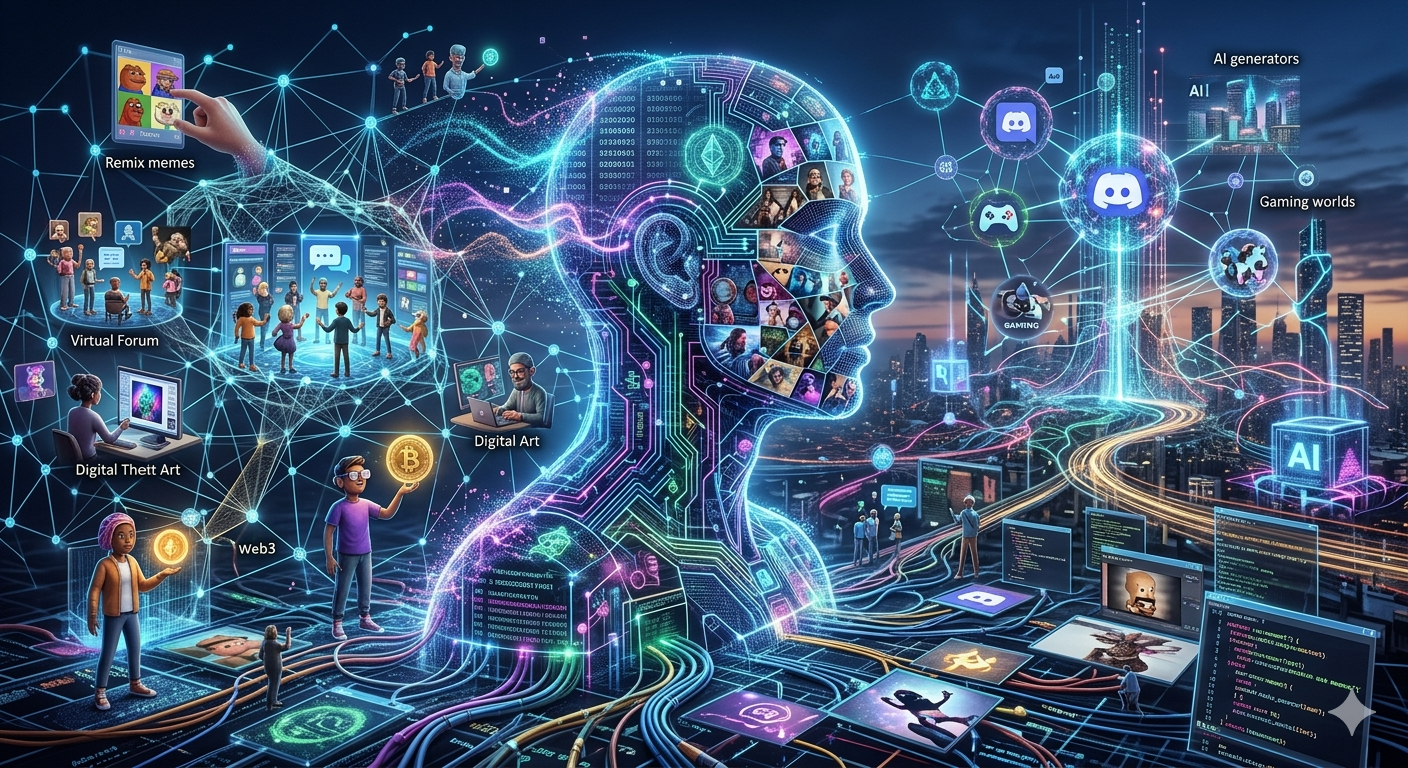
But what seems to be happening now is slightly more complex. Identity is becoming participatory. A person no longer simply consumes a cultural environment online. They contribute to it continuously. Through memes, remix culture, comments, creator ecosystems, gaming environments, fandom communities, and increasingly through AI-generated forms of expression that blur the line between creator and audience.
The result is that communities no longer gather merely around products or interests. They gather around shared interpretations of reality itself.
AI and the Collapse of Creative Distance
AI complicates this further because it reduces the distance between imagination and execution. For most of internet history, there remained a gap between wanting to create and possessing the technical ability to do so. AI increasingly compresses that gap. Images, writing, music, avatars, even synthetic personalities can now be generated with minimal friction, often at a speed that fundamentally alters the rhythm of cultural production itself.
This does not simply increase the volume of content. It changes the nature of participation. A user can now generate variations of identity almost endlessly (different personas, aesthetics, ideological positions, creative outputs) each tailored to specific communities or contexts.
In such an environment, authenticity itself becomes harder to define, not necessarily because people are being deceptive, but because identity becomes increasingly modular. And marketing, which has historically depended on stable audience definitions, begins to encounter a moving target.
Community Is Becoming More Valuable Than Audience
This shift is perhaps most visible in the growing importance of digitally native communities. Traditional marketing frameworks tend to prioritise reach: larger audiences, broader visibility, greater scale. But many of the most culturally influential spaces online today are not necessarily the largest. They are the most cohesive.
Discord servers. Private Telegram groups. Reddit subcultures. Gaming communities. Crypto-native ecosystems. These spaces often function less like audiences and more like social environments with their own internal rules, values, and economies of trust.
What matters within them is not merely visibility. It is participation.And participation requires fluency.
Web3 and the Question of Digital Ownership
This is where concepts associated with Web3 and blockchain become culturally interesting, even beyond their financial or technological implications. Much of the conversation around Web3 has focused on speculation (cryptocurrencies, NFTs, decentralised finance) often overshadowing the more subtle behavioural shift taking place beneath those headlines.
Because at its core, Web3 introduces a different idea about how identity and participation might function online. Ownership becomes portable. Reputation becomes community-linked rather than platform-linked. Participation itself can become economically embedded. Whether or not the current forms of these technologies persist is almost secondary to the behavioural precedent they introduce.
The idea that users may increasingly expect not just access to digital environments, but some degree of stake, contribution, or identity continuity within them.
This is already visible in fragments. Gaming economies where virtual items carry social meaning. NFT communities that function less as investment vehicles and more as identity markers. Token-gated communities where belonging itself becomes part of the value exchange. These systems remain early, uneven, and often speculative. But culturally, they suggest a subtle shift away from passive consumption toward participatory affiliation.
Brands Are No Longer Entering Culture From the Outside
One of the more interesting implications of all this is the changing role of brands themselves. Historically, brands operated as external storytellers. They observed culture, interpreted it, and inserted themselves into it through campaigns and positioning.
Increasingly, that distance appears difficult to maintain. Because internet-native communities often expect brands not merely to communicate, but to participate. To understand references, respond in real time, and behave with a level of contextual fluency that traditional campaign cycles struggle to accommodate.
This creates tension. A brand seeking relevance must become culturally adaptive. But excessive adaptation risks appearing performative. And performative participation is detected very quickly in environments shaped by highly networked communities. Which may explain why some of the most successful digital-native brands today behave less like institutions and more like evolving personalities.
The Fragmentation of the Self
What AI, internet culture, and decentralised communities collectively seem to be producing is a more fragmented but also more fluid model of identity online. A single person may simultaneously exist as:
- A professional identity on LinkedIn,
- A creator identity on TikTok,
- An anonymous participant within a Discord community,
- A gamer within a virtual economy,
- And a co-creator within AI-assisted spaces.
None of these identities are entirely false. But neither are they fully unified. And as these layers multiply, consumer behaviour becomes harder to reduce to static segmentation models or predictable demographic categories.
People do not simply belong to markets anymore. They move between cultural states.
Closing Thought
It is tempting to think of AI, Web3, and internet culture as separate trends unfolding in parallel. But increasingly, they appear interconnected. AI lowers the barrier to creation. Communities reshape how identity is formed and validated. Web3 introduces new ideas around ownership and participation. And together, they begin to alter the relationship between individuals, platforms, brands, and culture itself.
Whether this leads to deeper fragmentation or entirely new forms of collective identity remains unclear. What does seem increasingly difficult to ignore, however, is that the internet is no longer simply a place where culture is observed. It is becoming the place where culture is negotiated in real time. Through algorithms, communities, synthetic identities, and networks of participation that are still only beginning to take shape.
And somewhere within that shift lies a question that marketing, perhaps more than any other discipline, will eventually be forced to confront: When identity itself becomes fluid, participatory, and continuously generated, what exactly does it mean to build a brand for people who are still in the process of building themselves?