Why I Stopped Chasing APY, And Started Using Vaults
--
There’s a moment almost every DeFi user eventually hits.
Usually around 2AM.
You’re tabs deep into five different dashboards, checking whether a farm still has enough liquidity, whether rewards are worth compounding, whether gas is low enough to rebalance, whether the “safe” strategy from last week is suddenly underwater.
And somewhere in the middle of all that, you realize something weird:
You’re spending more time managing capital than growing it.
That’s the part nobody talks about when they sell the dream of DeFi.
DeFi Didn’t Just Create Opportunity. It Created Maintenance.
At first, manual DeFi feels empowering.
You control everything.
You decide where liquidity goes.
You chase the best APY.
You move between protocols faster than everyone else.
It feels active. Smart. Competitive.
Until you realize most of your “strategy” is actually operational labor.
Refreshing dashboards.
Claiming rewards.
Repositioning liquidity.
Monitoring emissions decay.
Tracking risk manually.
And the more DeFi expands, the worse this gets.
More chains.
More protocols.
More complexity disguised as opportunity.
Eventually the question changes.
Not:
“Where’s the best yield?”
But:
“Why am I manually doing the job infrastructure should handle?”
That’s the moment vaults start making sense.
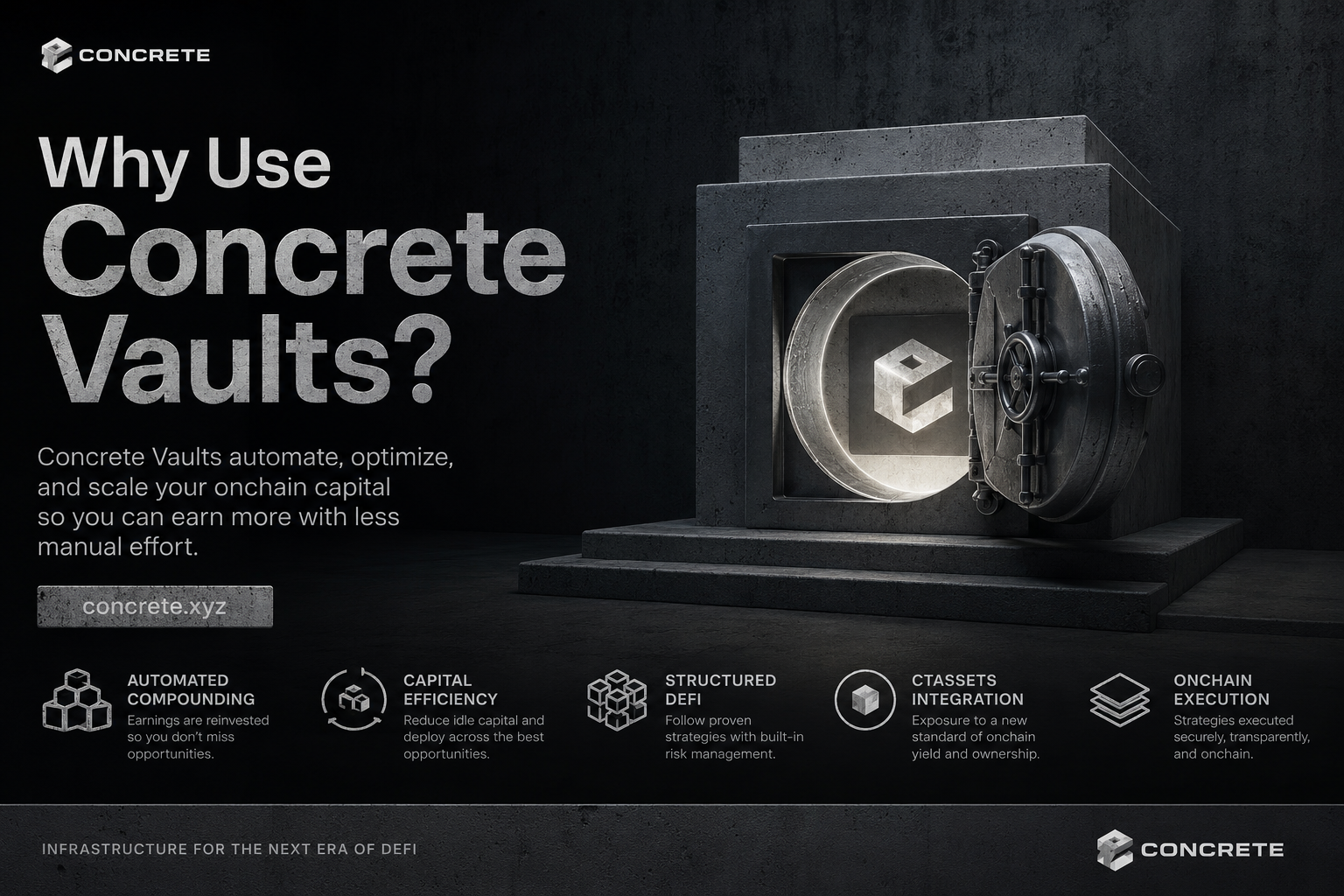
A Concrete Vault Isn’t Just a Container
A lot of people hear the word “vault” and think:
“Oh, it just auto-compounds.”
That’s like calling a trading desk a calculator.
A Concrete Vault is not just a place capital sits.
It’s a structured system designed to coordinate capital more efficiently than an individual user realistically can.
Instead of manually hopping between opportunities, users deposit into a system that:
Aggregates liquidity
Deploys capital across strategies
Compounds automatically
Optimizes positions over time
Continuously manages exposure onchain
The important part isn’t automation alone.
It’s coordination.
The Hidden Cost of Manual DeFi
Here’s the thing most users underestimate:
Idle capital quietly destroys returns.
Not because markets crashed.
Not because the strategy failed.
But because humans are inconsistent.
People forget to compound.
They hesitate to rebalance.
They react emotionally to volatility.
They move too late.
Or too often.
In DeFi, inefficiency compounds just as aggressively as yield does.
And most users are carrying more inefficiency than they realize.
That’s why vault infrastructure matters.
Not because users are incapable.
But because systems outperform manual repetition.
The Difference Between Access and Management
DeFi already solved access.
Anyone can deploy capital.
The harder problem is management.
How do you continuously optimize capital deployment without requiring users to become full-time operators?
That’s where Concrete Vaults feel fundamentally different from the old “farm-and-refresh” model.
They create structured exposure.
You’re no longer manually managing every position yourself.
You’re participating in a coordinated system designed to manage capital continuously.
That distinction matters more than people think.
Why Structure Matters
Good vault infrastructure is not just about yield.
It’s about discipline.
Concrete Vaults are designed with systems that coordinate:
Capital deployment
Position rebalancing
Strategy constraints
Onchain execution
Automated compounding
That creates something DeFi historically struggled with:
Consistency.
Not “highest APY this week.”
Not temporary emissions spikes.
Just structured capital management operating continuously in the background.
That’s a very different philosophy from traditional yield farming.
ctAssets Change the Experience
One of the smartest parts of the system is how ctAssets simplify exposure.
Instead of constantly managing multiple moving parts manually, users hold a representation of their position while the vault handles the operational complexity underneath.
The experience becomes cleaner.
Less micromanagement.
Less fragmentation.
Less time reacting.
More time actually letting capital work.
And honestly, that’s what most people wanted from DeFi in the first place.
The Bigger Shift Happening in DeFi
DeFi is growing up.
The early era rewarded people who could move fastest between protocols.
The next era will reward systems that coordinate capital most efficiently.
Because manual strategy management does not scale.
Not for retail.
Not for institutions.
Not for global onchain finance.
Infrastructure scales.
Vault systems scale.
Structured execution scales.
That’s why I think the future of DeFi won’t belong to the people clicking between dashboards all day.
It’ll belong to systems designed to make capital move intelligently by default.
And that’s exactly why Concrete Vaults matter.
Explore Concrete at https://concrete.xyz/ 🚀