What Role Do Governance Tokens Play in the Long-Term Sustainability of DEXs?
 Divyesh Patel7 min read·Just now
--
The concept of decentralized exchanges has developed way beyond the concept of a token-swap interface. They are today living ecosystems that operate on a community-owned governance, programmable incentives and a well thought-out token mechanics. The governance token is the central element in this evolution, and it is undervalued. However, even with its centrality, not many participants are aware of the technical depth, economic rationality, or long-term consequences of how the governance tokens actually sustain a DEX in reality and make it evolve.
This article will provide an in-depth, technical examination of the mechanisms of governance tokens, why their design distinguishes successful protocols and forks that die, and what the current DEXs, with the innovative trends of Dexlyn and Curve Finance in the lead, are getting right in the year 2025 and beyond.
What is a Governance Token?
A governance token is a cryptographic resource which provides its owner with a proportional say in the decision-making of a decentralized protocol. However, when it comes to a DEX, it is much more than a mere voting mechanism. Governance tokens enable their holders to propose and vote on upgrades to the protocol, parameter changes, and fee structures, and risk management strategies, as well as to maintain constant alignment between stakeholder interests and the long-term success of the platform.
The important difference between a well-designed and poorly-designed governance token is whether the holding of the token is associated with the real economic utility — not merely a symbolic vote. Governance utility rewards the retention of tokens over the long term because retaining tokens gives a consistent ability to decide, which generates economic stability by eliminating speculative trading pressure and motivating the stakeholders to invest in long-term growth.
Vote-Escrow Model: Long-Term commitment Engineering
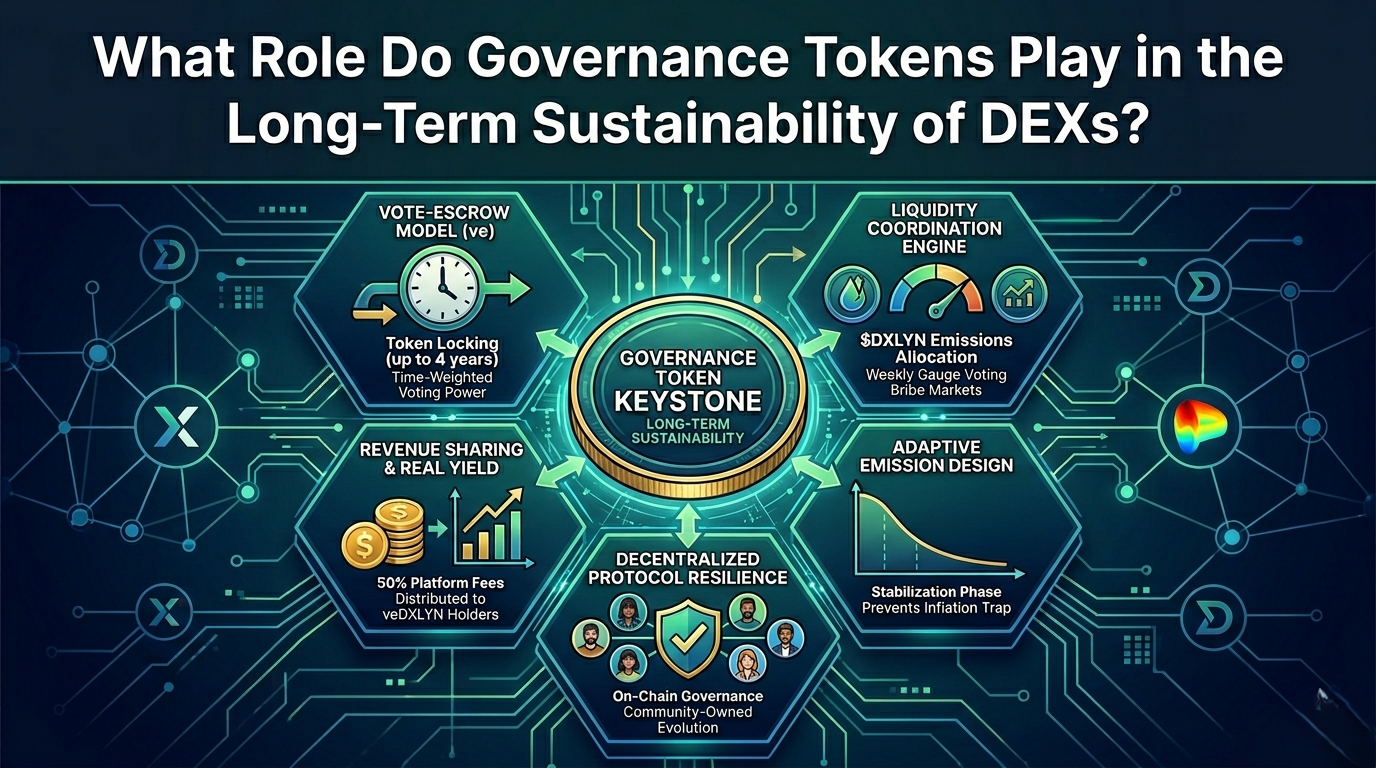
A vote-escrow (ve) governance design, introduced by Curve Finance and its veCRV system, is the most technical design to have surfaced in DeFi. The vote-escrowed governance model of Curve uses long-term commitment by incentivizing users to lock tokens of CRV between one week and four years, earning them a veCRV granting voting rights, increased pool rewards up to 2.5x, and fee rebates — instead of incentivizing participants to act solely in the short term to extract protocol health.
Dexlyn is a future-generation DEX based on the Supra Network that goes a step further with its ve(3,3) tokenomics model. The token holders of $DXLYN have the option of locking their tokens in veDXLYN during periods of one week to four years. The weight is linear: a 1,000 $DXLYN locked up to the maximum of four years will give 1,000 veDXLYN, and 1,000 $DXLYN locked up to the maximum of one year will give 250 veDXLYN. The time-weighted system means that those who have been believers over time will gain greater governance power than those who are short-term speculators — essentially deciding who can drive the protocol.
This locking mechanic also provides anti-dilution protection. The rebase mechanism of Dexlyn equally allocates new emissions among the holders of veDXLYN, so that those who hold governance positions do not lose their voting power as the overall amount of supply increases. Rebase is strategically high when locking rates, in general, are low, which forms a self-reinforcing incentive to lock new participants and enhances governance participation in the long run.
Governance Tokens as Liquidity Coordination Engines
The use of governance tokens to guide liquidity is one of the most significant (and misconceived) purposes of a DEX. The ve model instead of using fixed liquidity mining programs, which draw mercenary capital, converts governance tokens into liquidity coordination mechanisms.
On Dexlyn, the veDXLYN electors vote weekly on what liquidity pool gauges are allocated $DXLYN emissions in the next epoch. The beginning of each epoch is on Thursday at 12:00 AM UTC. The pools with more votes will get a correspondingly higher allocation of weekly emissions, thus more liquidity providers. Any protocol and project aiming to provide greater liquidity to their tokens may provide external incentives, such as bribes, to veDXLYN holders to cast their votes in favor of their desired pool gauge.
This bribe market makes governance a liquidity competitive market. Product-first sustainable tokenomics protocols such as Curve were able to maintain users and remain market leaders, and the liquidity mining programs during DeFi Summer were unsustainable as mercenary yield farmers would soon move onto the new protocols once they were farmed and dumped. This is exactly what the Dexlyn gauge voting system attempts to do: where governance requires it, emissions flow, and who governs is those who have a real economic stake in the game.
Revenue Sharing: Turning Governance Into Yield
A token of governance that merely gives the power to vote, but not to be economically rewarded will be discarded. The sustainable DEX design should bridge the gap between protocol revenue and token holders returns.
The model of fee distribution by Dexlyn is a good example of this alignment. The protocol has several streams of revenue: DEX trading fees, perpetual trading fees, bridge fees, and IDO listing fees. Half of the total platform fees are sold $DXLYN in the open market and paid back to veDXLYN holders as weekly dividends, which are apportioned based on veDXLYN holdings. The other half of it is allocated to protocol operations, liquidity incentives and ecosystem growth.
This buy and distribute system generates stable, organic demand for $DXLYN that is directly related to real platform usage — not speculation. The more difficult the protocol is, the greater the fees it generates, and the more value is directed to long-term participants in governance.
PancakeSwap shares a similar philosophy: its native token CAKE is currently supported by robust tokenomics and a burn mechanism and allows the project to maintain its value in the saturated market. The principle is the same — protocol revenue should provide a structured channel to token holders to maintain long term engagement.
Emission Design: Preventing the Inflation Trap
Uncontrolled inflation is one of the biggest threats to DEX tokenomics. When the emission schedule of a governance token mints excessively and lacks demand sinks, the value of the token falls, and the incentive system that it is supposed to enable collapses.
This is taken care of in the two-phase emission model by Dexlyn. The first twelve weeks (the Acceleration Phase) will see a two percent per week rise in the weekly emissions, which will encourage early liquidity growth and reward early adopters. Since Week 13 (Stabilization Phase), emissions are reduced by one percent per week — a gradual but regulated decrease that will reduce inflation but keep liquidity providers incentivized.
Experience of previous inflationary regimes has made many more recent protocols incorporate a capped supply, designed burn, or internalized incentives to hold and not to flip. The decaying emission schedule of Dexlyn is a perfect representation of this philosophy, as it guarantees that early adopters are not punished and instead receive an incentive to adopt the product without causing a supply overload, as many of its predecessor DEX tokens.
Decentralized Protocol Resilience and Governance Tokens
In addition to economics, governance tokens are an invaluable part of ensuring the structural soundness of DEXs. DEXs that have active communities and governance tokens give users a real say in the future development of the platform — be it by voting on protocol upgrades or fee mechanics — and user engagement is one of the most important indicators of sustainability in the long term.
A governance community, rather than a central team, votes on how to respond when a DEX experiences a market stress event or a smart contract vulnerability, or is threatened by a competitor. Such decentralized resilience can only exist in the situation when the tokens of governance are widely distributed, economically significant to possess, and technically enabled to make binding decisions on-chain.
The governance system at Dexlyn includes adapting fee structures, emission allocation among liquidity pools, and major protocol upgrades — all of which are decided by veDXLYN holders. Decentralized participation in governance has become a key pillar in modern best practices, and community incentives
such as staking rewards, liquidity provision, and participation in governance have developed self-reinforcing cycles whereby user contributions enhance network security and utility.
The Future: Governance Token as the Keystone to DeFi Longevity.
One thing has become evident in the DEX landscape in 2025: the protocols that viewed governance tokens as a side-thought have failed, whereas those that designed real utility, such as voting power, revenue sharing, emission control, and anti-dilution mechanisms, have created long-lasting moats. The generation of revenue, the utility of tokens that can be used in governance and sharing of fees, and the competitive positioning due to network effects and technical innovations have become the new standard of determining the long-term viability of a DeFi protocol.
The ve(3,3) architecture by Dexlyn illustrates the appearance of the next generation of governance-token-driven DEXs: a technically accurate, economically rational system in which the locking, voting, earning, and governing are not distinct processes but a unified flywheel. By locking DXLYN to veDXLYN, a user becomes eligible to vote on emissions, shares a portion of the protocol revenue, and is not diluted by rebases, and is in a bribe market that makes their vote economically valuable, all at the same time.
The implication of this is simple to builders, investors and the participants of DeFi. Governance tokens do not constitute governance theater. Properly constructed, rigorously, time-weighted locking, revenue-based rewards, adaptive emissions, and authentic on-chain authority can be the most significant part of a DEX in the long-term survival. The rules which internalize this lesson to-day are the rules which will be running and expanding and governing themselves for ten years hence.