What Quantitative Trading Really Looks Like — Beyond the Algorithms
 Sandy Wang4 min read·Just now
--
Hi, I’m Sandy, a high school student at an international school in Shenzhen, China, with a strong interest in the connection between education, career exploration, and the real world. While many students are asked to choose university majors and future paths early on, they often have limited exposure to what different professions actually look like. To help bridge that gap, I created this career interview series, where I speak with professionals across industries about their career journeys, daily work, challenges, and growth experiences. My goal is to provide students with clearer, more practical insights so they can make more informed decisions about their academic and professional futures.
In my last article, I shared how Carmen found her way into quantitative trading — from choosing her majors at UCL and Imperial College, to discovering her passion for quantitative finance. But one question still lingered: What does a quant actually do at work every day?
Most people picture quant trading as just coding, math, and numbers flashing on screens. But after talking to Carmen, I realized the job is much more dynamic, practical, and human than I expected. This episode pulls back the curtain on what a career in quant really looks like.
A Simple Way to Describe Her Job
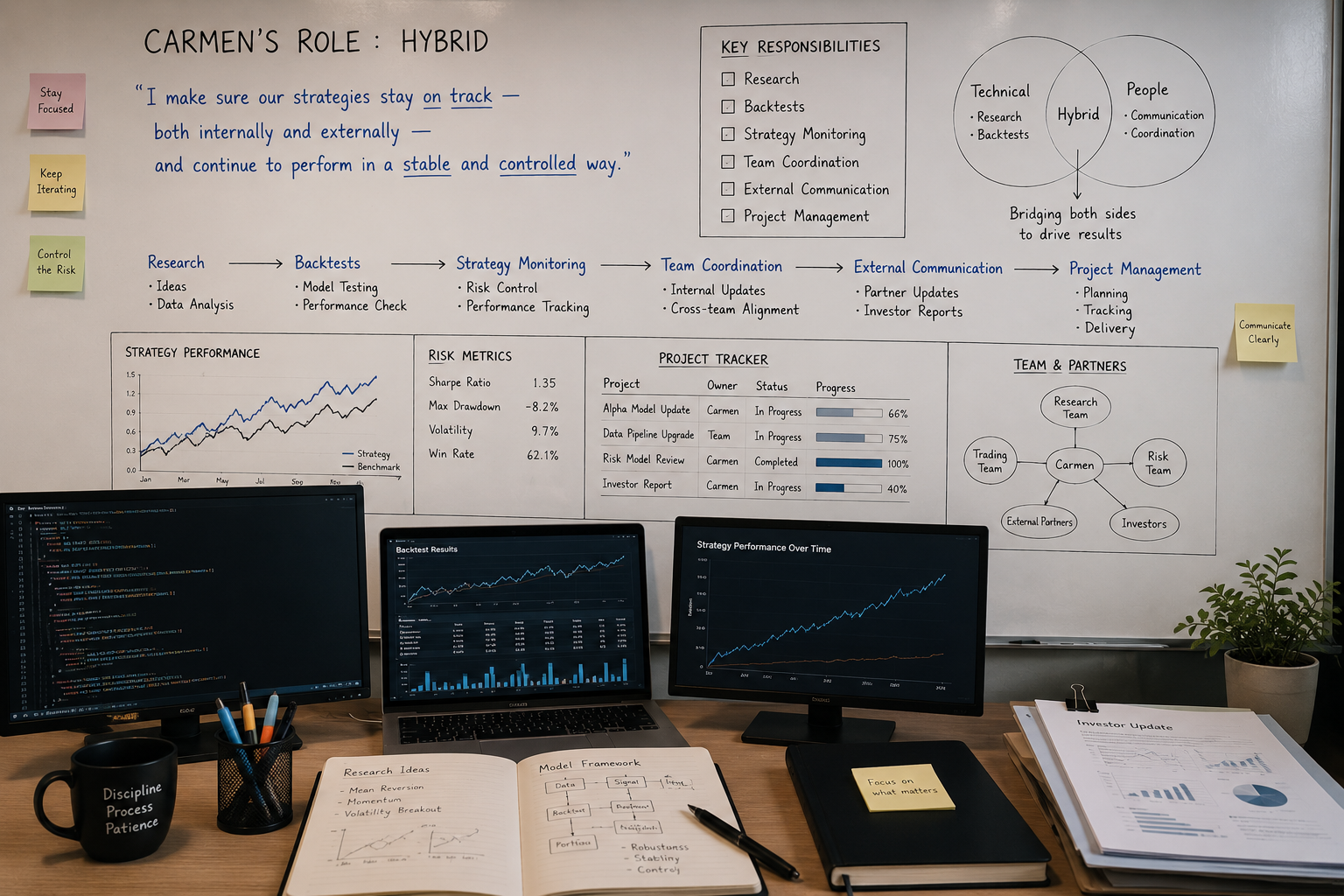
Carmen’s role is hybrid — she does research, runs backtests, coordinates with different teams, and even manages projects. When I asked her to sum up her work in one sentence, she said: I make sure our strategies stay on track — both internally and externally — and continue to perform in a stable and controlled way.
Since quant teams are usually small, people often take on more than one job. Carmen handles both technical work and external relationships because she’s good at communicating across different areas.
Inside the Team: Research & Strategy
Internally, she works with researchers and traders to improve strategies.
- She tests new alpha factors to see if they work.
- She analyzes how strategies behave in different market environments.
- She builds filters to control risk and keep performance steady.
The goal isn’t just to make more profit — it’s to make the strategy stable and reliable, even when markets change.
Outside the Team: Partnerships & Infrastructure
Externally, she works with exchanges, brokers, and tech providers. She makes sure the team has fast, stable connections and reliable trading systems. For quant, especially high‑frequency trading, speed and stability can make a huge difference.
Data Analysis Isn’t Just About Profit
When it comes to data, Carmen looks at many kinds: stock indices like NASDAQ, A‑share markets, and commodity futures. But what surprised me is that maximizing profit isn’t the only goal.
She focuses more on:
- Better risk‑adjusted returns
- Smaller drawdowns
- Strategies that stay strong in both calm and volatile markets
She studies patterns in volatile periods to understand risk better — so the team can adjust before things get too risky.
Backtesting: The Heart of Quant Work
If there’s one foundational task in quant trading, it’s backtesting. Simply put, backtesting uses historical data to see how a strategy would have performed in the past.
Carmen’s team doesn’t just run a simple test. They:
- Define what each signal is supposed to do
- Use clean, real‑world data
- Include costs like transaction fees and slippage
- Test carefully to avoid overfitting
A strategy that works great in a bull market might fail completely in a sideways or volatile market. So robustness is everything.
What About High-Frequency Trading?
Yes, Carmen’s team also works on strategies like high‑frequency arbitrage and CTA trend‑following.
High-frequency arbitrage tries to catch tiny price differences across markets — but opportunities only last milliseconds. Success depends on speed, low latency, and strict risk control. It’s not as “wild” or random as people think; it’s highly systematic.
How She Balances Tech Work & Project Management
With so many different tasks, I wondered how she stays organized. Carmen said project management actually makes her more efficient. The key is prioritization: clear goals, broken-down tasks, and good communication.
In a small team, things move fast — but that also makes the work feel flexible and meaningful.
A Typical Day in Quant Trading
I was also curious about her daily routine. This is what a normal day looks like for her:
- First, check live strategy performance (many run 24/7)
- Morning team meeting to align priorities
- Afternoon focused on research, backtesting, and strategy optimization
- Business and coordination tasks throughout the day
The two things that take most of her time? Strategy optimization and working with different teams.
What I Learned From This Episode
Before this interview, I thought quant trading was just coding and math. Now I understand:
- Quant work is hybrid, not just technical.
- Risk management is just as important as making profits.
- Communication and partnership skills matter a lot.
- The job is structured, but never boring — markets keep changing.
This episode helped me see quant trading as a real, human career, not just a mysterious algorithmic job. Thanks Carmen for giving us such a clear, honest look inside the world of quantitative trading.