Crypto Regulation 2026: Did China Ban Bitcoin?
Opinions By Dan Burgin Sat, 9/05/2026 - 17:00 China has reinforced its sweeping ban on cryptocurrency activity, targeting offshore yuan-backed stablecoins and tightening restrictions on digital asset trading while continuing to push its state-controlled digital yuan strategy. Advertisement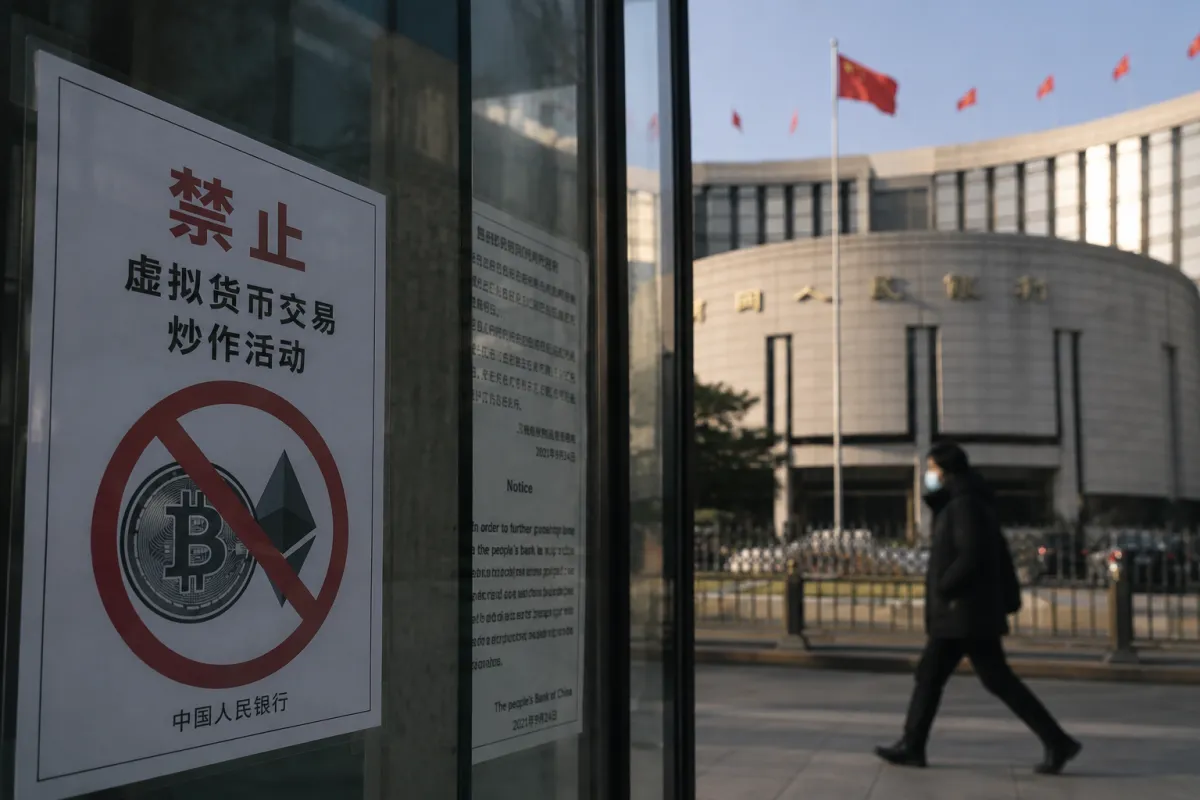

- China's crypto regulation: A brief history
- E-CNY: Bitcoin killer?
- Latest crypto ban
- Offshore RMB stablecoins face direct pressure
- China draws a line between blockchain and crypto
- Holding crypto remains a legal gray area
- Toward a regulated crypto environment
China's crypto regulation: A brief history
China’s approach to blockchain and cryptocurrency has evolved into a dual-track strategy: aggressively supporting blockchain infrastructure and digital currency development while limiting speculative cryptocurrency activity.
China was an early adopter of crypto, specifically in the sector of Bitcoin mining. 2013 marked an inflection point for mining in China, as Bitcoin began to receive nationwide media attention.
The rapid adoption of Bitcoin mining in China in Bitcoin’s early days led to Chinese dominance of Bitcoin’s hashrate, with their share peaking between 60% and 75% during the 2017-2020 period.
HOT Stories Crypto Regulation 2026: Did China Ban Bitcoin? Largest Swiss Bank Loads Up on Strategy (MSTR)In 2019, the President of the People’s Republic of China and General Secretary of the Communist Party of China publicly called for increased investment and development in blockchain technology.
Advertisement You Might Also Like Sat, 04/25/2026 - 23:59
Crypto Regulation 2026: U.S. Outlook
ByDan Burgin
Sat, 04/25/2026 - 23:59
Crypto Regulation 2026: U.S. Outlook
ByDan Burgin
Since then, China has accelerated efforts to integrate blockchain into government services, finance, and enterprise infrastructure.
The Chinese government later released a blockchain application blueprint for government services and introduced new cryptography laws that align with the country’s cybersecurity framework. China also expanded its Civil Code to allow inheritance rights related to virtual assets.
AdvertisementAt the same time, regulators continued tightening oversight of cryptocurrency markets. In 2017, Chinese authorities banned initial coin offerings (ICOs) and shut down domestic crypto exchanges, arguing that token sales constituted unauthorized public financing and posed risks including fraud and illegal fundraising.
E-CNY: Bitcoin killer?
In 2025, China has taken another decisive step in reshaping its digital asset landscape. Under the new regulatory framework, all private possession, trading, and mining of cryptocurrencies are now fully prohibited, with the digital yuan (e-CNY) designated as the only legal digital currency.
The People’s Bank of China (PBoC) officially implemented the ban on June 1, 2025, citing the need to ensure financial stability, reduce systemic risks, and strengthen national security.
This move builds upon earlier restrictions but now closes the final gap by targeting individual holdings as well as commercial activities.
At the same time, regulators are not turning away from digital innovation entirely. The Shanghai State-owned Assets Supervision and Administration Commission (SASAC) recently held discussions on stablecoins and blockchain strategy, signaling that select pilot areas may see more flexible rules in the future.
In line with the broader tightening, the revised Anti-Money Laundering Law has incorporated crypto-related transactions into the compliance framework, addressing long-standing gaps in monitoring illicit flows tied to digital assets.
Latest crypto ban
In February, the People’s Bank of China (PBOC), alongside the Ministry of Public Security and several other agencies, issued a joint notice declaring a broad range of crypto-related activities illegal.
Officials said speculative trading involving virtual currencies threatens financial stability and disrupts the country’s financial order.
The updated measures, often referred to as “Ban 2.0,” strengthen earlier restrictions and close many remaining loopholes involving offshore exchanges and peer-to-peer settlements.
Under the new framework, any company operating offshore is prohibited from issuing tokens tied to Chinese domestic assets or the yuan without explicit approval from Chinese authorities.
The directive follows the principle of “same business, same risk, same rules,” extending Beijing’s regulatory reach beyond mainland borders.
Offshore RMB stablecoins face direct pressure
The crackdown represents a major blow to offshore yuan stablecoin initiatives and could undermine Hong Kong’s ambitions to become a regional crypto hub.
As recently as June last year, Hong Kong officials had not ruled out the possibility of stablecoins pegged to the renminbi under a regulated framework. However, Beijing’s latest stance strongly suggests that privately issued RMB-linked stablecoins will not be tolerated without direct government oversight.
Regulators stated that stablecoins pegged to fiat currencies effectively perform monetary functions and therefore require strict supervision. Both domestic and foreign entities are now banned from issuing offshore yuan-backed stablecoins without authorization.
The measures are also designed to prevent capital flight and maintain tighter control over China’s financial system.
China draws a line between blockchain and crypto
Despite the stricter ban on cryptocurrencies, Beijing continues supporting blockchain technology under tightly controlled conditions.
China has embraced a “walled garden” strategy that permits tokenization and blockchain development only through approved systems such as the Blockchain-based Service Network (BSN). Authorities appear increasingly interested in regulated real-world asset (RWA) tokenization, particularly involving officially sanctioned infrastructure.
Some analysts believe the latest notices indicate that China may be laying groundwork for a formal legal structure around RWA tokenization, even while maintaining its prohibition on decentralized cryptocurrencies.
At the same time, regulators reiterated that virtual currencies do not have legal tender status in China and warned banks and payment providers against offering services connected to crypto transactions.
Holding crypto remains a legal gray area
While crypto trading and exchange operations are illegal, personal ownership of cryptocurrencies remains legally ambiguous.
Individuals are generally not prosecuted solely for holding digital assets. However, Chinese courts typically refuse to protect crypto-related contracts or disputes, arguing that such transactions violate public financial order.
This means investors who lose funds through scams, hacks, or failed transactions often have little legal recourse.
Enforcement risks have also increased. Authorities reportedly use AI-powered financial surveillance systems to identify suspicious transaction patterns associated with crypto trading, including peer-to-peer bank transfers.
Converting crypto into renminbi can lead to frozen bank accounts, confiscated funds, and potential social credit consequences.
Toward a regulated crypto environment
The latest measures reinforce Beijing’s broader strategy of promoting the digital yuan while suppressing competing forms of digital money.
The People’s Bank of China became one of the first major central banks to formally pursue a state-backed digital currency initiative. In 2020, the central bank issued draft legislation granting legal status to the digital yuan.
The broader strategy reflects China’s effort to separate blockchain innovation from decentralized cryptocurrency speculation, supporting state-controlled digital finance while restricting private token issuance and exchange activity.
Chinese regulators emphasized that only state-backed digital currency systems are considered legitimate. Officials also warned financial institutions against providing banking, settlement, or clearing services for crypto-related businesses.
You Might Also Like Mon, 05/04/2026 - 09:40
Crypto Regulation 2026: What Is Happening in Russia?
ByDan Burgin
Mon, 05/04/2026 - 09:40
Crypto Regulation 2026: What Is Happening in Russia?
ByDan Burgin
The approach highlights China’s ongoing effort to maintain centralized control over digital finance while selectively supporting blockchain innovation under government supervision.
Chinese courts have produced mixed rulings involving cryptocurrency disputes. They have largely ruled that Bitcoin mining machines themselves are legal goods, making related purchase agreements enforceable.
Courts have also often refused to protect Bitcoin investment management agreements, ruling that investors must bear the risks associated with virtual currency speculation.
Rulings involving crypto trading platforms remain inconsistent. Some courts invalidated contracts involving token transactions, while others supported investors in disputes over forked assets such as Bitcoin Cash.
The commission warned against automatically invalidating all Bitcoin-related contracts, arguing that administrative regulations should not unnecessarily interfere with civil agreements unless they clearly violate public policy or mandatory law.
China's main focus remains on promoting its central bank digital currency (CBDC), the digital yuan (e-CNY), aiming to enhance monetary sovereignty and reduce reliance on the dollar-based international financial system.
#Crypto Regulation #Bitcoin #CBDC- China's crypto regulation: A brief history
- E-CNY: Bitcoin killer?
- Latest crypto ban
- Offshore RMB stablecoins face direct pressure
- China draws a line between blockchain and crypto
- Holding crypto remains a legal gray area
- Toward a regulated crypto environment