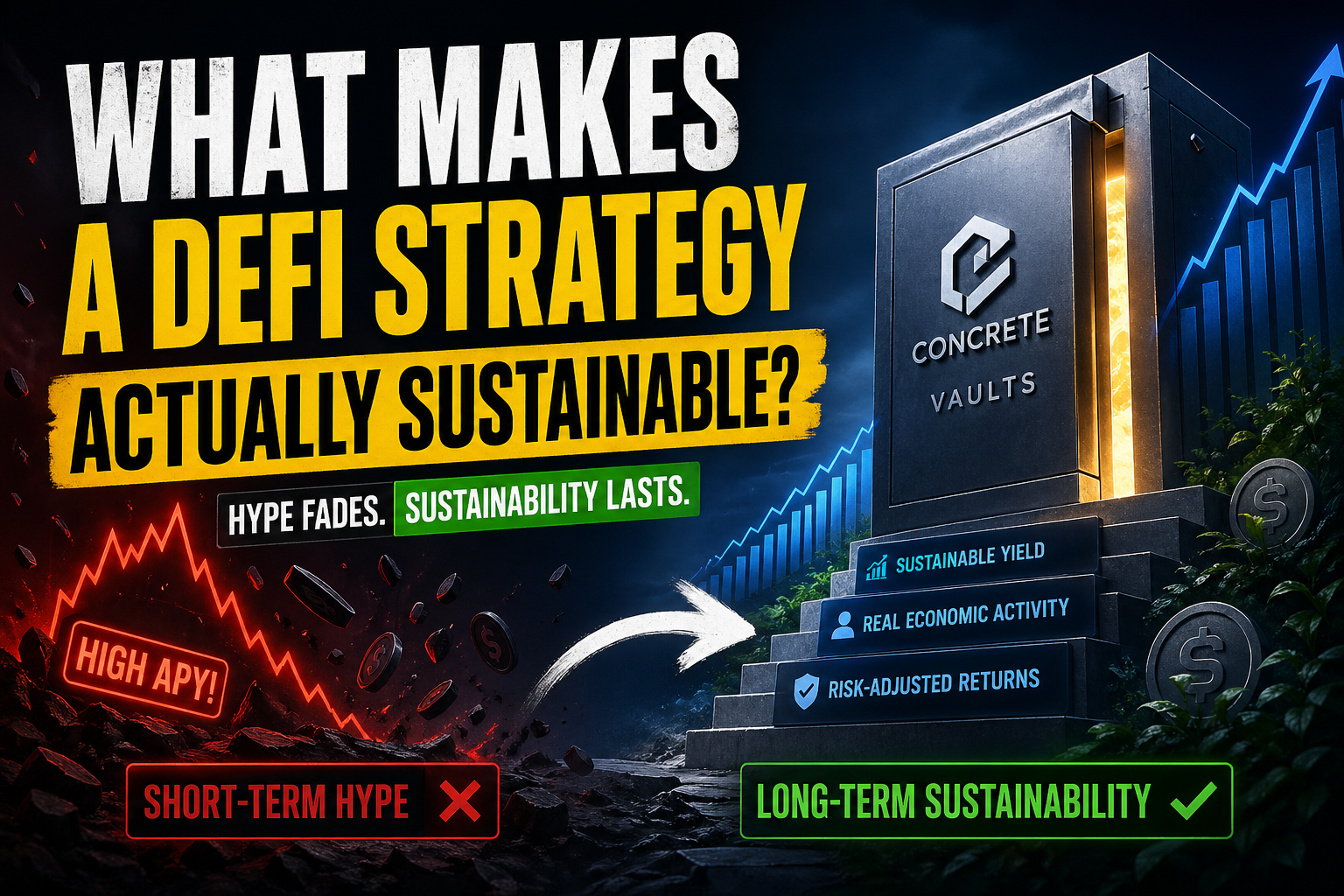
What Makes a DeFi Strategy Actually Sustainable?
--
DeFi has no shortage of yield.
Every cycle introduces new protocols, new opportunities, and new headline APYs designed to attract capital fast. Liquidity rushes in, yields spike, and for a moment, the strategy looks unbeatable.
Then the familiar pattern unfolds.
Rewards compress. Incentives fade. Capital rotates elsewhere.
The strategy that looked extraordinary often proves temporary.
This has become one of DeFi’s repeating cycles — a pattern driven less by durable economics and more by short-term yield extraction.
Which raises a more important question:
What makes a DeFi strategy sustainable?
Because the highest yield is rarely the one that lasts.
Durability Over Performance
A sustainable yield strategy is not simply one that performs well for a few weeks.
It is one that can survive changing market regimes.
True sustainable yield tends to share three characteristics:
- It generates relatively consistent returns over time
- It does not rely entirely on token incentives or emissions
- It remains viable across both favorable and adverse market conditions
That is the difference between performance and durability.
And in mature financial systems, durability usually wins.
The strongest strategies are often not the ones producing the highest returns in one moment, but the ones capable of compounding through multiple cycles.
Real Yield vs Temporary Yield
A major divide in DeFi strategies is the difference between real yield and temporary yield.
Temporary yield is often driven by emissions.
Protocols distribute tokens to attract liquidity, APYs appear elevated, and capital flows in to farm incentives. But as emissions decline, so does the yield.
These strategies often depend on continued subsidy.
Once the subsidy weakens, the opportunity weakens too.
Real yield is different.
It comes from actual economic activity:
- Trading fees
- Lending spreads
- Arbitrage capture
- Funding-rate opportunities
- Market-making revenue
These sources tend to be more durable because they are rooted in demand, not promotional incentives.
Not all yield is created equal.
And sustainable DeFi strategies increasingly favor yield backed by activity over yield inflated by emissions.
Liquidity Is Part of Sustainability
A strategy can only persist if the market structure around it supports persistence.
Liquidity depth matters.
User activity matters.
Volatility matters.
Demand matters.
Some strategies perform only in specific environments.
A carry trade may thrive in one volatility regime and degrade in another.
A leveraged farming strategy may work when liquidity is abundant, but collapse when exits become crowded.
Sustainable strategies tend to be adaptive rather than condition-dependent.
They survive because they are built with changing market structure in mind.
That is where managed DeFi starts to separate from opportunistic farming.
Sustainability Is Also About Costs
Headline APY often hides what actually matters.
Net returns.
Execution costs can erode strategy performance over time:
- Slippage
- Rebalancing friction
- Gas costs
- Position maintenance
- Correlation shifts during stress events
A strategy that looks exceptional on paper may underperform once these hidden costs are accounted for.
This is why risk-adjusted yield matters more than raw yield.
The question is not just:
How much does this strategy earn?
It is:
How much does it keep after risk and costs?
That is a much harder standard.
And a much more sustainable one.
Better Strategies Behave Like Systems
Durable DeFi strategies increasingly look less like isolated opportunities and more like systems.
They are designed through:
- Diversification across multiple yield sources
- Continuous monitoring
- Active adaptation to changing conditions
- Focus on net returns rather than headline APYs
This is where DeFi begins to mature.
Capital stops chasing isolated yields and starts allocating across managed frameworks.
That shift is foundational for institutional DeFi and long-term onchain capital.
Why Concrete Vaults Focus on Durability
This is where Concrete vaults represent an important evolution.
Rather than optimize purely for peak yield, Concrete emphasizes sustainable yield through managed DeFi vault design.
The approach centers on:
- Prioritizing durable yield sources
- Allocating capital across strategies
- Adapting as market conditions evolve
- Reducing reliance on short-term incentives
That matters because incentives can attract liquidity.
But infrastructure retains it.
And infrastructure is what lasts.
Concrete vaults are designed around the idea that risk-adjusted yield should be more important than speculative yield spikes.
That is a very different philosophy from traditional yield chasing.
Concrete DeFi USDT as an Example
Concrete DeFi USDT illustrates this well.
Offering up to approximately 8.5% stable yield, the opportunity may appear less dramatic than volatile farms promising triple-digit APYs.
But that is partly the point.
Consistency can outperform excitement over time.
Stable, repeatable returns often attract more serious long-term capital than unstable bursts of performance.
Because sustainable yield does not need to look spectacular.
It needs to endure.
And for many allocators, that reliability is the strategy.
Explore Concrete at: https://app.concrete.xyz/earn
The Bigger Shift in DeFi
DeFi is moving through a broader transition.
From:
Short-term yield chasing.
Toward:
Long-term capital strategy.
This shift changes how value is judged.
Peak returns matter less.
Durable systems matter more.
The next phase of DeFi may not be defined by who offers the highest APY.
It may be defined by who builds strategies capable of surviving across cycles.
Because incentives fade.
Infrastructure compounds.
And the future of onchain capital likely belongs not to the loudest opportunities —
but to the DeFi strategies that last.