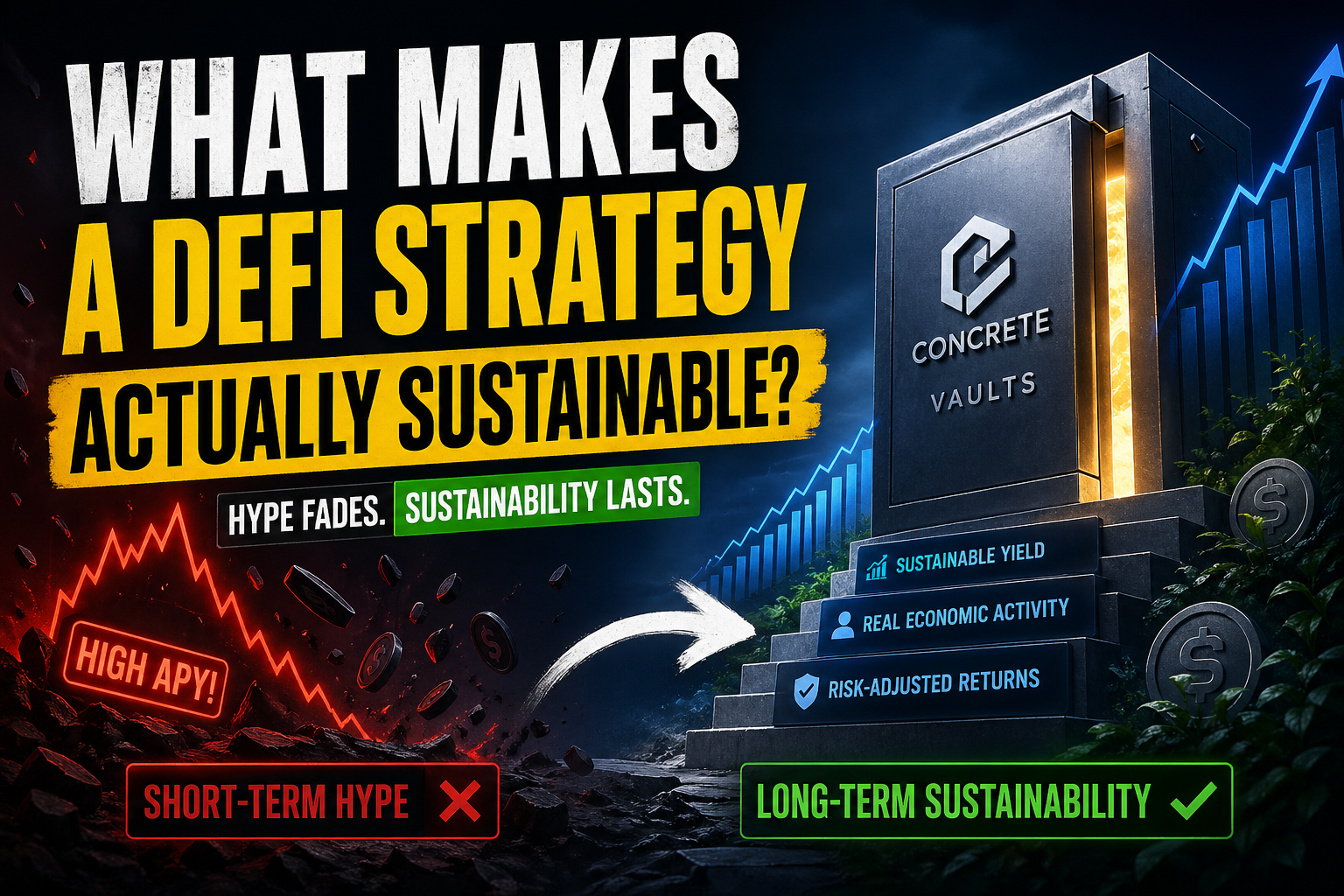
What Makes a DeFi Strategy Actually Sustainable?
 Crypto Update3 min read·Just now
--
DeFi is full of yield.
Every week, new protocols launch with eye-catching APYs. Capital rushes in. Numbers look incredible - sometimes too good to ignore. But then the pattern repeats:
Yields compress.
Liquidity rotates.
Opportunities disappear.
We’ve all seen it.
So the real question isn’t: “Where is the highest APY right now?”
It’s: “What actually lasts?”
The Pattern We Keep Repeating
DeFi moves in cycles.
A new protocol launches with aggressive incentives. Early users pile in, driving TVL up fast. High emissions boost yields, attracting even more capital. For a brief moment, everything looks sustainable.
Then reality kicks in.
Token emissions dilute. Rewards shrink. Early participants exit. Liquidity dries up. And the strategy that once looked like a goldmine becomes irrelevant.
This isn’t a one-off event — it’s the default lifecycle of most DeFi strategies.
So why do most of them fade so quickly?
Because they were never built to last.
What “Sustainable” Actually Means
A sustainable yield strategy isn’t about short-term performance. It’s about durability.
At its core, a sustainable strategy should:
- Generate consistent returns over time
- Avoid dependence on temporary incentives
- Remain viable across different market conditions
This is where the concept of risk-adjusted yield becomes critical. It’s not just about how much you earn - it’s about how reliably you can earn it.
Sustainable yield is less about spikes… and more about stability.
Real Yield vs Temporary Yield
Not all yield is created equal.
There are two main sources:
1. Real Yield
- Comes from actual economic activity
- Trading fees, lending interest, arbitrage opportunities
- Backed by real demand
2. Temporary (Incentive-Driven) Yield
- Funded by token emissions
- Designed to bootstrap liquidity
- Often unsustainable long-term
Emission-driven strategies can look extremely attractive at first. But they tend to decline as incentives dry up.
Real yield, on the other hand, is tied to ongoing usage. As long as users trade, borrow, or provide liquidity, the strategy has a foundation.
That’s why sustainable DeFi strategies prioritize real activity over artificial incentives.
Liquidity, Market Conditions, and Adaptability
Sustainability doesn’t exist in a vacuum.
It depends on:
- Liquidity depth
- User activity
- Market volatility
- Demand for the underlying strategy
Some strategies only work in bull markets. Others rely on high volatility. A few can adapt across conditions.
The most durable strategies are flexible. They adjust exposure, rebalance positions, and evolve with the market.
This is where managed DeFi starts to outperform static approaches.
The Hidden Layer: Costs and Risk
Many strategies look great on paper - but fall apart in practice.
Why?
Because of hidden factors like:
- Execution costs
- Slippage
- Rebalancing frequency
- Changing correlations
A strategy showing 15% APY might deliver far less after accounting for these realities.
True sustainability requires understanding net returns, not just headline numbers.
It also requires constant monitoring - because what works today might not work tomorrow.
Designing Better DeFi Strategies
Sustainable strategies aren’t accidental — they’re designed.
They often include:
- Diversification across multiple yield sources
- Continuous monitoring and adjustment
- Dynamic allocation based on market conditions
- Focus on risk-adjusted yield instead of raw APY
At this level, DeFi stops being a collection of opportunities — and starts becoming a system.
A system that manages onchain capital intelligently over time.
Where Concrete Vaults Come In
This is exactly the philosophy behind Concrete vaults.
Instead of chasing short-term spikes, they aim to:
- Prioritize sustainable yield sources
- Actively manage capital across strategies
- Adapt to changing market environments
- Reduce reliance on temporary incentives
These DeFi vaults are built for durability - not just peak performance.
They reflect a shift toward institutional DeFi, where consistency matters more than hype.
A Real Example: Concrete DeFi USDT
Take Concrete DeFi USDT as an example.
It offers up to ~8.5% stable yield.
At first glance, that might not seem as exciting as triple-digit APYs. But over time, stability often outperforms volatility.
Consistent returns:
- Attract long-term capital
- Reduce downside risk
- Compound more effectively
This is the essence of sustainable yield — it’s not about being the highest. It’s about being reliable.
The Bigger Shift in DeFi
DeFi is evolving.
We’re moving away from short-term yield chasing…
Toward long-term capital strategies.
In this new phase:
- Sustainability matters more than peak returns
- Risk-adjusted yield becomes the standard
- Infrastructure outlasts incentives
The future of DeFi won’t be defined by the highest APY.
It will be defined by the strategies that survive.
Explore Concrete at: https://app.concrete.xyz/earn