What Makes a DeFi Strategy Actually Sustainable?
 crypto hunter7 min read·1 hour ago
--
DeFi is full of yield. New strategies launch every week. APYs spike. Capital flows in.
But most of these strategies don’t last.
Yields drop. Liquidity leaves. Opportunities disappear.
So the real question isn’t: “What has the highest yield?”
It’s: “What actually lasts?”
The Pattern We’ve All Seen Before
Open up any DeFi aggregator on a given week and you’ll spot it immediately:
- A new protocol launches with eye-watering APY
- Capital rushes in — sometimes hundreds of millions
- Yields compress within weeks as rewards dilute
- Liquidity rotates somewhere else chasing the next shiny thing
This cycle repeats relentlessly across DeFi. It’s become so predictable that some traders practically treat it like clockwork: swoop in, farm the incentives, exit before the music stops.
The problem? Not everyone times it right. And even when you do, you’re constantly hopping between strategies, paying gas, taking risks, and grinding through volatility — all for a window that might close faster than you expected.
So why do most strategies fade so quickly?
The honest answer: because they were never built to last. They were built to attract capital, not retain it.
What Does “Sustainable” Actually Mean?
Let’s strip this down to something practical.
A sustainable DeFi strategy isn’t necessarily the one with the biggest headline APY. It’s one that:
- Generates consistent returns over time — not just for a sprint, but across quarters and market cycles
- Doesn’t depend entirely on incentives — when token emissions stop or reduce, the strategy should still make economic sense
- Remains viable across different market conditions — bull runs, bear markets, low volatility, high volatility — durability is the key word here
Think of it like a business versus a marketing campaign. A business generates real revenue. A marketing campaign generates buzz. One can sustain itself. The other needs constant fuel to keep going.
In DeFi terms, sustainability is about finding strategies rooted in actual economic activity — not just incentive structures designed to look attractive on a dashboard.
Real Yield vs. Temporary Yield
This is where the rubber meets the road.
Real yield comes from genuine onchain activity: trading fees, lending interest, arbitrage spreads, liquidity provision in healthy markets. These are dollars earned because value is being created — users are borrowing, swapping, staking, and the protocol takes a cut.
Temporary yield (sometimes called emissions-driven yield) comes from token incentives. The protocol essentially pays you in its own tokens to bootstrap usage. On paper, the APY looks incredible. But when you strip out the token rewards? The underlying strategy might be operating at a loss.
Here’s why this matters:
- Emissions-driven yield often declines as token emission schedules reduce over time. If a protocol rewards you 15% APY in governance tokens on top of 3% real yield, that 15% won’t be there forever. Once it tapers, you’re left holding the underlying yield — which might be a fraction of what you originally expected.
- Real economic activity is more stable. If traders are actively using a protocol because it offers better prices, deeper liquidity, or superior execution — that activity persists. It doesn’t evaporate when an emission schedule ends.
Not all yield is created equal. The number on the screen means nothing if it’s not backed by something real.
The Role of Liquidity & Market Conditions
Sustainability also depends heavily on market structure:
- Liquidity depth — A strategy that works beautifully with $10M in TVL might behave completely differently with $500M. Thin liquidity amplifies slippage, creates impermanent loss risks, and can make otherwise solid strategies blow up.
- User activity levels — If a protocol’s user base shrinks, fee revenue drops. What looked like a sustainable yield source can quickly become marginal.
- Market volatility — Some strategies thrive in volatile markets (arbitrage, momentum) but struggle in sideways ones. Others do the opposite. A strategy that only works half the time isn’t sustainable.
- Demand for the underlying mechanism — At the end of the day, yield comes from demand for something. If that demand disappears — due to competition, regulatory pressure, or shifting user behavior — the yield dries up with it.
Some strategies are essentially weather-dependent. They work great in specific conditions but fall apart when the environment shifts. Sustainable strategies tend to have more optionality — they adapt, or they serve a persistent need that doesn’t go away with market sentiment.
The Hidden Costs Nobody Talks About
Here’s where strategy analysis often falls short: the friction costs.
When someone says a strategy delivers 12% APY, they’re usually talking about gross yield — not net yield. But real returns get eaten by:
- Execution costs — gas fees, trading fees, keeper costs
- Rebalancing — if your strategy requires active repositioning, each rebalance is a transaction cost
- Slippage — especially relevant in DeFi pools with low liquidity
- Changing correlations — assets that seemed uncorrelated might start moving together during stress events, destroying hedges you thought were solid
A strategy might look spectacular on a backtested chart but degrade significantly over time once these factors are properly accounted for. Risk-adjusted yield — meaning yield after accounting for the risks and costs involved — is a much more honest metric than raw APY.
This is why sophisticated DeFi participants increasingly focus on net returns, not headline numbers. A strategy that delivers 6% net with low volatility and minimal management overhead might actually outperform a “10% APY” strategy that requires constant monitoring, high gas costs, and carries tail risks nobody mentioned.
Designing Strategies That Last
When you shift from chasing yield to building durable exposure, the design philosophy changes.
Sustainable strategies tend to share a few principles:
- Diversification across sources — don’t rely on a single yield engine. If one source compresses, others absorb the impact.
- Continuous monitoring and adaptation — the DeFi landscape shifts fast. Strategies need active management to pivot when conditions change.
- Focus on net returns, not peak APY — the headline number gets you in the door. The net number is what actually hits your wallet.
- Alignment with real demand — strategies that serve genuine user needs (efficient borrowing, reliable swaps, composable infrastructure) tend to persist longer than those built purely for yield farming.
This is where the DeFi narrative starts to shift from “DeFi as a yield casino” toward DeFi as a serious financial infrastructure layer — where capital is deployed thoughtfully, managed actively, and built to last.
Concrete Vaults: Durability by Design
This is where Concrete comes in.
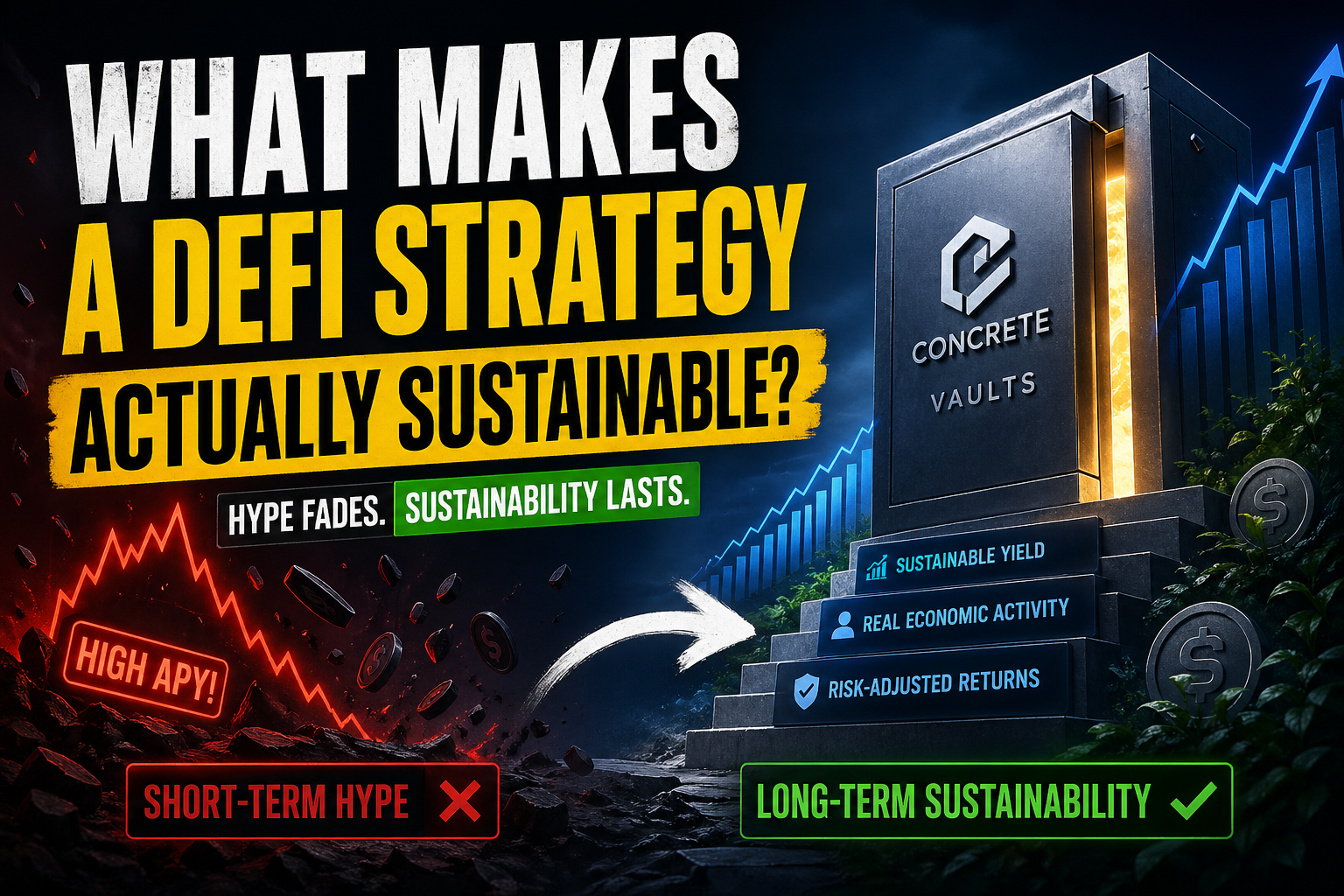
Concrete vaults are designed around a simple premise: prioritize sustainable yield sources over temporary incentive boosts. Instead of chasing the highest APY in any given week, Concrete focuses on strategies that make economic sense across different market environments.
Key priorities for Concrete vaults:
- Sustainable yield generation — targeting sources of real yield, not just emissions
- Active capital management — deploying across strategies dynamically based on conditions
- Adaptability — adjusting exposure as market structure changes
- Reduced reliance on short-term incentives — building exposure that doesn’t evaporate when token emissions taper
Concrete isn’t trying to advertise the highest number on any given day. It’s trying to build something that works reliably — quarter after quarter, cycle after cycle.
Because at the end of the day, a vault that delivers 8% consistently is worth more than one that delivers 25% for three weeks and 2% for the next six.
A Real Example: Concrete DeFi USDT
Let’s ground this in something concrete.
Concrete DeFi USDT offers up to ~8.5% stable yield on USDT deposits. That’s not the flashiest number in DeFi. You can probably find higher APYs somewhere — at least on any given Tuesday.
But here’s the thing: stability outlasts volatility.
A strategy that offers 8.5% with low drawdown, minimal management overhead, and consistent week-over-week performance often attracts more sophisticated capital than one that spikes to 30% and crashes to 5%. Why? Because the latter requires active management, carries timing risk, and frankly — most participants won’t exit at the right time.
The consistent 8.5% might look less exciting on a Twitter screenshot. But it looks a lot better on a P&L statement twelve months later.
This is the kind of thinking that attracts long-term capital to Concrete — users who care about what they actually keep, not just what they earn.
The Bigger Shift Coming to DeFi
We’re at an inflection point.
DeFi is maturing. The era of purely emissions-driven, incentive-chasing yield is narrowing. Users are getting more sophisticated. Protocols are being held to higher standards. And capital — especially institutional capital — is starting to ask better questions:
- What’s the actual risk-adjusted return?
- How does this perform across a full market cycle?
- What’s the exit strategy if conditions change?
- Is this built to last, or is it built to attract TVL?
The future of DeFi won’t be defined by whoever can advertise the highest APY on a given day. It’ll be defined by the protocols and strategies that survive and compound — that build real infrastructure, serve genuine economic purposes, and treat capital allocation as a serious discipline rather than a marketing exercise.
Sustainability will matter more than peak returns.
Infrastructure will outlast incentives.
And the protocols that figure this out first will define the next chapter of onchain finance.
Explore Concrete and see how sustainable yield is actually built:
Join here: https://app.concrete.xyz/earn