What Makes a DeFi Strategy Actually Sustainable?
--
DeFi is full of yield.
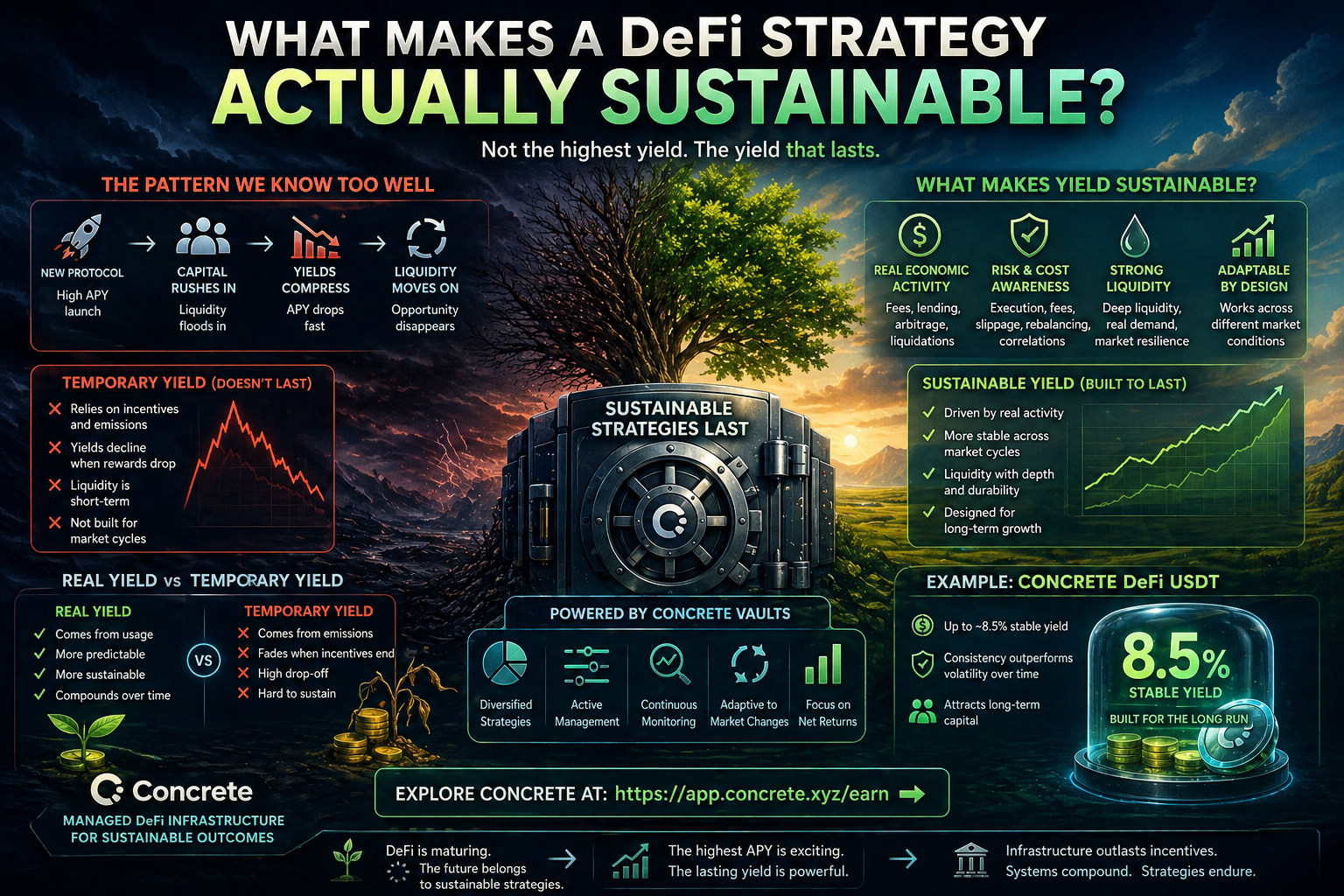
Every week, new protocols launch with eye-catching APYs. Capital rushes in, yields spike, and for a brief moment, everything looks like an opportunity. But the pattern is familiar. Yields compress, liquidity rotates out, and the strategy that looked unbeatable just weeks ago fades into the background.
This cycle repeats across DeFi again and again.
So the real question isn’t: What has the highest yield right now?
It’s: Why do most strategies fade so quickly — and what actually lasts?
Defining Sustainability in DeFi
A sustainable DeFi strategy isn’t about short-term performance. It’s about durability.
At its core, a sustainable strategy should:
- Generate consistent returns over time
- Avoid relying entirely on token incentives
- Remain viable across different market conditions
This shifts the focus from peak APY to risk-adjusted yield — returns that hold up not just in ideal conditions, but across cycles.
Real Yield vs Temporary Yield
Not all yield is created equal.
Some strategies generate returns from real economic activity:
- Trading fees
- Lending demand
- Arbitrage opportunities
Others rely heavily on emissions and incentives:
- Token rewards
- Liquidity mining programs
- Short-term bootstrapping mechanisms
The difference is critical.
Emissions-driven yield tends to decline as incentives taper off or token prices drop. In contrast, yield backed by real usage is more stable because it reflects actual demand within the system.
This is where the concept of sustainable yield becomes meaningful — returns supported by activity, not just subsidies.
Liquidity, Market Conditions, and Adaptability
Sustainability also depends on the environment a strategy operates in.
Key factors include:
- Liquidity depth
- User participation
- Market volatility
- Demand for the underlying assets or services
Some DeFi strategies only perform well under specific conditions, such as high volatility or strong bull markets. Others are more adaptable, adjusting to shifting dynamics and continuing to generate returns even as conditions change.
The more a strategy depends on a narrow set of conditions, the less durable it becomes.
The Hidden Costs of Yield
Many strategies look attractive on paper but degrade in practice.
Why?
Because of overlooked factors like:
- Execution costs
- Rebalancing frequency
- Slippage
- Changing correlations between assets
These elements eat into returns over time. A strategy advertising high APY may deliver significantly less once these real-world frictions are accounted for.
Sustainable DeFi strategies take these into account upfront, focusing on net returns, not just headline numbers.
Designing for Long-Term Performance
As DeFi matures, strategy design is evolving.
Instead of chasing isolated opportunities, more robust approaches focus on:
- Diversification across multiple strategies
- Continuous monitoring and adjustment
- Adapting to changing market conditions
- Prioritizing consistency over spikes
This is where managed DeFi begins to resemble traditional financial systems — less about opportunistic trades, more about resilient systems.
The Role of DeFi Vaults
This evolution is reflected in the rise of DeFi vaults.
Vaults aim to:
- Allocate capital dynamically
- Optimize across multiple yield sources
- Reduce reliance on short-term incentives
- Maintain performance across cycles
Concrete vaults, for example, are designed with durability in mind. Rather than chasing the highest yield available at any moment, they focus on building strategies that persist — balancing risk, return, and adaptability.
A Real-World Example: Stability Over Hype
Consider a product like Concrete DeFi USDT, which offers up to ~8.5% stable yield.
At first glance, this may seem less exciting compared to triple-digit APYs seen elsewhere in DeFi. But over time, consistency often outperforms volatility.
Why?
Because:
- Stable returns compound reliably
- Lower volatility reduces capital flight
- Predictability attracts long-term participants
This is the essence of institutional DeFi — prioritizing steady, risk-aware growth over short-term gains.
The Bigger Shift in DeFi
DeFi is evolving.
What began as a landscape dominated by yield chasing is gradually shifting toward long-term capital strategy.
The next phase will be defined by:
- Sustainable yield over peak APY
- Risk-adjusted performance over raw returns
- Infrastructure over incentives
The strategies that last won’t be the ones that spike the highest — they’ll be the ones that endure.
The future of DeFi belongs to systems that can survive cycles, adapt to change, and consistently deliver value.
Explore Concrete at: https://app.concrete.xyz/earn