-5 min read·Just now
--
What Makes a DeFi Strategy Actually Sustainable?
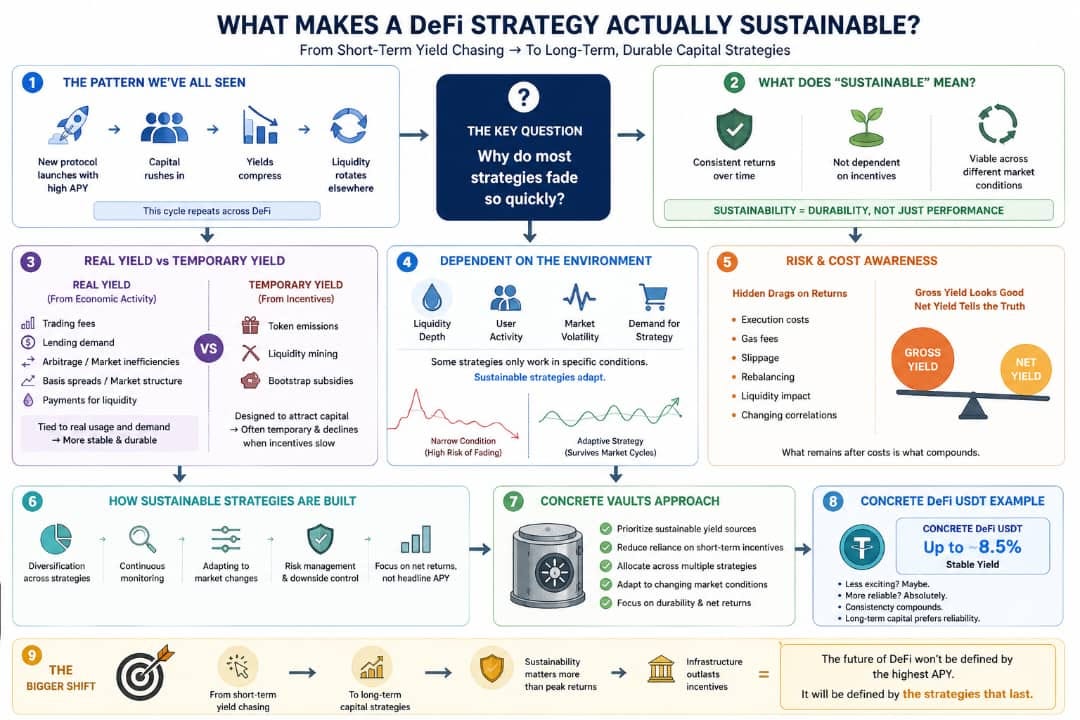
1.) Start With the Pattern
DeFi is full of yield.
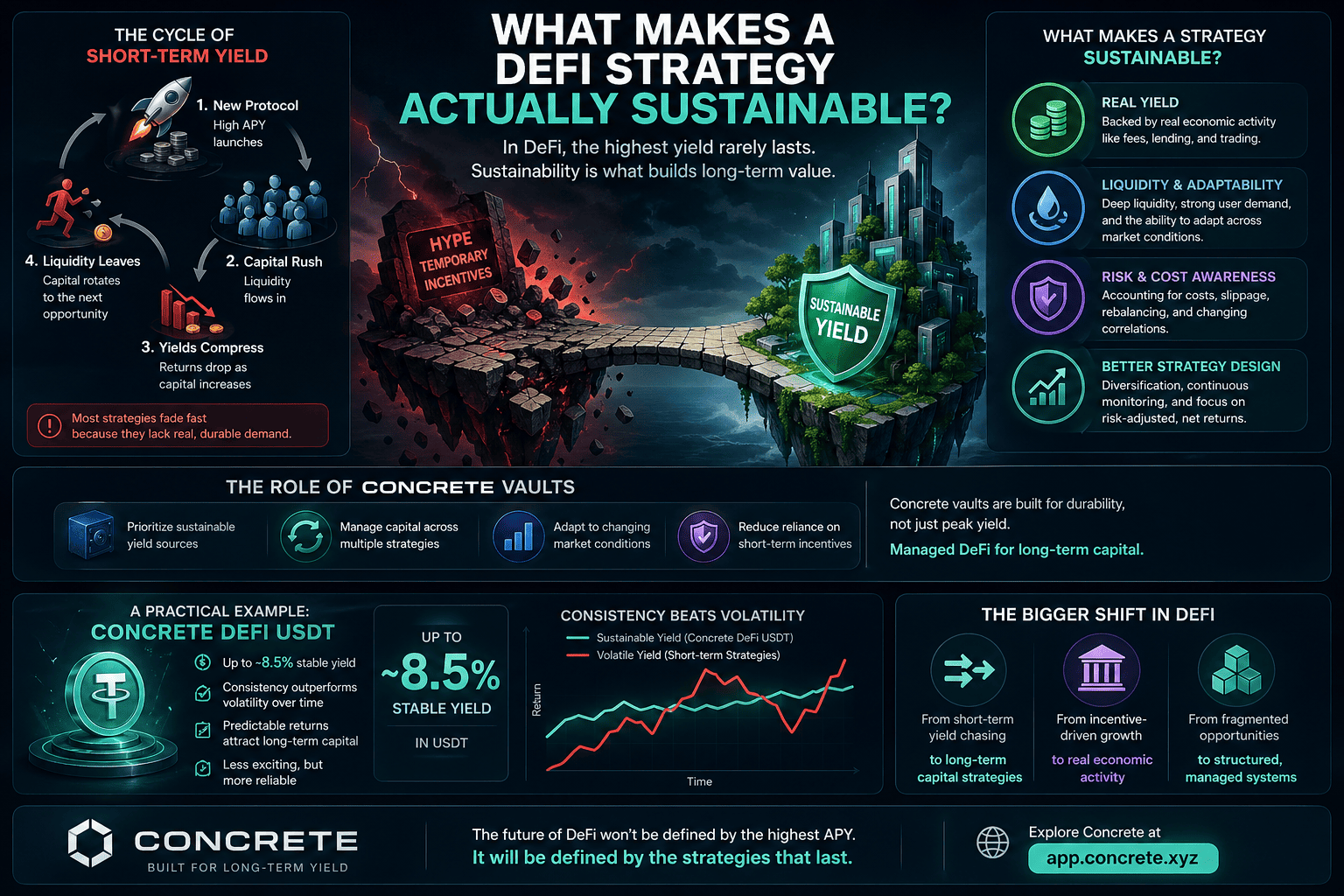
Every week, new protocols launch with fresh opportunities. APYs spike, dashboards light up, and capital moves fast. Users rush in, TVL climbs, and for a moment, everything looks like the perfect strategy.
Then the cycle repeats.
Yields compress. Incentives slow down. Liquidity rotates elsewhere. What looked like a high-performing opportunity suddenly becomes another short-lived farm left behind by the market.
This pattern has become one of the most familiar parts of DeFi.
And it raises the real question:
Not “What has the highest yield?”
But:
“What actually lasts?”
Because in mature financial systems, the best strategies are rarely the ones that perform for one week—they are the ones that survive across market cycles.
That is where the conversation shifts from chasing APY to understanding sustainable yield.
2.) Define What “Sustainable” Means
A sustainable DeFi strategy is not defined by the highest number on a dashboard.
It is defined by whether it can continue generating returns when market conditions change.
A truly sustainable strategy should:
1.generate consistent returns over time
2.avoid total dependence on token incentives
3.remain viable across both bullish and bearish markets
4.preserve capital while producing strong risk-adjusted yield
This is not about performance for a moment.
It is about durability across time.
Anyone can create temporary yield with aggressive emissions.
Very few can build something that lasts.
That is the difference between speculation and strategy.
3.) Compare Real Yield vs Temporary Yield
Not all yield is created equal.
One of the biggest mistakes in DeFi is treating every APY as if it comes from the same source.
It does not.
There is a major difference between:
3.1 Temporary Yield
This usually comes from:
token emissions
liquidity mining rewards
short-term protocol incentives
These strategies work because protocols pay users to participate.
The problem is simple:
When incentives stop, the yield often disappears.
This is why emissions-driven farming frequently leads to short-lived capital rotation. The strategy was never supported by real economic demand—it was supported by rewards.
3.2 Real Yield
This comes from:
trading fees
lending demand
arbitrage opportunities
borrowing activity
productive onchain capital deployment
This yield is generated by actual market behavior.
It is tied to usage, not marketing.
That makes it far more stable.
Sustainable DeFi strategies are usually built around real economic activity, not temporary emissions.
Because incentives attract attention.
But real yield attracts long-term capital.
4.) Highlight the Role of Liquidity & Market Conditions
Even strong strategies depend on the environment around them.
Sustainability is heavily shaped by:
1.liquidity depth
2.market volatility
3.user demand
4.trading volume
5.lending activity
6.market structure
Some opportunities only work in perfect conditions.
For example, a delta-neutral strategy may perform extremely well during periods of high funding rates. But when funding normalizes, the edge disappears.
Similarly, LP strategies may look attractive during volatility, but become less efficient when volume drops.
This is why adaptability matters.
The best DeFi strategies are not rigid.
They respond to changing conditions.
They are designed to survive multiple environments, not just optimize one.
This is where managed DeFi becomes far more powerful than passive yield chasing.
5.) Introduce Risk & Cost Awareness
Many strategies look incredible on paper.
But reality is more expensive.
Execution costs matter.
Sustainability depends on understanding:
1.slippage
2.gas costs
3.rebalancing frequency
4.liquidity fragmentation
5.changing asset correlations
6.protocol risk
A strategy showing 15% APY may deliver far less after costs.
A strategy showing 8% net yield may actually be stronger over time.
This is why risk-adjusted yield matters more than headline APY.
Professional capital does not optimize for the biggest number.
It optimizes for the best outcome after risk and execution.
This mindset is what separates short-term farming from institutional strategy design.
And increasingly, this is where institutional DeFi is heading.
6.) Connect This to Better Strategy Design
Sustainable yield is not found.
It is designed.
Strong strategy architecture usually includes:
1.diversification across multiple yield sources
2.continuous monitoring of market conditions
3.dynamic allocation of capital
4.protection against overexposure
5.focus on net returns instead of gross APY
This is where DeFi starts to look less like isolated opportunities and more like financial infrastructure.
It becomes a system.
Capital is no longer manually chasing yield.
It is being managed across environments.
This is the role of modern DeFi vaults.
And this is why vault infrastructure matters.
7.) Connect to Concrete Vaults
This is exactly where Concrete vaults fit.
Instead of relying on users to constantly rotate capital between protocols, vaults are designed to manage that process intelligently.
The goal is not maximum short-term APY.
The goal is sustainable yield.
Concrete vaults aim to:
1.prioritize durable yield sources
2.allocate capital across strategies
3.adapt to changing market conditions
4.reduce dependence on short-term emissions
5.optimize for consistent long-term returns
This approach reflects a more mature model of onchain capital deployment.
Users are not simply farming incentives.
They are participating in structured capital management.
That is the foundation of long-term managed DeFi.
8.) Use Concrete DeFi USDT as an Example
A strong example of this philosophy is Concrete DeFi USDT.
Instead of offering extreme, unstable APYs, it focuses on something much more valuable:
Consistency.
With yields of up to approximately 8.5% stable yield, the strategy reflects a simple truth:
Reliable returns often outperform volatile opportunities over time.
A strategy that survives for years can outperform one that spikes for two weeks.
This is especially important for larger capital pools.
Long-term allocators care less about temporary APY peaks and more about:
1.capital preservation
2.stable returns
3.predictable exposure
4.efficient risk management
That is why sustainable yield often looks less exciting.
But it is also why it attracts serious capital.
Stability is not boring.
It is infrastructure.
9.) Close With the Bigger Shift
DeFi is growing up.
The industry is moving from short-term yield chasing toward long-term capital strategy.
This shift changes everything.
The future will belong less to protocols offering the highest APY and more to systems delivering the strongest sustainability.
Because eventually, incentives end.
But infrastructure remains.
The next phase of DeFi will be defined by:
1.sustainable yield
2.durable strategy design
3.institutional DeFi adoption
4.smarter DeFi vaults
5.better risk-adjusted capital allocation
The highest APY will always attract attention.
But the strategies that last will define the future.
Because the future of DeFi will not be built on temporary rewards.
It will be built on systems that survive.
And in the end, sustainability will matter more than excitement.
Because the best strategy is not the one that performs today.
It is the one still working tomorrow.