--
**What Makes a DeFi Strategy Actually Sustainable?**
DeFi has a pattern we’ve all seen before.
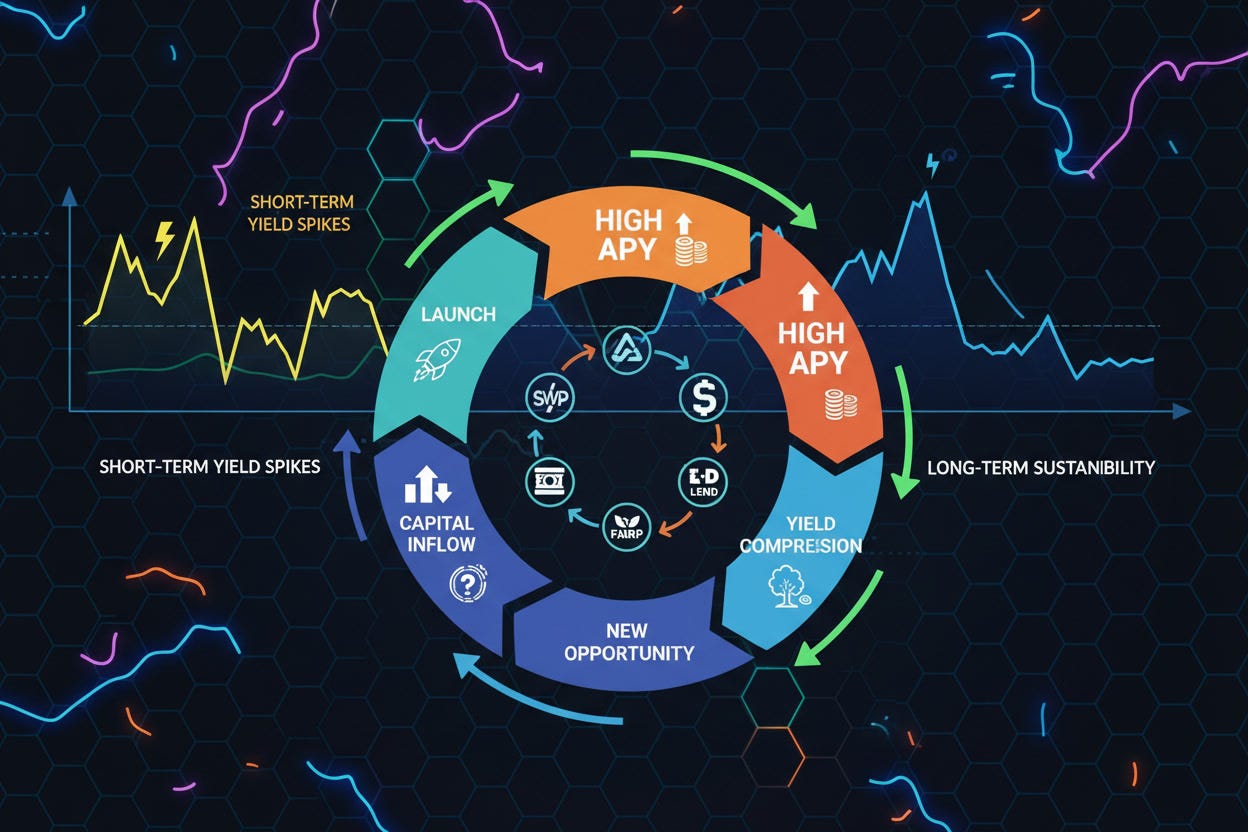
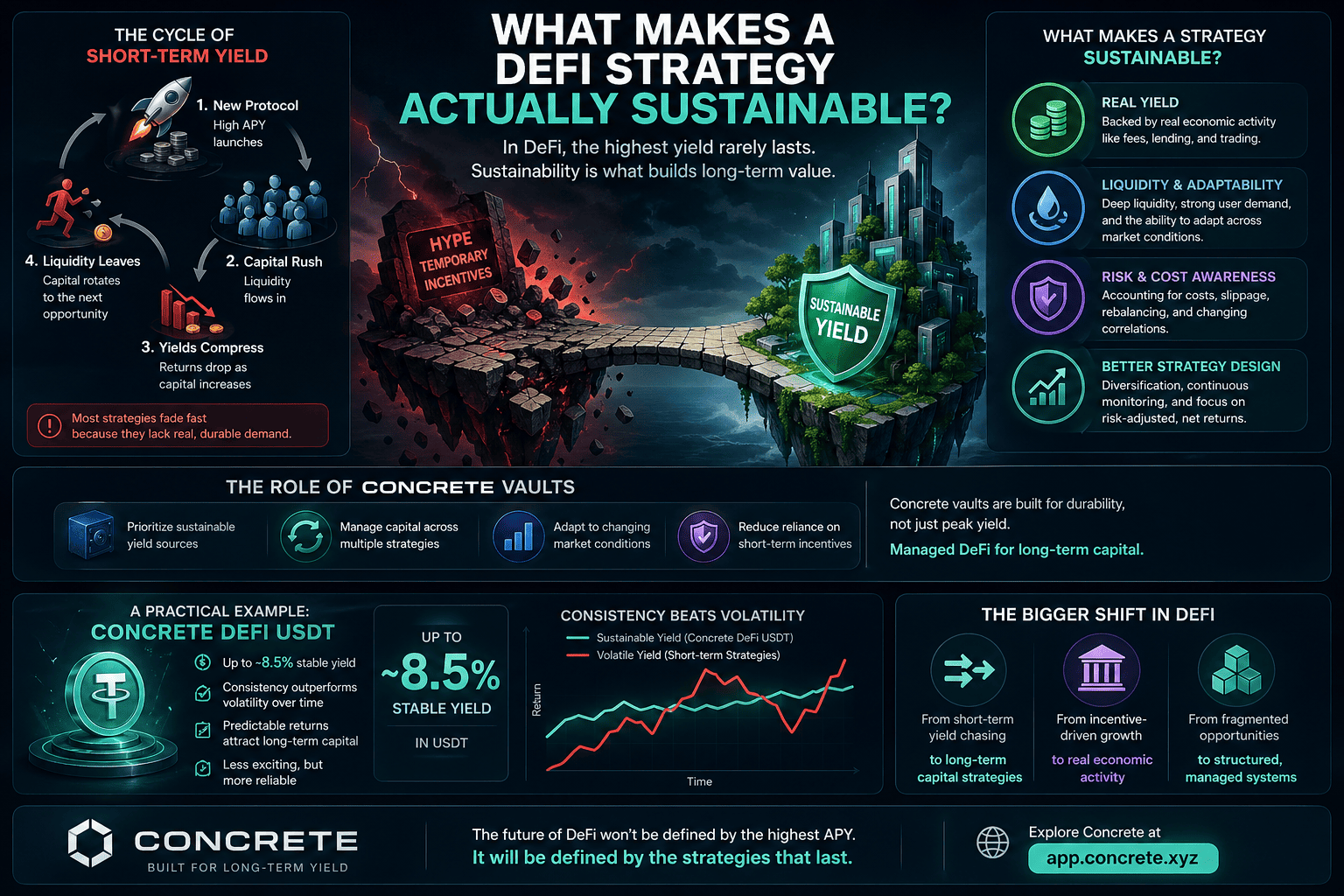
A new protocol launches with eye-catching APYs. Capital rushes in. Yields spike, then compress. Liquidity rotates out just as quickly as it arrived.
A week later, the opportunity is gone — replaced by the next “hot” strategy promising even higher returns.
This cycle repeats across DeFi. Over and over again.
Which raises a more important question than “What yields the most right now?”:
**What actually lasts?**
---
### The Pattern Behind DeFi Yield
Short-term yield opportunities are everywhere. They’re driven by novelty, incentives, and rapid capital inflows. But they often lack durability.
The lifecycle is predictable:
* High emissions attract liquidity
* Returns dilute as capital increases
* Incentives taper off
* Capital exits
The result? Most strategies fade as quickly as they appear.
Sustainability, then, isn’t about capturing peak APY — it’s about surviving beyond the initial surge.
---
### Defining Sustainable Yield
A sustainable DeFi strategy isn’t just profitable — it’s **durable**.
It should:
* Generate consistent returns over time
* Function without relying entirely on token incentives
* Remain viable across different market conditions
This is the difference between **performance** and **resilience**.
Sustainable yield prioritizes **risk-adjusted yield**, not just raw returns.
---
### Real Yield vs Temporary Yield
Not all yield is created equal.
Some returns come from **real economic activity**:
* Trading fees
* Lending demand
* Arbitrage inefficiencies
Other returns come from **incentives**:
* Token emissions
* Liquidity mining rewards
The difference matters.
Incentive-driven yield often declines as emissions decrease or token prices fall. Meanwhile, yield tied to actual usage tends to be more stable.
Sustainable DeFi strategies lean toward **real yield**, where returns are backed by genuine market demand.
---
### Liquidity, Market Conditions, and Adaptability
Sustainability is also shaped by the environment.
A strategy’s success depends on:
* Liquidity depth
* User activity
* Market volatility
* Demand for the underlying asset
Some strategies only perform in bull markets. Others rely on high volatility. Few can adapt across cycles.
The most resilient approaches are flexible — they evolve as conditions change instead of breaking when they do.
---
### The Hidden Costs of Yield
Headline APYs don’t tell the full story.
Real-world performance is affected by:
* Execution costs
* Slippage
* Rebalancing frequency
* Changing correlations between assets
A strategy that looks strong on paper can degrade quickly once these factors are considered.
Sustainable yield focuses on **net returns**, not theoretical ones.
---
### Designing Better DeFi Strategies
As DeFi matures, strategy design is evolving.
The focus is shifting toward:
* Diversification across multiple yield sources
* Continuous monitoring and adjustment
* Adaptive capital allocation
* Emphasis on risk-adjusted yield
This is where DeFi starts to resemble a system — not just a collection of opportunities.
It’s no longer about chasing yield. It’s about managing it.
---
### The Role of Managed DeFi and Vaults
This shift is reflected in the rise of **DeFi vaults** and managed strategies.
Instead of relying on users to constantly rotate capital, vaults:
* Allocate across strategies
* Adjust positions based on market conditions
* Optimize for long-term performance
**Concrete vaults** are designed with this philosophy in mind.
They prioritize:
* Sustainable yield sources
* Dynamic onchain capital deployment
* Reduced reliance on short-term incentives
The goal isn’t to capture the highest APY — it’s to maintain consistent performance over time.
---
### A Practical Example: Stability Over Hype
Take **Concrete DeFi USDT** as an example.
Offering up to ~8.5% stable yield, it may not compete with the highest short-term APYs in DeFi.
But that’s the point.
Over time, consistency can outperform volatility:
* Less exposure to sudden yield collapse
* More predictable returns
* Greater appeal for long-term capital
Sustainable strategies often look less exciting — but they tend to be more reliable.
---
### The Bigger Shift in DeFi
DeFi is evolving.
We’re moving from:
* Short-term yield chasing
→ to long-term capital strategies
From:
* Incentive-driven growth
→ to real economic activity
From:
* Fragmented opportunities
→ to structured, managed systems
In this future, sustainability matters more than peak returns.
Infrastructure will outlast incentives.
And the strategies that define DeFi won’t be the ones with the highest APY — but the ones that continue delivering, cycle after cycle.
---
Explore Concrete at **app.concrete.xyz**