What Makes a DeFi Strategy Actually Sustainable?
 Dinaalanaa5 min read·Just now
--
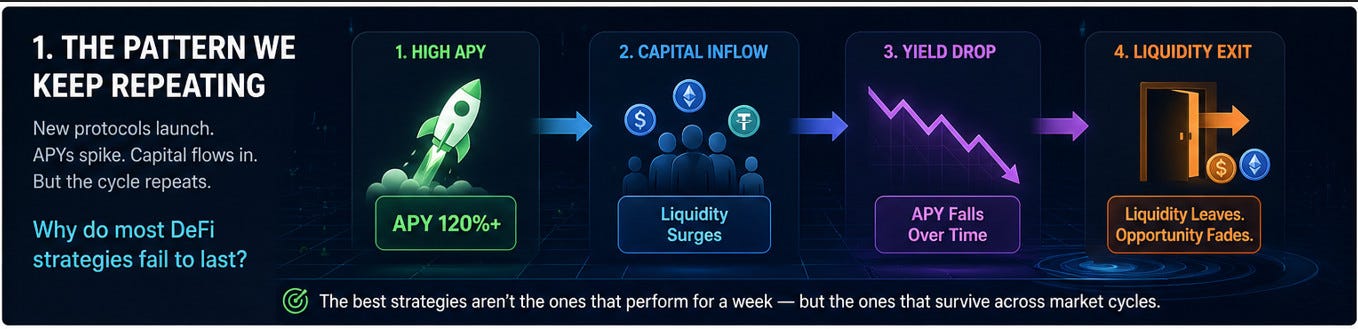
DeFi has always been full of yield.
New protocols launch every week.
APYs spike to eye-catching numbers.
Capital flows in quickly, chasing the highest returns available.
And then, almost just as fast, the cycle repeats.
Yields begin to drop.
Liquidity starts to move elsewhere.
The once-exciting opportunity fades into the background.
This pattern has played out across countless DeFi strategies. From liquidity mining programs to high-incentive farming pools, the lifecycle often looks the same: rapid growth, temporary excitement, and eventual decline.
So the real question isn’t:
“What has the highest yield right now?”
It’s:
“What actually lasts?”
As DeFi matures, sustainability is becoming more important than short-term performance. The future of decentralized finance will not be defined by explosive APYs — but by strategies that continue to perform across different market conditions.
Defining What “Sustainable” Really Means
When people talk about sustainable yield in DeFi, they’re not just talking about returns — they’re talking about durability.
A truly sustainable DeFi strategy should meet several key conditions:
- It generates consistent returns over time
- It does not rely entirely on temporary incentives
- It remains viable across different market environments
- It adapts instead of collapsing when conditions change
This shift in thinking represents a major evolution in how capital approaches DeFi strategies.
In the early days of decentralized finance, yield was often measured by headline APY numbers. But experienced participants now understand that risk-adjusted yield matters far more than raw performance.
A strategy that produces moderate but reliable returns often outperforms one that spikes briefly before fading.
Sustainability is not about chasing performance — it’s about building systems that survive.
Real Yield vs Temporary Yield
Not all yield is created equal.
Some returns come from real economic activity. Others come from incentives designed to attract liquidity quickly.
Understanding this difference is critical.
Real Yield Comes From:
- Trading fees generated by actual user activity
- Lending interest paid by borrowers
- Arbitrage opportunities driven by market inefficiencies
- Productive capital usage within functioning ecosystems
These sources of yield are tied to real demand. As long as users continue interacting with the system, these opportunities remain viable.
Temporary Yield Often Comes From:
- Token emissions
- Liquidity incentives
- Promotional rewards
- Short-term growth campaigns
These incentives can create impressive APYs in the beginning, but they rarely last.
As emissions decline, yields compress. Liquidity rotates toward the next opportunity. The strategy weakens.
This is why sustainable yield tends to originate from real economic activity, not artificial incentives.
The Role of Liquidity and Market Conditions
Even well-designed DeFi strategies depend heavily on liquidity and market structure.
Liquidity depth determines whether trades can execute efficiently. User activity determines whether opportunities exist. Market volatility influences the availability of arbitrage and trading volume.
Some strategies only work under very specific conditions.
For example:
- High volatility may create strong arbitrage opportunities
- Deep liquidity pools enable stable execution
- Active markets generate consistent trading fees
But when those conditions change, the strategy may weaken.
This is why sustainable DeFi strategies must be adaptable. Instead of relying on one single environment, they should operate across multiple market conditions.
Strong liquidity and continuous user engagement are essential ingredients for long-term strategy performance.
Without them, even promising systems struggle to survive.
Risk and Cost Awareness: The Hidden Factors
One of the most overlooked elements of DeFi strategies is cost.
On paper, many strategies look highly profitable. But real-world execution often tells a different story.
Hidden factors can significantly reduce returns:
- Execution costs
- Slippage during trades
- Rebalancing expenses
- Changing correlations between assets
- Network transaction fees
These costs accumulate over time.
A strategy that appears profitable initially may gradually lose efficiency as these factors take effect. Over weeks or months, the gap between theoretical returns and actual performance becomes more noticeable.
This is why sustainable DeFi strategies must account for net returns, not just projected yields.
Risk-adjusted yield matters far more than headline APY.
Understanding costs is not optional — it is essential.
Designing Strategies That Actually Last
As DeFi evolves, strategy design is becoming more sophisticated.
Rather than relying on single opportunities, modern approaches treat capital deployment as a dynamic system.
Sustainable strategies often include:
- Diversification across multiple opportunities
- Continuous monitoring of performance
- Automated rebalancing mechanisms
- Adaptive responses to market changes
- Focus on long-term efficiency rather than short-term spikes
This is where decentralized finance begins to resemble traditional financial engineering — but with onchain transparency and automation.
Managed DeFi is no longer just about finding opportunities.
It’s about maintaining them.
The best-performing systems are not static — they evolve.
How Concrete Vaults Focus on Durability
This shift toward sustainability is exactly where modern DeFi vaults play an important role.
Concrete vaults are designed to manage capital intelligently across different strategies, focusing on long-term durability rather than temporary gains.
Instead of relying on short-term incentives, managed DeFi vaults aim to:
- Prioritize sustainable yield sources
- Adjust allocations as market conditions change
- Reduce reliance on volatile incentives
- Optimize risk-adjusted yield across strategies
- Support consistent onchain capital deployment
This systematic approach reflects a broader trend in institutional DeFi.
Rather than manually chasing opportunities, vault-based systems allow capital to move strategically, responding to data and changing conditions.
This is not just yield farming.
It is structured capital management.
Concrete DeFi USDT as a Practical Example
A strong example of sustainable yield design can be seen in Concrete DeFi USDT, which offers up to approximately 8.5% stable yield.
At first glance, that number might seem less exciting than triple-digit APYs found elsewhere.
But over time, consistency often outperforms volatility.
Stable yield strategies provide several advantages:
- Predictable returns
- Reduced exposure to extreme market swings
- Greater capital confidence
- Stronger long-term performance
This is especially important for participants who prioritize reliability over speculation.
In many cases, a stable yield maintained across multiple market cycles delivers better long-term outcomes than temporary spikes followed by decline.
Consistency attracts long-term capital.
And long-term capital builds stronger systems.
If you want to explore how sustainable yield strategies are being implemented, Explore Concrete at app.concrete.xyz and see how managed DeFi vaults approach long-term performance.
The Bigger Shift: From Yield Chasing to Capital Strategy
DeFi is entering a new phase.
The early era was defined by rapid experimentation and aggressive incentives. That phase was necessary to bootstrap liquidity and attract users.
But the next phase is about maturity.
It is about sustainability.
Capital is beginning to move differently. Instead of chasing the highest APY, participants are focusing on:
- Risk-adjusted yield
- Long-term stability
- Adaptive infrastructure
- Durable strategy design
This transition marks a significant turning point for institutional DeFi and managed DeFi ecosystems.
The future will not belong to the highest yield.
It will belong to the most reliable systems.
Infrastructure will outlast incentives.
And sustainable DeFi strategies will define the next generation of onchain capital deployment.
Because in the end, the most important question isn’t:
“What performs today?”
It’s:
“What continues to perform tomorrow?”