--
What Makes a DeFi Strategy Actually Sustainable?
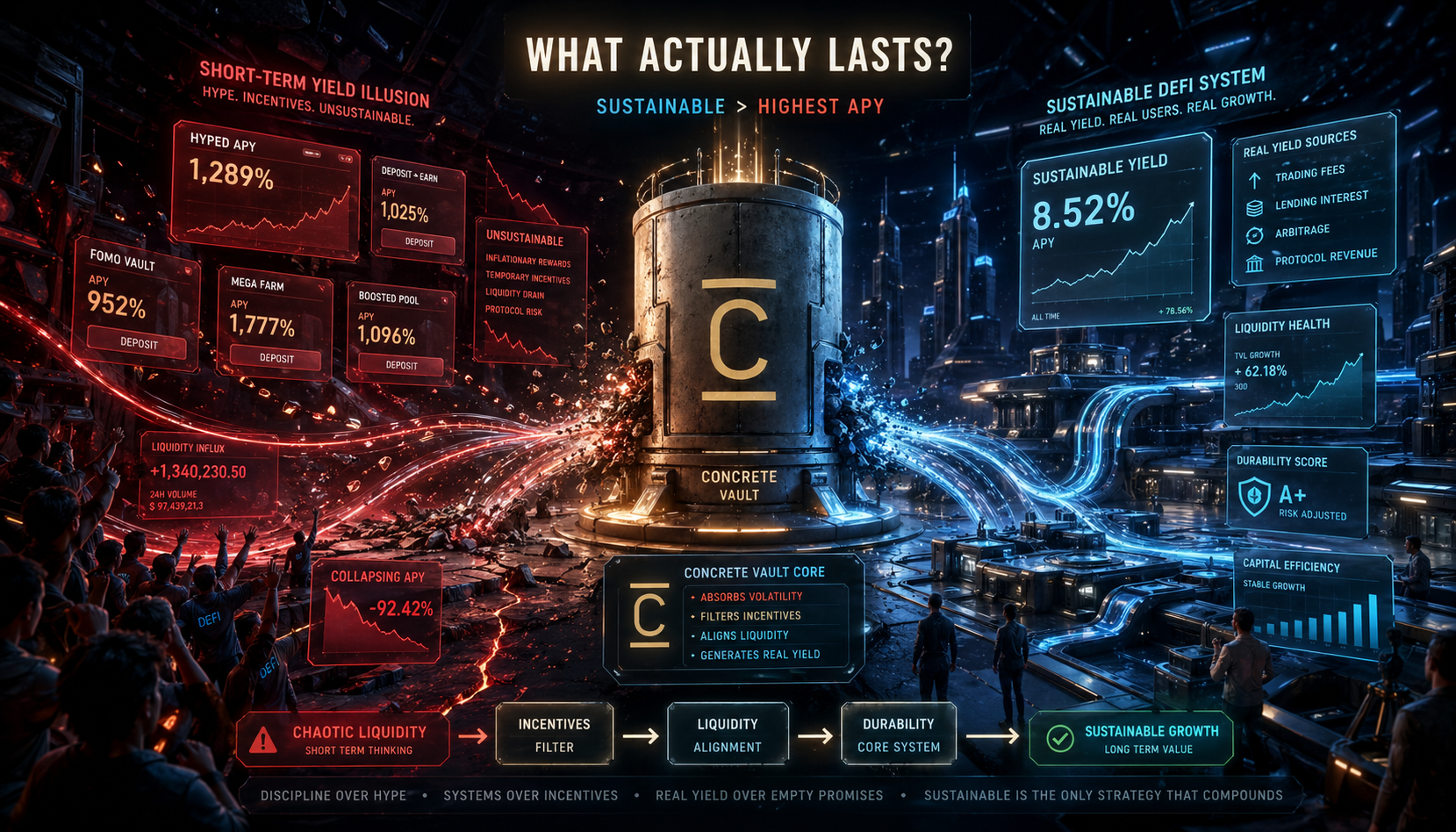
DeFi has made yield visible, liquid, and accessible to anyone with a wallet. Every week, new strategies emerge with eye-catching APYs. Capital flows in quickly, dashboards light up, and returns look impressive—at least for a while.
But the pattern is familiar.
A new protocol launches with high incentives. Early users pile in. Yields spike. Then, as liquidity grows, those yields compress. Incentives dry up. Capital rotates to the next opportunity.
And just like that, what looked like a promising strategy fades.
So the real question isn’t: “What has the highest yield?”
It’s: “What actually lasts?”
---
The Cycle We Keep Repeating
Across DeFi, the same loop plays out:
- New strategies launch with aggressive APYs
- Capital rushes in to capture returns
- Yields decline as liquidity increases
- Incentives weaken or disappear
- Liquidity exits and rotates elsewhere
This cycle isn’t случай—it’s structural. Many strategies are designed to bootstrap growth, not to sustain long-term returns.
Which raises a deeper question:
Why do most strategies fail to persist?
---
What “Sustainable” Actually Means
A sustainable DeFi strategy isn’t defined by how high it peaks—but by how long it holds.
At its core, sustainability means:
- Consistent returns over time
- Independence from short-term incentives
- Resilience across different market conditions
This is about durability, not hype. A strategy that performs moderately but consistently will often outperform one that spikes and collapses.
---
Real Yield vs Temporary Yield
Not all yield is created equal.
Some returns come from real economic activity, such as:
- Trading fees
- Lending interest
- Arbitrage opportunities
Others come from token emissions or incentives, designed to attract liquidity.
The difference is critical:
- Emissions-based yield tends to decline as incentives are reduced
- Real yield is tied to actual demand and usage
In the long run, strategies backed by real activity are more stable—because they’re rooted in value creation, not distribution.
---
Liquidity, Markets, and Adaptability
Sustainability doesn’t exist in isolation. It depends heavily on market conditions.
Key factors include:
- Liquidity depth — shallow liquidity leads to unstable returns
- User activity — without demand, yield disappears
- Market volatility — some strategies thrive in volatility, others break
- Strategy demand — not all opportunities remain relevant
Some strategies only work in specific environments. Others are designed to adapt.
The difference often determines whether a strategy survives—or fades.
---
The Hidden Layer: Costs and Risks
One of the most overlooked aspects of DeFi strategies is what happens beneath the surface.
A strategy might look strong on paper, but degrade over time due to:
- Execution costs
- Slippage
- Rebalancing inefficiencies
- Changing asset correlations
These factors quietly erode returns. What starts as a high APY can become far less attractive once real-world conditions are accounted for.
Sustainability requires looking at net returns, not just headline numbers.
---
Designing for the Long Term
Sustainable strategies don’t happen by accident—they’re designed.
They typically involve:
- Diversification across multiple strategies
- Continuous monitoring and adjustment
- Adaptation to shifting market conditions
- Focus on net, risk-adjusted returns
At this level, DeFi begins to resemble a system—not a collection of isolated opportunities.
---
Where Concrete Vaults Fit In
This is where vault infrastructure becomes important.
Concrete vaults are built with a different objective:
- Prioritize sustainable yield sources
- Allocate capital dynamically across strategies
- Adapt to changing market environments
- Reduce reliance on short-term incentives
Instead of chasing peak yield, the focus is on durability and consistency.
---
A Practical Example: Concrete DeFi USDT
Consider a product like Concrete DeFi USDT, offering around ~8.5% stable yield.
At first glance, it may seem less exciting than volatile, high-APY opportunities.
But over time, stability compounds.
- Consistent returns reduce uncertainty
- Lower volatility protects capital
- Reliability attracts long-term liquidity
In many cases, a steady 8.5% can outperform a fluctuating 30% that collapses after a few weeks.
Sustainable yield often looks boring—but it tends to win.
---
The Bigger Shift in DeFi
DeFi is evolving.
The early phase was defined by yield chasing—moving capital to wherever returns were highest in the moment.
The next phase is about capital strategy:
- Long-term thinking over short-term gains
- Systems over isolated opportunities
- Sustainability over peak performance
In this future, infrastructure matters more than incentives.
Because incentives fade.
But well-designed strategies endure.
---
Final Thought
The future of DeFi won’t be defined by the highest APY.
It will be defined by the strategies that last.
---
🚨 Explore Concrete at: https://app.concrete.xyz/earn 🚨