What Makes a DeFi Strategy Actually Sustainable?
--
DeFi has made yield easy to find.
Open any dashboard and there is always something offering more:
higher APY, newer incentives, faster growth, bigger numbers.
And the pattern is familiar.
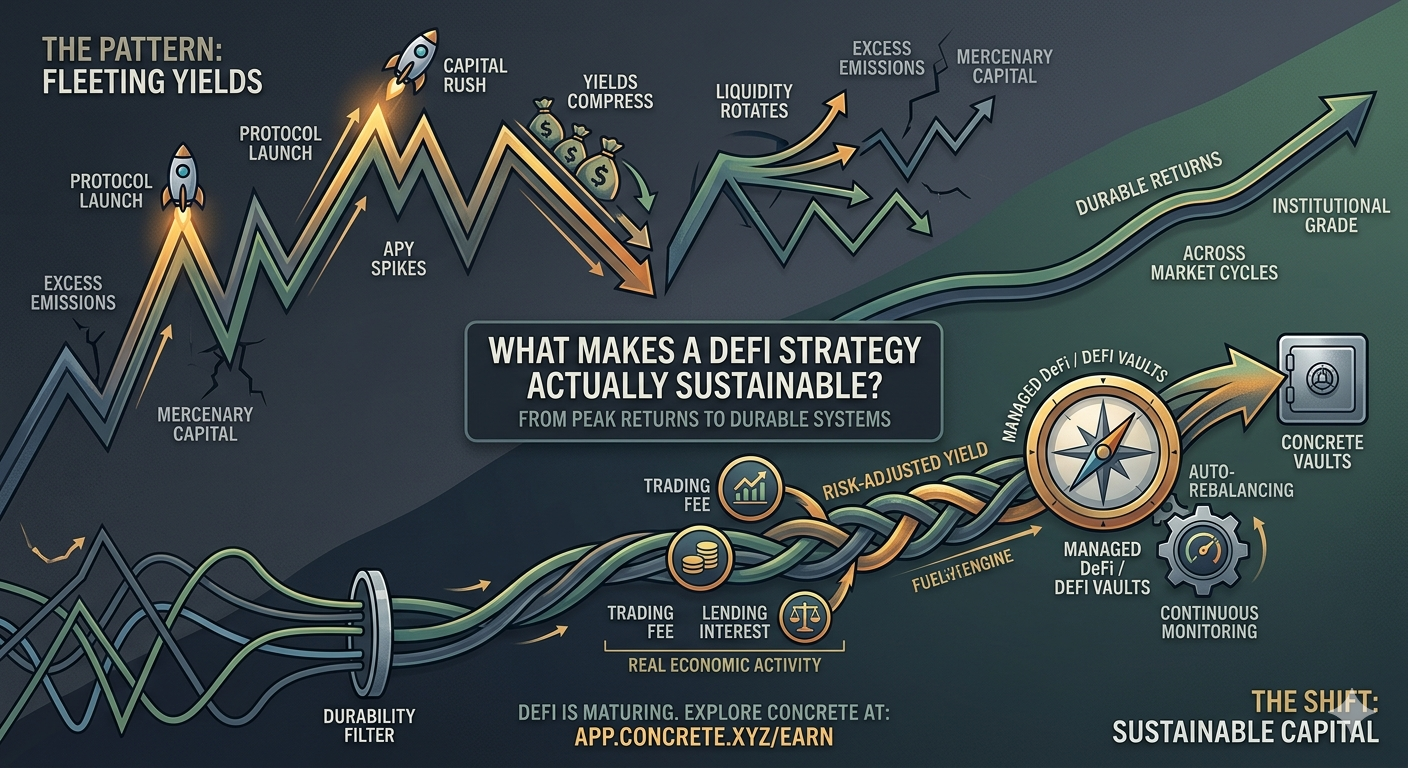
A new protocol launches.
It offers aggressive yield.
Capital rushes in.
TVL spikes.
Returns compress.
Liquidity rotates.
The opportunity fades.
A week later, the cycle starts again somewhere else.
This has become one of the defining loops of DeFi: short-term yield appears, attracts attention, and disappears just as quickly.
Which raises the more important question.
Not what pays the most today.
But what actually lasts?
Because in mature financial systems, the most valuable strategies are rarely the ones that perform best for a single week. They are the ones that remain viable across market cycles, changing liquidity conditions, and shifting demand.
That is the real test of sustainable yield.
The Problem With Most DeFi Strategies
Most DeFi strategies are not built to last.
They are built to attract capital.
That usually means one thing: emissions.
Protocols bootstrap growth by distributing token incentives.
Users deposit capital to farm those rewards.
Yield spikes.
Liquidity arrives.
But the strategy is often not producing durable economic value.
It is producing temporary participation.
That distinction matters.
Because once incentives decline, the strategy is forced to stand on its own.
And most cannot.
Liquidity leaves.
Depth disappears.
Execution worsens.
Returns fall.
The strategy breaks.
This is why so many DeFi strategies look strong in the short term but fail to remain attractive over time.
They were never designed for sustainability.
They were designed for acquisition.
What “Sustainable” Actually Means
A sustainable strategy is not defined by the highest return.
It is defined by durability.
A sustainable yield strategy should do three things well:
- generate consistent returns over time
- remain viable without depending entirely on token incentives
- continue functioning across different market conditions
That is the difference between temporary performance and durable design.
The best DeFi strategies are not simply profitable when everything is working.
They are resilient when conditions change.
That means sustainability is not just about yield.
It is about whether a strategy can survive compression, volatility, lower liquidity, and changing user behavior without collapsing.
This is where sustainable yield becomes much more than a number.
It becomes a systems question.
Real Yield vs Temporary Yield
Not all yield is created equal.
This is one of the most important distinctions in DeFi, and one of the most misunderstood.
Some yield comes from real economic activity.
That includes:
- trading fees
- lending demand
- basis spreads
- arbitrage flows
- liquidity provisioning tied to actual usage
This is yield generated by market function.
It exists because users are paying for access, execution, or capital efficiency.
That kind of yield tends to be more durable because it is tied to real demand.
Other yield comes from emissions.
This is incentive-driven yield:
token rewards distributed to attract deposits, deepen liquidity, or stimulate growth.
Emissions can be useful.
They help bootstrap protocols.
They help attract early users.
They can accelerate network effects.
But emissions are not durable yield.
They are subsidies.
And subsidies, by definition, fade.
This is where many DeFi strategies fail.
They mistake temporary incentives for sustainable economics.
Real yield may look smaller.
But it is often more stable, more repeatable, and far more investable over time.
Sustainability Depends on Market Structure
Even strong strategies are not sustainable in every environment.
A strategy can be fundamentally sound and still fail under the wrong conditions.
That is because sustainability is not only about logic.
It is also about market structure.
A durable strategy depends on:
- sufficient liquidity depth
- consistent user activity
- stable execution conditions
- reliable demand for the underlying trade
Without these, even good strategies degrade.
A lending strategy needs borrowing demand.
A carry strategy needs spread persistence.
A liquidity strategy needs real trading flow.
An arbitrage strategy needs enough dislocation to justify execution.
Some DeFi strategies only work in narrow windows.
They perform well in high volatility.
Or during strong risk-on cycles.
Or while incentives remain elevated.
But once those conditions change, returns disappear.
The most sustainable DeFi strategies are not the ones tied to one market regime.
They are the ones built to adapt across many.
Why Risk-Adjusted Yield Matters More Than Headline APY
Headline APY is one of the most misleading metrics in DeFi.
It tells you what a strategy might return in ideal conditions.
It tells you very little about what capital actually keeps.
This is why risk-adjusted yield matters more.
A strategy may show strong gross returns on paper, but degrade quickly once real execution is considered.
That degradation usually comes from the same places:
- slippage
- rebalancing costs
- gas and execution overhead
- liquidity fragmentation
- correlation shifts during stress
- declining efficiency at scale
These costs are easy to ignore in static models.
They are much harder to ignore in live markets.
This is where many DeFi strategies fail the sustainability test.
They optimize for visible yield.
They ignore invisible drag.
And over time, invisible drag is what determines whether a strategy remains investable.
Sustainable yield is not about gross performance.
It is about what remains after cost, volatility, and risk are accounted for.
That is what makes risk-adjusted yield the metric that actually matters.
Sustainable DeFi Requires Better Strategy Design
As DeFi matures, strategy design has to mature with it.
The next generation of DeFi strategies will not be built around isolated yield opportunities.
They will be built around systems.
That means:
- diversifying across multiple yield sources
- continuously monitoring execution quality
- reallocating capital as conditions change
- adapting to market structure in real time
- optimizing for net returns, not headline APY
This is the shift from manual yield chasing to managed DeFi.
And it is one of the clearest signs that DeFi is becoming a real capital market.
The future of DeFi strategies is not just better access to yield.
It is better infrastructure for managing it.
Why DeFi Vaults Matter
This is where DeFi vaults become important.
Vaults are not just passive wrappers around yield.
At their best, they are capital allocation systems.
They allow onchain capital to move across opportunities with more discipline, more efficiency, and better risk controls than manual users can typically achieve on their own.
That is what makes DeFi vaults such an important part of managed DeFi.
Instead of chasing whatever yield is highest this week, vaults can prioritize:
- sustainable yield sources
- dynamic allocation
- risk management
- cost-aware execution
- continuous adaptation
This is the difference between participating in DeFi and operating within it strategically.
As markets become more competitive, this layer becomes essential.
Because sustainable yield is no longer just about finding opportunity.
It is about managing complexity.
Why Concrete Vaults Focus on Durability
This is the core design philosophy behind Concrete vaults.
Concrete is built around the idea that the best DeFi strategies are not the ones with the highest temporary yield.
They are the ones capable of producing durable, risk-aware returns across changing market conditions.
That means Concrete vaults are designed to:
- prioritize sustainable yield over temporary spikes
- allocate across multiple DeFi strategies
- adapt to changing liquidity and volatility
- reduce dependence on short-term incentives
- optimize for long-term capital efficiency
This is not yield farming as a weekly activity.
It is managed DeFi designed for durability.
That distinction matters more as DeFi grows.
Because the more capital enters onchain markets, the less valuable temporary incentives become — and the more valuable disciplined infrastructure becomes.
Concrete DeFi USDT and the Value of Stability
A useful example is Concrete DeFi USDT.
Concrete DeFi USDT offers up to ~8.5% stable yield by focusing on consistency over spectacle.
That may appear less exciting than volatile triple-digit APYs.
But over time, stability often compounds more effectively than short-lived spikes.
This is one of the most important lessons in institutional DeFi.
Long-term capital does not optimize for the most exciting week.
It optimizes for repeatable performance.
Consistent returns are easier to size.
Easier to manage.
Easier to trust.
And far more attractive to serious onchain capital.
That is what makes stable, sustainable yield so powerful.
It often looks less impressive in the short term.
But it is significantly more durable in the long term.
Explore Concrete at: https://app.concrete.xyz/earn
The Next Phase of DeFi
DeFi is entering a different phase.
The first era was defined by access.
The second was defined by incentives.
The next will be defined by infrastructure.
That shift changes how capital behaves.
The market is moving away from short-term yield chasing and toward long-term capital strategy.
Toward risk-adjusted yield.
Toward managed DeFi.
Toward systems designed to endure.
This is where DeFi becomes more than a collection of opportunities.
It becomes capital infrastructure.
And in that future, the winners will not be the strategies with the highest APY.
They will be the ones that last.