Chalobah3 min read·Just now
--
What Makes a DeFi Strategy Actually Sustainable?
DeFi moves fast. New protocols launch daily, yields spike overnight, and narratives shift just as quickly. But beneath all the noise lies one important question:
What actually makes a DeFi strategy sustainable?
Let’s break it down.
The Illusion of High APY
At first glance, DeFi looks like a goldmine. Triple-digit APYs, farming rewards, and “early opportunities” flood timelines.
But here’s the reality:
- Most of these yields don’t last
- Liquidity moves quickly
- Opportunities disappear as fast as they appear
Chasing high APYs isn’t a strategy—it’s speculation. Sustainable growth in onchain capital requires a shift in mindset toward risk-adjusted yield, not just headline returns.
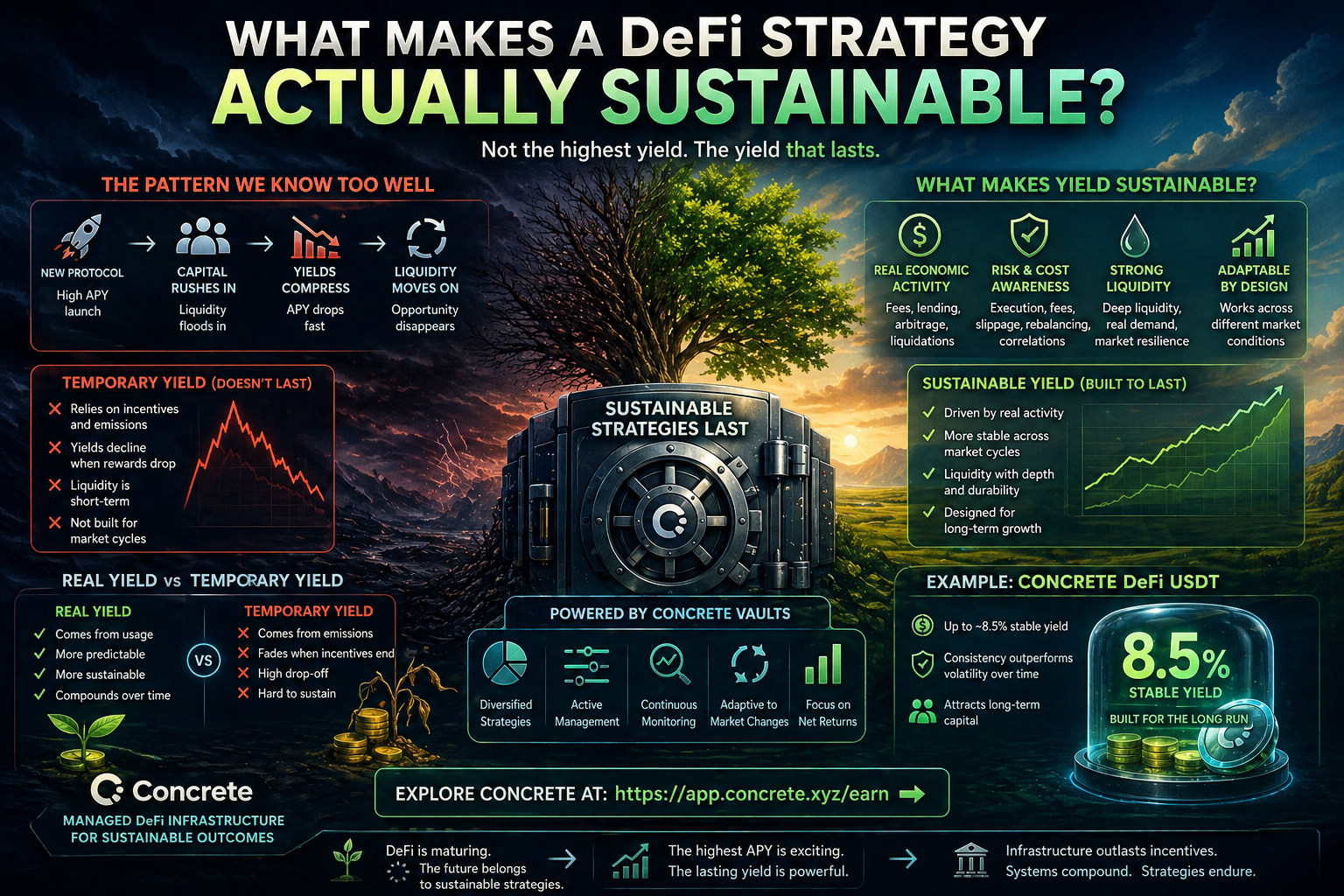
Sustainable Yield vs Temporary Incentives
Not all yield is created equal.
There are two main types:
1. Real Yield
- Comes from actual economic activity
- Trading fees, borrowing interest, liquidation fees
- More stable and predictable.
2. Incentivized Yield
- Funded by token emissions
- Designed to attract users temporarily
- Often unsustainable
If you’re serious about long-term performance, your focus should be on sustainable yield—returns that can persist even when incentives dry up.
The Rise of Smarter DeFi Strategies
The next evolution of DeFi strategies is already happening.
Instead of manually chasing opportunities, users are turning to:
- DeFi vaults that automate yield generation
- Managed DeFi solutions that optimize positions
- Platforms that abstract complexity and focus on performance
This shift mirrors traditional finance, where strategy and risk management outperform impulsive decision-making.
Risk, Liquidity, and Market Conditions
Sustainability doesn’t exist in a vacuum.
Every strategy depends on:
- Liquidity depth → Thin liquidity increases volatility
- Market conditions → Bull vs bear cycles change outcomes
- Demand drivers → Real usage sustains yield
A strong institutional DeFi approach evaluates these variables before allocating capital—not after losses occur.
Why Risk-Adjusted Yield Wins
High returns mean nothing without context.
A 200% APY that collapses in two weeks is far less valuable than a stable 8% that compounds consistently.
That’s where risk-adjusted yield comes in:
- It balances return vs exposure
- It prioritizes consistency
- It reduces drawdowns over time
This is how serious players grow onchain capital—not by chasing spikes, but by managing risk intelligently.
From Complexity to Clarity: The Role of Structured Products
DeFi is powerful—but also complex.
That’s why platforms offering structured solutions, like Concrete vaults, are gaining traction. These systems:
- Bundle strategies into a single product
- Optimize allocations automatically
- Reduce manual intervention
- Focus on long-term sustainability
They represent a step toward institutional DeFi, where performance is driven by design—not guesswork.
A Practical Perspective
Consider two approaches:
- Farming a new token at 150% APY (high risk, short lifespan)
- Allocating to a well-designed vault targeting 5–10% sustainable yield
Over time, the second approach often wins—not because it’s exciting, but because it’s consistent.
That’s the core of effective managed DeFi: fewer surprises, better outcomes.
Final Thoughts: Play the Long Game
DeFi rewards those who think beyond the moment.
Instead of asking:
- “What’s the highest yield right now?”
Start asking:
- “Is this yield sustainable, and is it worth the risk?”
The future belongs to strategies built on:
- Real economic activity
- Strong risk management
- Thoughtful capital allocation
Because in the end, success in DeFi isn’t about chasing hype—it’s about building resilient systems that grow your capital over time.