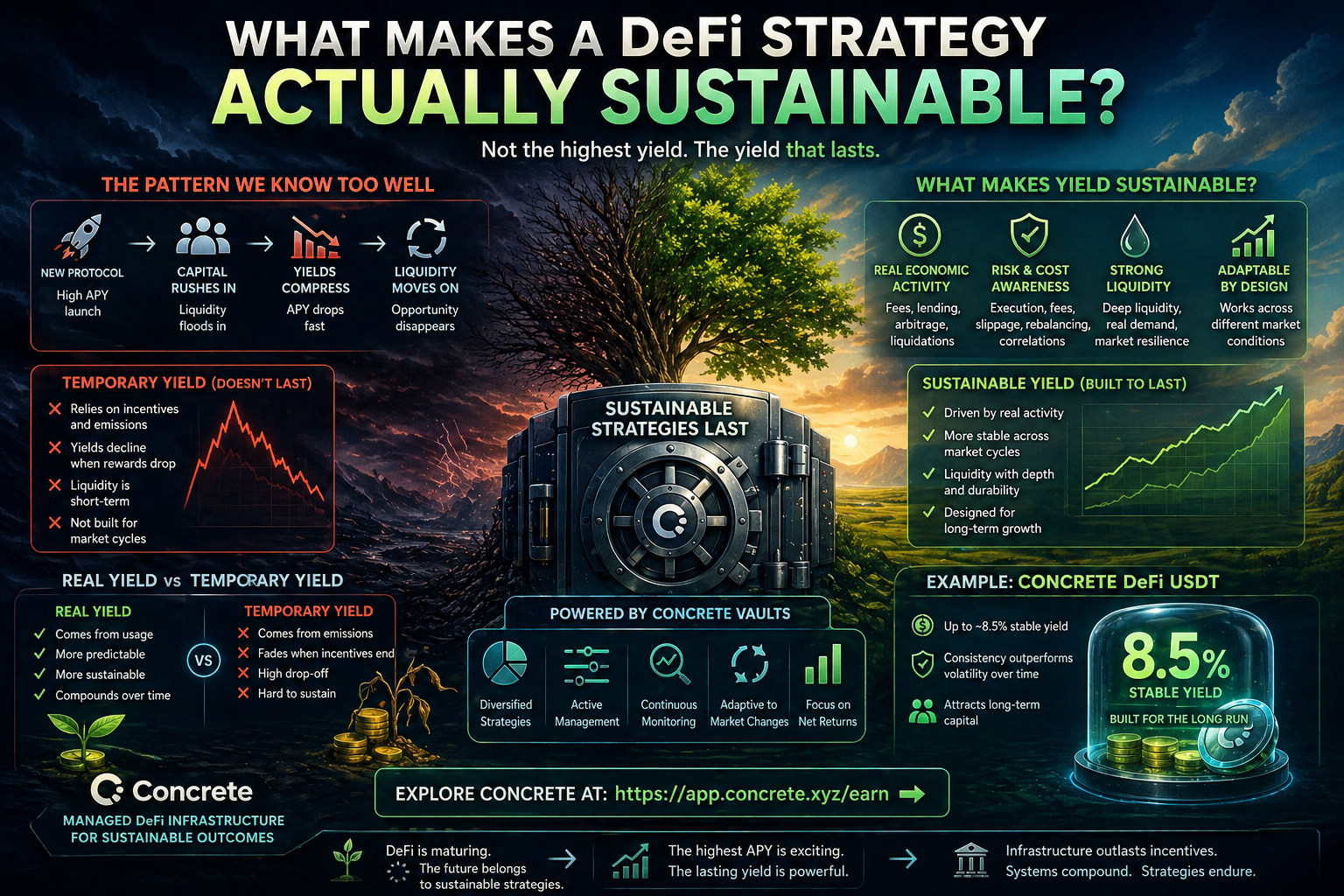
What Makes a DeFi Strategy Actually Sustainable?
DeFi follows a familiar cycle:
New protocols launch with high APY → capital rushes in → yields compress → liquidity leaves.
Then it repeats.
So the real question isn’t “what pays the most?”
It’s what actually lasts?
What Is Sustainable Yield?
A sustainable DeFi strategy delivers:
Consistent returns over time
Low reliance on incentives
Performance across market cycles
This is about durability, not hype.
Real Yield vs Temporary Yield
There are two types of yield:
Real yield → trading fees, lending, arbitrage
Temporary yield → token emissions, incentives
Incentives fade. Capital leaves. Yields collapse.
Real economic activity is what sustains risk-adjusted yield over time.
What Actually Impacts Sustainability?
Sustainable DeFi strategies depend on:
Liquidity depth
User demand
Market conditions
Volatility
Plus hidden costs like:
Slippage
Rebalancing
Execution fees
Headline APY means nothing without net returns.
From Yield Chasing to Strategy Design
Strong DeFi strategies are built, not found.
They rely on:
Diversification
Active monitoring
Adaptability
Focus on sustainable yield
This is where managed DeFi and DeFi vaults come in.
Why Concrete Vaults Matter
Concrete vaults are designed to:
Allocate across multiple strategies
Adapt to changing markets
Reduce reliance on incentives
Optimize for long-term performance
They treat onchain capital like a system — not a gamble.
A Real Example: Stability Over Hype
Concrete DeFi USDT offers up to ~8.5% yield.
Not flashy. But consistent.
And over time, consistency beats volatility.
This is what attracts serious, long-term capital in institutional DeFi.
The Bigger Shift
DeFi is evolving:
From short-term yield chasing → to long-term strategy
From incentives → to real value
From hype → to infrastructure
The future belongs to strategies that survive, not spike.
🚨 Explore Concrete at: https://app.concrete.xyz/earn� 🚨
--