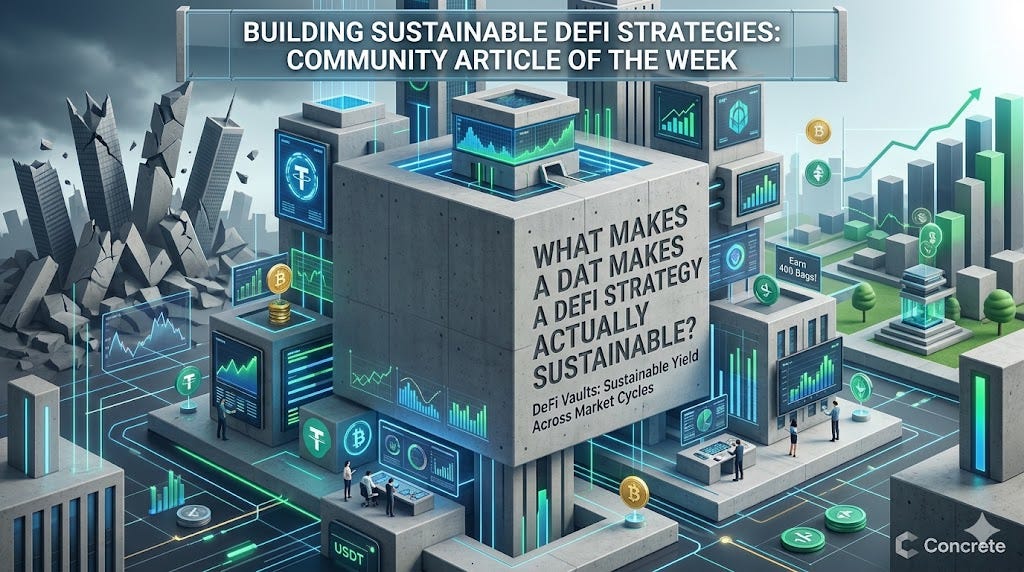
“What Makes a DeFi Strategy Actually Sustainable?”
 Moneta3 min read·Just now
--
Every time a new protocol launches, we see a familiar cycle: an eye‑catching APY is advertised, capital rushes in, the high‑yield pools fill quickly, and then the easy returns begin to compress. As the original incentives fade, liquidity drifts to newer, higher‑yield opportunities, leaving the first protocol with lower yields and a thinner order book. This “boom‑and‑bust” rhythm repeats across lending, staking, and yield‑farm products, which is why most strategies only survive for weeks or months.
A sustainable DeFi strategy is one that can generate consistent returns over an extended horizon without relying solely on temporary incentives. Its durability rests on three pillars:
- Steady income: Returns should stem from genuine economic activity, not just reward emissions.
- Incentive‑independence: The strategy must remain viable once token emissions taper or disappear.
- Market‑cycle resilience: It should operate profitably in both bullish and bearish environments.
- Real yield originates from core services such as borrowing‑lending spreads, trading fees, or arbitrage opportunities. These sources are tied to the underlying demand for capital and typically persist as long as the market participants need the service.
- Temporary yield is largely driven by token emissions, liquidity mining bonuses, or launch‑phase incentives. As the token’s issuance rate drops or the incentive program ends, the extra APY evaporates, exposing the underlying economics.
Because real yield is anchored in actual usage, it tends to be more predictable and less volatile than emissions‑driven returns.
Sustainability hinges on the depth and quality of liquidity:
- Depth: Deep order books absorb large trades with minimal price impact, supporting stable fee generation.
- User activity: Constant borrowing, swapping, or hedging keeps the protocol’s revenue stream flowing.
- Volatility: Strategies that depend on extreme price swings may thrive during high‑vol periods but falter when markets calm.
- Demand: Persistent demand for the underlying service (e.g., stablecoin lending) provides a reliable income base.
Strategies that can adapt to varying liquidity profiles and market states are more likely to endure.
Many high‑APY proposals overlook hidden costs:
- Execution fees: Gas or transaction fees can erode nominal yields, especially on congested chains.
- Rebalancing costs: Frequent portfolio adjustments add slippage and fee overhead.
- Correlation shifts: When assets that were once uncorrelated become linked, the risk‑adjusted return deteriorates.
A robust sustainability assessment subtracts these operational costs from headline APY to reveal the net return that an investor can actually capture over time.
Building lasting DeFi products involves:
- Diversification: Spreading capital across multiple uncorrelated protocols reduces exposure to a single failure.
- Continuous monitoring: On‑chain analytics and automated alerts help detect deteriorating conditions early.
- Adaptive allocation: Reallocating capital based on real‑time performance keeps the portfolio aligned with the most profitable sources.
- Net‑return focus: Prioritizing the after‑fee yield, not the headline percentage, ensures realistic expectations.
When these practices are embedded into the protocol’s design, the strategy behaves more like a financial system than a fleeting opportunity.
Concrete vaults embody the sustainable‑yield philosophy. Rather than chasing the highest short‑term APY, they:
- Prioritize sources of yield that are generated by genuine economic activity (e.g., stablecoin lending on reputable protocols).
- Dynamically shift capital among vetted strategies to capture the best risk‑adjusted returns.
- Limit exposure to emission‑heavy incentives, reducing the impact of token tapering.
By focusing on durability, Concrete vaults aim to protect capital across market cycles.
Concrete DeFi USDT currently offers around 8.5 % stable yield on a USD‑pegged asset. The modest, yet consistent, payoff illustrates a key point: a lower‑profile APY that remains stable can outperform a volatile, higher‑profile offering over the long run. Investors seeking predictable income often favor such “steady‑as‑stone” products, which attract long‑term capital and reinforce the protocol’s liquidity foundation.
The DeFi ecosystem is moving away from short‑term yield chasing toward strategies that can survive multiple market cycles. As infrastructure matures, the emphasis will be on:
- Longevity: Protocols that prove durable will command deeper liquidity and lower risk premiums.
- Capital efficiency: Systems that deliver net returns after accounting for all costs will attract institutional and retail investors alike.
- Resilience: Projects that can operate without heavy reliance on token emissions will be better positioned when the market cools.
In this emerging paradigm, the most successful DeFi strategies will be those that balance attractive returns with true economic utility — strategies that last, not just peak.
Explore Concrete at: https://app.concrete.xyz/earn 🚨